UNCTAD: $35.2 Billion in Direct Damages in Gaza and $71.4 Billion for Recovery and Reconstruction Needs
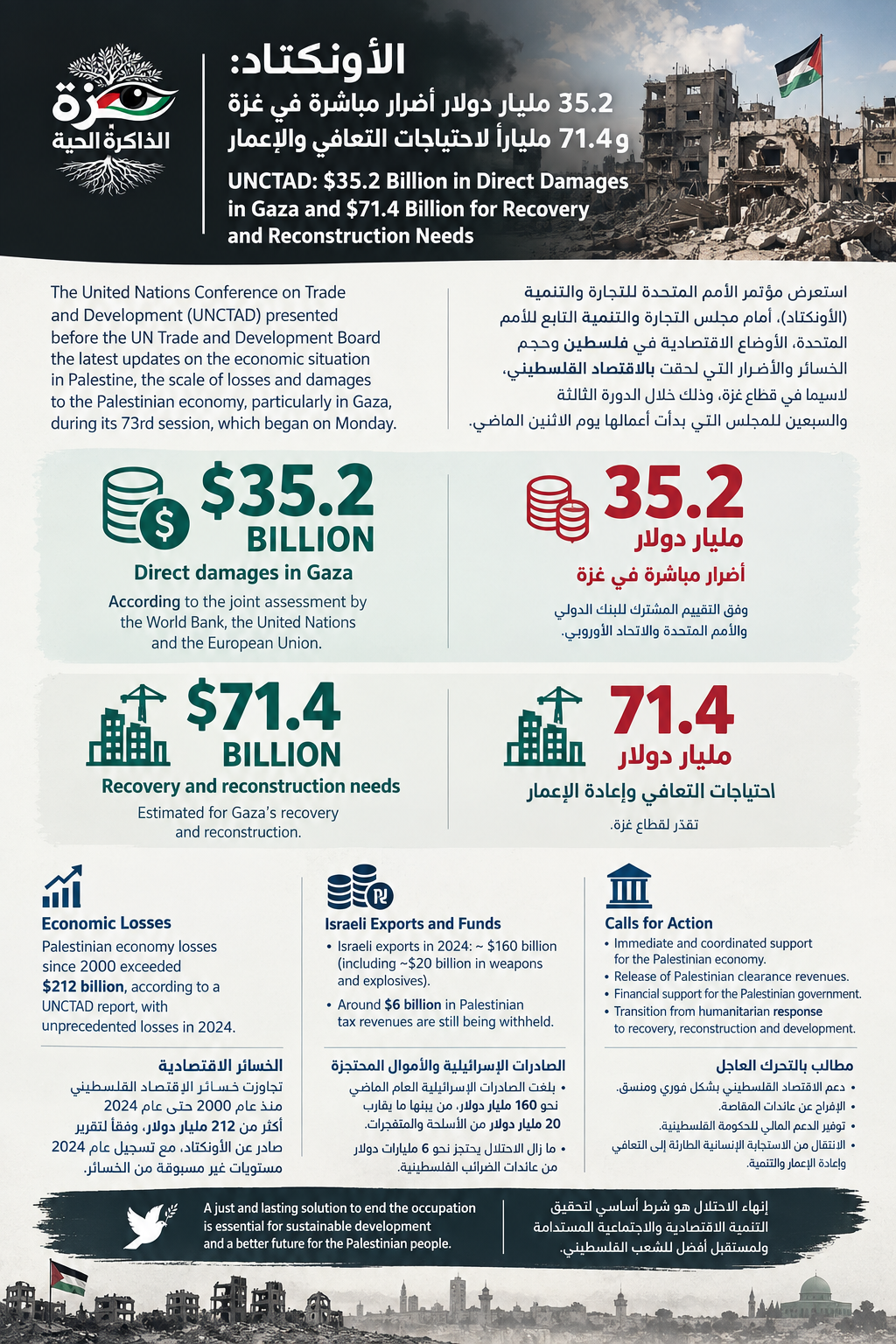
The United Nations Conference on Trade and Development (UNCTAD) presented a review of the economic conditions in Palestine and the scale of losses and damages inflicted on the Palestinian economy, particularly in the Gaza Strip, before the UN Trade and Development Board during its 73rd session, which commenced last Monday.
The Acting Secretary-General of UNCTAD, Pedro Manuel Moreno, reviewed the extent of the damage caused to the infrastructure, productive sectors, and basic services in the Gaza Strip. He noted that direct material damages reached approximately $35.2 billion, according to a joint assessment by the World Bank, the United Nations, and the European Union, while recovery and reconstruction needs are estimated at around $71.4 billion.
Mutasim Elagraa, Coordinator of the Assistance to the Palestinian People Unit at UNCTAD, provided an explanation regarding the deterioration of economic conditions in Palestine, especially in the Gaza Strip, resulting from the aggression, destruction, and blockade, alongside the economic and financial restrictions imposed on the West Bank.
In a recorded speech delivered to the meeting, Prime Minister Mohammad Mustafa emphasized that achieving economic recovery and development requires ending the occupation, enabling the Palestinian people to exercise sovereignty over their resources and borders, and lifting restrictions on the movement of people, goods, and investment. He called for a revision of the Paris Economic Protocol to prevent the perpetuation of economic dependency.
Ambassador Ibrahim Khraishi, the Coordinator of the Arab Group and Permanent Observer of the State of Palestine in Geneva, delivered the statement of the Arab Group, affirming its support for UNCTAD's efforts to assist the Palestinian people and strengthen their developmental capacities.
The Arab Group called on UNCTAD to continue assessing the economic cost of the occupation, preparing studies related to trade and development in Palestine, and updating estimates of damages and losses in line with its mandate and UN resolutions. It also urged the international community and donors to provide the necessary resources to support the organization's work and build Palestinian institutions, stressing that ending the occupation is a fundamental prerequisite for achieving sustainable economic and social development.
The session featured interventions from the Group of 77 and China, the European Union, the African Group, the Asia-Pacific Group, the Group of Friends in Defense of the Charter of the United Nations, and the Group of Least Developed Countries, alongside a number of countries and regional and international organizations.
Participants called for urgent and coordinated action to support the Palestinian economy, release clearance revenue (tax revenues), provide financial support to the Palestinian government, and transition from an emergency humanitarian response to recovery, reconstruction, and development.
The interventions emphasized that colonial expansion, the fragmentation of Palestinian land, and restrictions imposed on movement, trade, and investment undermine the prospects for development and the establishment of a viable Palestinian state. They stressed that reviving the Palestinian economy requires, in addition to aid and reconstruction, addressing the structural causes of the crisis and reaching a just and lasting political solution that ends the occupation and paves the way for sustainable Palestinian development.
At the conclusion of the session, the Permanent Representative of the State of Palestine to the United Nations in Geneva spoke in his national capacity, thanking the groups and countries that delivered statements and noting what had been heard from the Prime Minister and relevant authorities regarding the current conditions and challenges facing the Palestinian people.
He explained that the losses of the Palestinian economy from 2000 to 2024 exceeded $212 billion, according to a report issued by UNCTAD, pointing out that the year 2024 witnessed unprecedented levels of losses.
He added that the volume of Israeli exports during the past year reached approximately $160 billion, including nearly $20 billion in weapons and explosives, noting that these weapons were used, according to his statement, against the Palestinian people. He also pointed to the continuous withholding of about $6 billion in Palestinian tax revenues.
The Ambassador expressed his hope that the United Nations General Assembly, during its upcoming meeting and in coordination with the countries that supported the New York Declaration and those participating in the International Coalition for the Implementation of the Two-State Solution, would take practical steps and measures to help end the tragedy experienced by the Palestinian people.
He referred to the report of the organization "B'Tselem," which concluded, as he mentioned, that what is happening in the Gaza Strip is genocide, and what is occurring in the West Bank is an apartheid system and ethnic cleansing, calling on the international community to take concrete measures toward the occupying power in light of these reports and practices.
He welcomed new international stances, including the statement issued by 12 countries last Tuesday, expressing hope that these statements and positions would be translated into practical steps to stop the violations, violence, and terrorism to which the Palestinian people are subjected.
Concluding his speech, the Permanent Representative expressed hope for reaching a comprehensive resolution by consensus addressing all agenda items of the current session, wishing that future meetings would be held under better circumstances, and that the Palestinian people and the international community would witness positive developments contributing to the achievement of security, peace, and stability.