Gaza Reconstruction.. Between Infrastructure Rubble, Financing Complexities, and Governance Challenges Amid Political Overlaps (2023–2026)
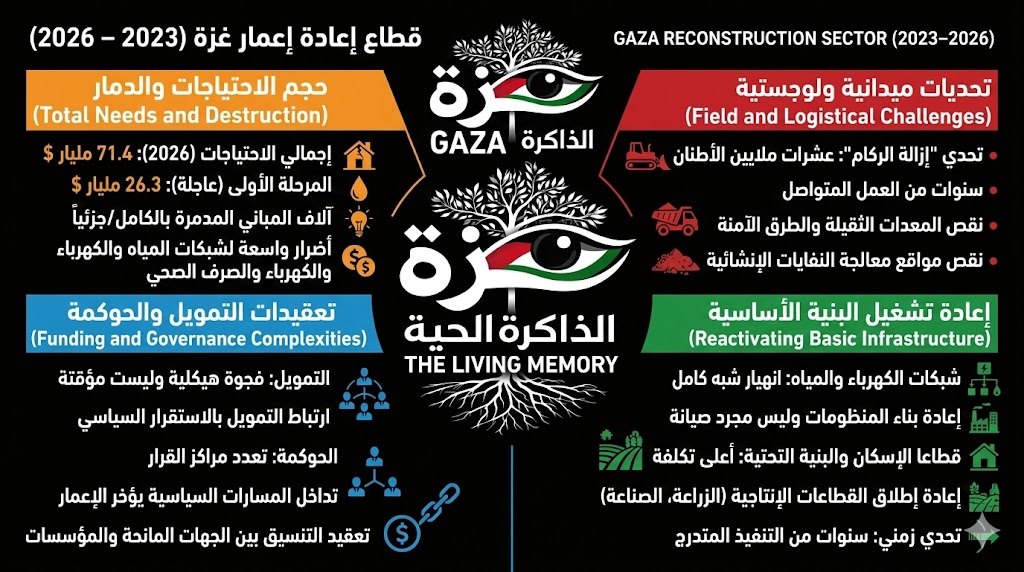
Since October 7, 2023, the Gaza Strip has entered an unprecedented phase of destruction in its modern history. The impact has not been limited to residential or service infrastructure but has extended to the very foundations upon which any viable economy depends. As the scale of devastation expanded, the concept of “reconstruction” shifted away from its traditional meaning toward the near-total re-establishment of a devastated urban system in terms of infrastructure, economy, services, and governance simultaneously. According to the joint assessment issued by the United Nations, the European Union, and the World Bank in 2026, Gaza’s recovery and reconstruction needs are estimated at approximately $71.4 billion over the coming years, of which around $26.3 billion is required urgently in the first phase to restore minimum essential services and rehabilitate critical infrastructure. These figures illustrate that the scale of destruction has surpassed the capacity of any comparable reconstruction effort in the region, both in terms of cost, time, and institutional complexity. On the ground, Gaza after the war appears to have lost its basic urban structure. Thousands of residential buildings have been fully or partially destroyed, while water, electricity, and sewage networks have suffered widespread damage, leaving large areas of the Strip effectively non-functional. United Nations estimates indicate that hundreds of thousands of housing units have been destroyed or damaged, while a significant proportion of hospitals and schools have gone out of service due to direct destruction or the collapse of essential operational supplies. This level of collapse means that reconstruction does not begin with rebuilding, but with a “debris removal” phase that is itself a massive engineering and logistical challenge. The enormous quantities of rubble, estimated at tens of millions of tons, require years of continuous work and an operational infrastructure that is currently unavailable, including heavy machinery, safe transport routes, and designated waste processing sites. At the same time, financing emerges as one of the most complex obstacles. Even when large international estimates exist for reconstruction needs, the actual mobilization of funds depends on political, administrative, and international conditionality factors. Previous experiences in similar conflict zones suggest that funding is rarely delivered in a single, comprehensive package but rather in phased and fragmented tranches linked to political stability, oversight mechanisms, and transparency guarantees. This creates a structural—not temporary—financing gap in the early years of reconstruction. In parallel, governance represents one of the most sensitive issues in the reconstruction process. Managing a project of this scale requires a clear executive framework, while the current reality reflects multiple overlapping actors: the Palestinian Authority in Ramallah, United Nations agencies, international donors, and existing administrative structures within Gaza itself. This multiplicity of decision-making centers does not only create administrative complexity but also affects implementation speed, project distribution, and financial and technical oversight mechanisms. In the absence of a unified reconstruction authority in the early stages, coordination among these actors becomes crucial. However, it also becomes a potential source of delay, especially in large-scale projects that require centralized decision-making and long-term institutional stability. At the infrastructure level, the challenge goes beyond rebuilding structures to the restoration of entire systems that have largely collapsed. Electricity networks, once dependent on external supply and limited generators, have suffered widespread disruption. Water and sewage treatment facilities have been severely damaged, making their restoration dependent on rebuilding rather than repairing existing systems. Road networks, which serve as the backbone of economic and humanitarian mobility, have also sustained extensive damage, affecting transportation of goods, services, and aid. Economically, reconstruction cannot be separated from the restoration of the economic cycle itself. Gaza’s local market has lost both its productive and consumption capacity, meaning that recovery requires simultaneous reactivation of key sectors such as agriculture, industry, trade, and services. However, this process depends on the availability of raw materials, the stability of supply chains, and the ability to move goods—factors that remain tied to the broader political and security environment. International estimates indicate that housing and infrastructure sectors account for the largest share of reconstruction costs, followed by essential services. This reflects the priorities of the initial phase, which focuses on restoring minimum living conditions before transitioning to long-term development projects. Behind this entire process lies the time factor, which is as critical as financing. Even if financial resources become available, reconstruction of this magnitude requires a long, phased timeline beginning with debris removal, followed by infrastructure rehabilitation, housing reconstruction, and finally gradual economic recovery. Across all stages, political and administrative stability remains the most sensitive variable. Any disruption at this level directly affects the pace of reconstruction and can push projects back to earlier phases of delay. In conclusion, Gaza’s reconstruction after 2023 is not a conventional engineering project. It represents a comprehensive rebuilding of an entire system of life, where engineering, economics, politics, and governance intersect. This makes it one of the most complex reconstruction challenges in modern history—not only because of the scale of destruction, but because of the nature of the environment in which reconstruction must take place, the multiplicity of actors involved, and the long time horizon required for recovery..