"An environmental disaster in Gaza due to the occupation's aggression: 33.2 million tons of carbon emissions."
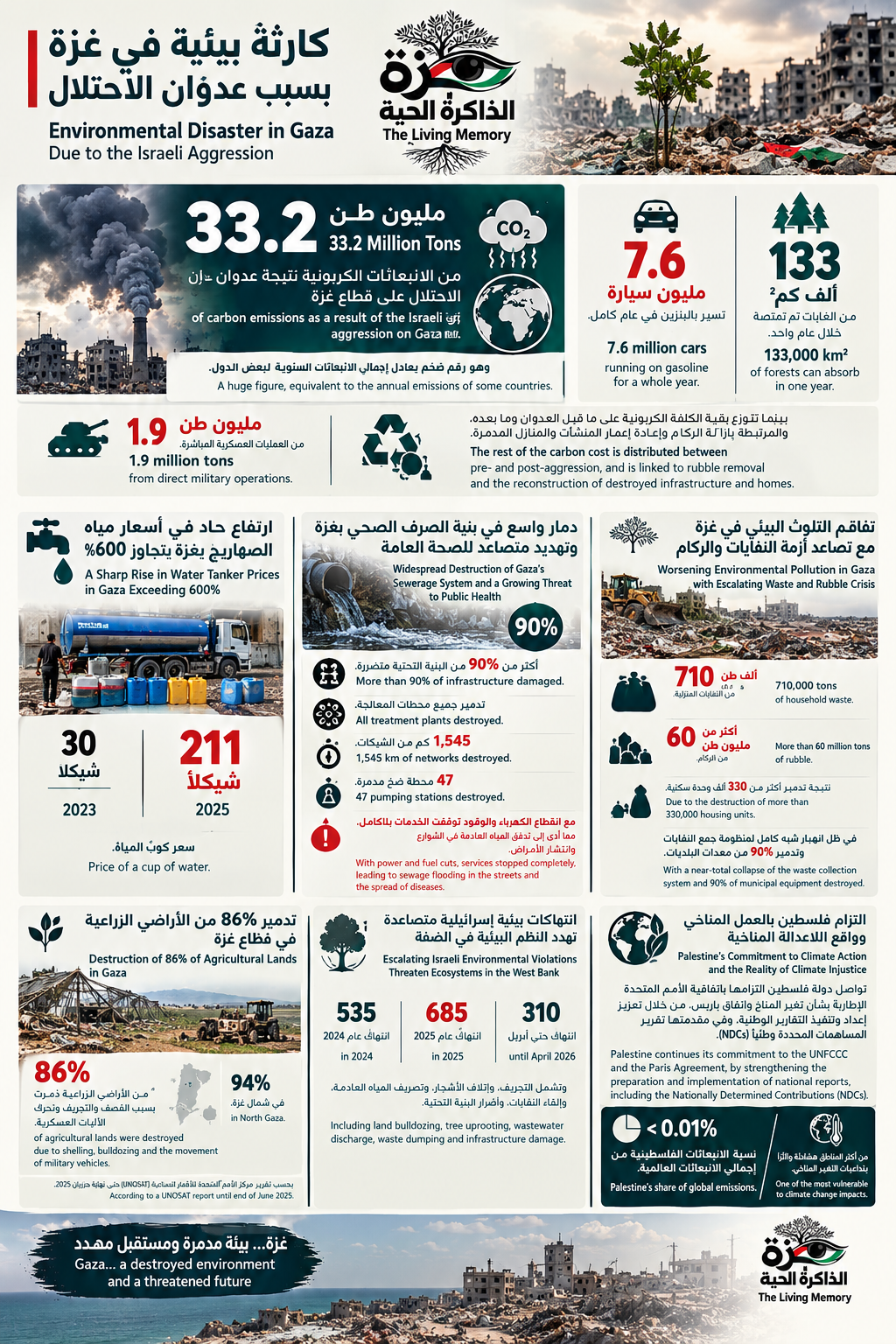
"Ramallah - Carbon emissions resulting from the Israeli occupation's aggression on the Gaza Strip reached 33.2 million tons of CO2 equivalent—a massive figure equal to the total annual emissions of some entire countries.
The Palestinian Central Bureau of Statistics (PCBS) explained that these emissions are equivalent to what about 7.6 million gasoline-powered cars produce in a whole year, and what forests spanning an area of 133,000 square kilometers can absorb of carbon dioxide within a single year.
The PCBS pointed out that this catastrophic cost is distributed between direct military operations, which caused the emission of about 1.9 million tons, and the pre- and post-aggression carbon costs linked to debris removal and the reconstruction of destroyed facilities and homes.
Sharp Rise in Water Tanker Prices in Gaza Exceeds 600%
The destruction of water networks in the Gaza Strip led to a sharp rise in water prices, particularly those distributed by tankers, as the price of a cubic meter of water rose to about 211 shekels in 2025 compared to 30 shekels in 2023, reflecting the worsening water crisis and the economic burden on citizens.
Widespread Destruction in Gaza's Wastewater Infrastructure and a Rising Threat to Public Health
The Gaza Strip is also witnessing an almost complete collapse of the sanitation system as a result of damage to more than 90% of the infrastructure and the destruction of all treatment plants, in addition to widespread destruction of networks (about 1,545 km) and 47 pumping stations. With the continuous power and fuel outages, services have stopped completely, leading to the flow of wastewater into the streets, rising environmental and health risks, and the spread of diseases.
Worsening Environmental Pollution in Gaza with the Escalation of the Waste and Debris Crisis
The Gaza Strip suffers from severe environmental degradation due to the accumulation of about 710,000 tons of domestic waste and more than 60 million tons of rubble resulting from the destruction of over 330,000 housing units. This comes amid an almost complete collapse of the waste collection system and the destruction of 90% of municipal equipment, which has led to the spread of pollution and diseases, worsening the environmental crisis and complicating recovery efforts.
Destruction of 86% of Agricultural Land in the Gaza Strip
A recent report by the United Nations Satellite Centre (UNOSAT) up to the end of June 2025 showed that the Israeli aggression caused widespread destruction to the agricultural sector in Gaza, as about 86% of agricultural land was destroyed due to bombardment, bulldozing, and the movement of military vehicles. Higher levels of destruction were recorded in some areas, with the destruction rate rising to 94% in northern Gaza. This rapid and continuous collapse of the agricultural sector reflects a direct and serious threat to the food security of more than two million people in the Strip.
Escalating Israeli Environmental Violations Threaten Ecosystems in the West Bank
The year 2025 witnessed a noticeable escalation in Israeli environmental violations in the West Bank, where 685 violations were recorded compared to 535 violations in 2024, and 310 violations were recorded until the end of April 2026. This reflects escalating attacks on the Palestinian environment. These violations varied between bulldozing agricultural land, destroying trees, discharging wastewater, and dumping waste, in addition to infrastructure damage, leading to increasing degradation of ecosystems and threatening the sustainability of natural resources.
The State of Palestine continues its commitment to the United Nations Framework Convention on Climate Change (UNFCCC) and the Paris Agreement by strengthening the preparation and implementation of national reports—foremost among them the Nationally Determined Contributions (NDCs) report—as a key tool for guiding climate action, enhancing adaptation, supporting national policies, and attracting green investments.
Despite the worsening environmental and climate challenges, Palestine's contribution to global greenhouse gas emissions remains extremely limited, with national Palestinian emissions estimated at less than 0.01% of total global emissions—a negligible percentage compared to major industrial countries. Nevertheless, Palestine is considered one of the most vulnerable regions affected by the repercussions of climate change. This reality reflects a state of 'climate injustice,' where Palestine bears the impacts of a global climate crisis despite its very minor contribution to causing it."
.