Between Condemnation and Limited Sanctions: How the International Community Responded to Israeli Settlement Expansion After October 7, 2023
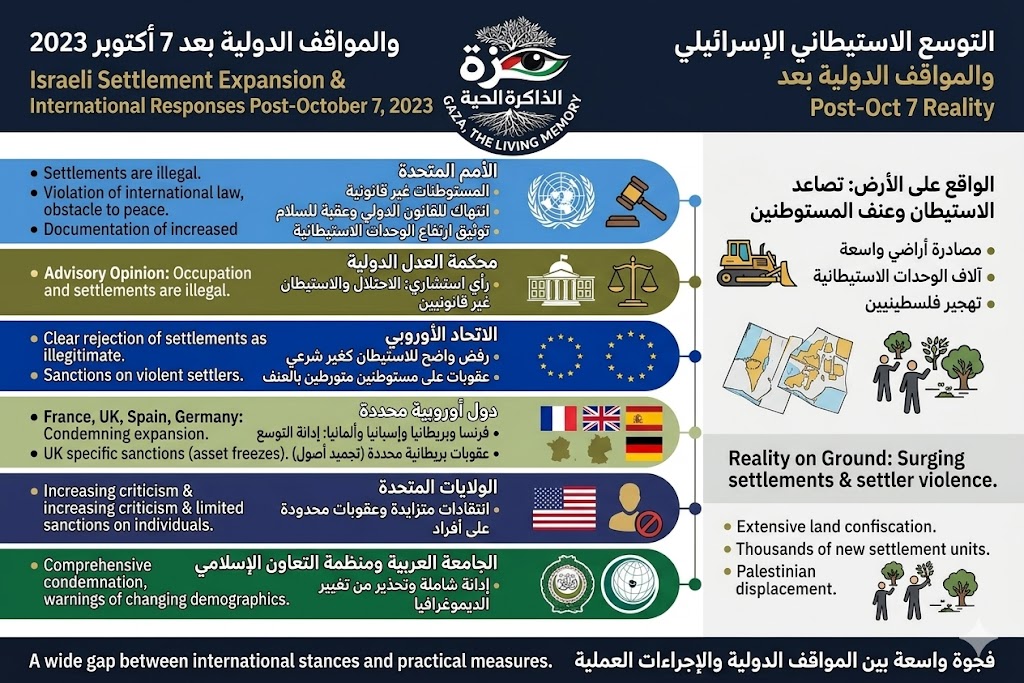
Gaza: The Living Memory Since the outbreak of the war on October 7, 2023, developments have not been confined to the Gaza Strip. The occupied West Bank has witnessed one of the largest waves of settlement expansion in decades, accompanied by an unprecedented rise in settler violence, land confiscation, and the establishment of new settlement outposts. In response, international and regional actors issued a series of statements rejecting Israeli settlement activities. However, a significant gap has remained between political positions and concrete actions, raising questions about the international community’s ability to halt settlement expansion or mitigate its consequences. United Nations: Settlements Are Illegal and Undermine the Two-State Solution Since the beginning of the war, the United Nations has repeatedly reaffirmed its long-standing position that all Israeli settlements in the occupied Palestinian territory are illegal under international law. UN Secretary-General António Guterres has stated on multiple occasions that settlement expansion constitutes a violation of international law and represents a major obstacle to peace. The Office of the United Nations High Commissioner for Human Rights has also warned that the rapid growth of settlements and the establishment of new outposts are contributing to the displacement of Palestinians and undermining the viability of an independent and geographically contiguous Palestinian state. Successive UN reports have documented significant increases in settlement construction and settler violence across the West Bank since October 2023. International Court of Justice: Occupation and Settlements Violate International Law In July 2024, the International Court of Justice (ICJ) issued a landmark advisory opinion concluding that Israel’s continued occupation of Palestinian territory, including its settlement activities, is contrary to international law. The Court affirmed that Israeli settlements in the occupied Palestinian territory violate international legal obligations and called for an end to policies that alter the demographic composition and character of the occupied territory. Although the advisory opinion is not legally binding, it has become a significant legal reference point for subsequent international positions regarding Israeli settlement policies. European Union: A Consistent Rejection of Settlements The European Union has maintained its long-standing opposition to Israeli settlement activities. The EU has repeatedly emphasized that all settlements in the occupied West Bank, including East Jerusalem, are illegal under international law. European officials have consistently condemned Israeli decisions authorizing thousands of new settlement housing units, arguing that such measures directly threaten the viability of the two-state solution. Throughout 2024 and 2025, the European Union also discussed additional measures against settlers involved in violence against Palestinians and supported sanctions targeting individuals and entities linked to serious settler attacks. France: Settlement Expansion Threatens Peace France has adopted one of the clearest European positions regarding Israeli settlement activities. The French government has repeatedly declared that settlements are illegal under international law and constitute a major obstacle to peace. Paris has condemned Israeli decisions to expand settlements and legalize new outposts, arguing that these measures seriously undermine prospects for a just and lasting political solution. France has also called for an immediate halt to all settlement activities and urged greater protection for Palestinian civilians living in areas affected by settler violence. United Kingdom: Sanctions on Violent Settlers The United Kingdom took unprecedented practical steps during 2024 and 2025. In addition to condemning settlement expansion, London imposed sanctions on several Israeli settlers and organizations linked to violent attacks against Palestinians in the West Bank. These measures included asset freezes and travel bans, reflecting growing concern over the impact of settler violence on regional stability. The British government has repeatedly reaffirmed that settlements are illegal under international law and remain a major obstacle to peace. Spain: One of the Strongest Critics of Settlement Policies Spain emerged as one of the most vocal European critics of Israeli settlement expansion following the war. The Spanish government has consistently linked settlement growth to the deterioration of prospects for a negotiated political solution. Madrid has supported European sanctions against violent settlers and called for stronger international measures to prevent the confiscation of Palestinian land and the continued expansion of settlements. This position forms part of Spain’s broader policy of support for Palestinian rights during the post-war period. Germany: Support for the Two-State Solution and Diplomatic Pressure Despite its close relationship with Israel, Germany has repeatedly stated that settlement activities violate international law. Berlin has expressed concern regarding the sharp increase in settlement construction and condemned attacks carried out by settlers against Palestinian civilians. However, Germany has generally favored diplomatic engagement and political pressure rather than broad sanctions targeting settlement activities. United States: Growing Criticism and Limited Measures While maintaining strong political and military support for Israel, the United States adopted a more critical tone regarding settler violence after October 2023. The administration of President Joe Biden imposed sanctions on several Israeli settlers accused of involvement in attacks against Palestinians. Washington also criticized the expansion of settlements and the legalization of new outposts, arguing that such actions undermine the prospects for peace. However, the United States stopped short of imposing comprehensive sanctions on the settlement enterprise itself, leading critics to view the measures as limited in scope and impact. Arab League: Condemnation and Diplomatic Action The Arab League has consistently reaffirmed its rejection of Israeli settlement policies. Through a series of statements and resolutions, the organization described settlement expansion as a blatant violation of international law and United Nations resolutions. The League has repeatedly called on the international community to take concrete measures to halt settlement construction and hold Israel accountable for policies involving land confiscation and the displacement of Palestinians. Settlement expansion has remained a permanent item on the agenda of Arab ministerial meetings since the outbreak of the war. Organization of Islamic Cooperation: Warning Against Demographic Transformation The Organization of Islamic Cooperation (OIC) has strongly condemned Israeli settlement activities, describing them as part of a broader effort to alter the geographic and demographic character of the occupied Palestinian territory. The organization has called upon the international community to provide protection for the Palestinian people and to ensure the immediate cessation of all settlement activities. Between International Positions and Reality on the Ground Despite broad international consensus regarding the illegality of Israeli settlements, settlement expansion has continued at an accelerated pace since October 2023. During this period, Israeli authorities approved tens of thousands of new settlement housing units, legalized and established numerous settlement outposts, and oversaw a period marked by unprecedented levels of settler violence. This reality suggests that most international responses have remained largely confined to political condemnation and limited diplomatic pressure, without producing substantial changes on the ground. From the United Nations and the European Union to France, the United Kingdom, Spain, the Arab League, and the Organization of Islamic Cooperation, there is near-universal international agreement that Israeli settlements violate international law and threaten the prospects for peace. Yet the gap between diplomatic condemnation and developments on the ground continues to widen. While governments and international organizations issue statements of concern, settlement expansion proceeds, reshaping the geography of the occupied West Bank and raising fundamental questions about the effectiveness of the international response in one of the world's longest-running conflicts..