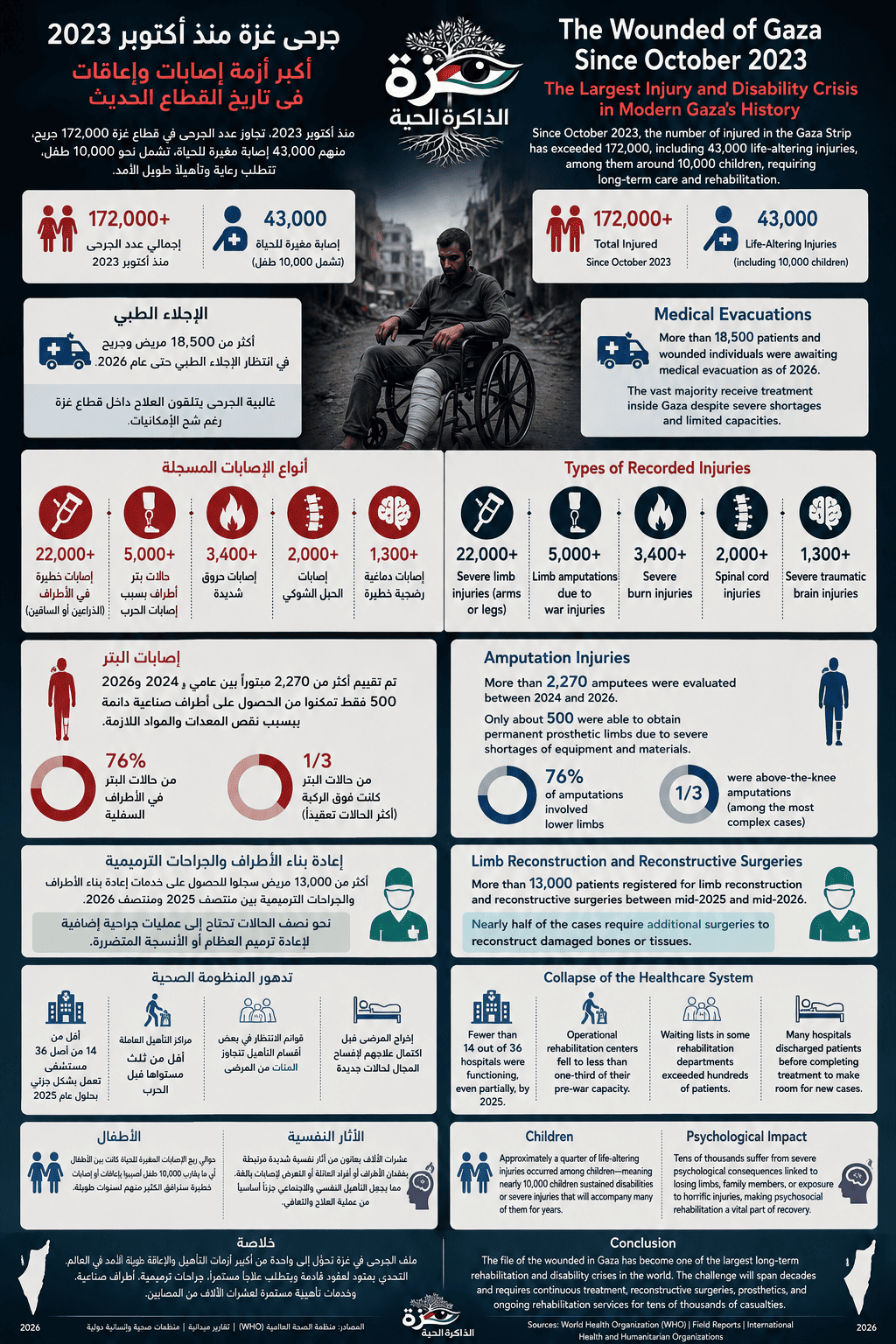
Gaza: The Living Memory— Latest estimates from the World Health Organization (WHO) indicate that the number of injured individuals in Gaza since October 2023 has exceeded 172,000. Among them, approximately 43,000 people, including around 10,000 children, have suffered "life-altering" injuries that require long-term care and rehabilitation.
Despite limited medical evacuations abroad, the vast majority of the wounded received treatment inside the Gaza Strip, within hospitals and medical centers already suffering from acute shortages of beds, medications, surgical supplies, and specialized medical personnel. The WHO notes that more than 18,500 patients and wounded individuals were awaiting medical evacuation as of 2026, meaning that tens of thousands were forced to seek treatment locally despite severely restricted capacities.
Regarding the nature of the injuries, WHO data reveals that limb injuries constituted the largest category among the wounded, with more than 22,000 people sustaining severe injuries to the arms or legs, many resulting in extensive damage to bones, tissues, and nerves. Additionally, more than 5,000 cases of limb amputations directly linked to war injuries were recorded, along with over 3,400 severe burn injuries, more than 2,000 spinal cord injuries, and over 1,300 severe traumatic brain injuries.
Amputation injuries remain one of the most complex files. According to WHO data, more than 2,270 amputees were evaluated between 2024 and 2026; however, only about 500 were able to secure permanent prosthetic limbs due to severe shortages of necessary equipment and materials. Furthermore, 76% of the recorded amputations involved the lower limbs, with nearly a third being above-the-knee amputations—which are among the most complex cases in terms of rehabilitation and mobility restoration.
Spinal cord injuries, which exceeded 2,000 cases, have left thousands of patients requiring specialized care and rehabilitation for years to come. Health reports indicate that a portion of these patients suffer from permanent or partial mobility disabilities, demanding wheelchairs, assistive devices, and continuous rehabilitation services at a time when rehabilitation centers in Gaza face extreme shortages of equipment.
In the burns file, over 3,400 severe burn injuries were documented, many among women and children. These cases require recurrent surgical interventions, skin grafts, and long-term treatment, compounding the immense pressure on hospitals operating under extraordinary circumstances.
The WHO also documented more than 13,000 patients registered for limb reconstruction and reconstructive surgeries between mid-2025 and mid-2026. Evaluations revealed that nearly half of these cases require additional surgeries to reconstruct damaged bones or tissues.
On the healthcare services front, the challenge was not limited to the volume of casualties, but extended to the collapse of a massive portion of the healthcare system itself. By 2025, fewer than 14 out of 36 hospitals were functioning, and even then, only partially. Meanwhile, the number of operational rehabilitation centers plummeted to less than a third of their pre-war capacity. Waiting lists in some rehabilitation departments exceeded hundreds of patients, forcing many hospitals to discharge patients before completing their treatment to make room for new influxes.
Regarding children, international data indicates that approximately a quarter of the life-altering injuries occurred among children—meaning that nearly 10,000 children sustained disabilities or severe injuries that will accompany many of them for years. Medical data from field hospitals supported by Médecins Sans Frontières (MSF / Doctors Without Borders) showed that children accounted for a significant percentage of injury cases requiring long-term follow-up.
The suffering of the wounded is not confined to physical trauma alone. Health and humanitarian organizations emphasize that tens of thousands suffer from severe psychological impacts linked to losing limbs, family members, or enduring horrific injuries, making psychological and social rehabilitation an indispensable pillar of the treatment and recovery process.
More than two and a half years since the outbreak of the war, the file of the wounded in Gaza is no longer an emergency medical crisis; it has transformed into one of the largest long-term rehabilitation and disability crises in the world. Amid more than 172,000 injured, 43,000 life-altering conditions, and thousands of amputations, spinal cord injuries, burns, and brain traumas, Gaza's healthcare system faces a challenge that spans decades into the future—even after military operations cease—driven by the critical need for continuous treatment, reconstructive surgeries, prosthetics, and ongoing rehabilitation for tens of thousands of casualties..