Special Report | Gaza: The Living Memory
Since October 7, 2023, the repercussions of the war have extended far beyond the Gaza Strip. While international attention has focused on the military campaign and humanitarian catastrophe in Gaza, the occupied West Bank has witnessed an unprecedented escalation in violence carried out by Israeli settlers. What was once described as sporadic settler attacks has evolved into a systematic and organized campaign targeting Palestinian communities, their lands, livelihoods, and property.
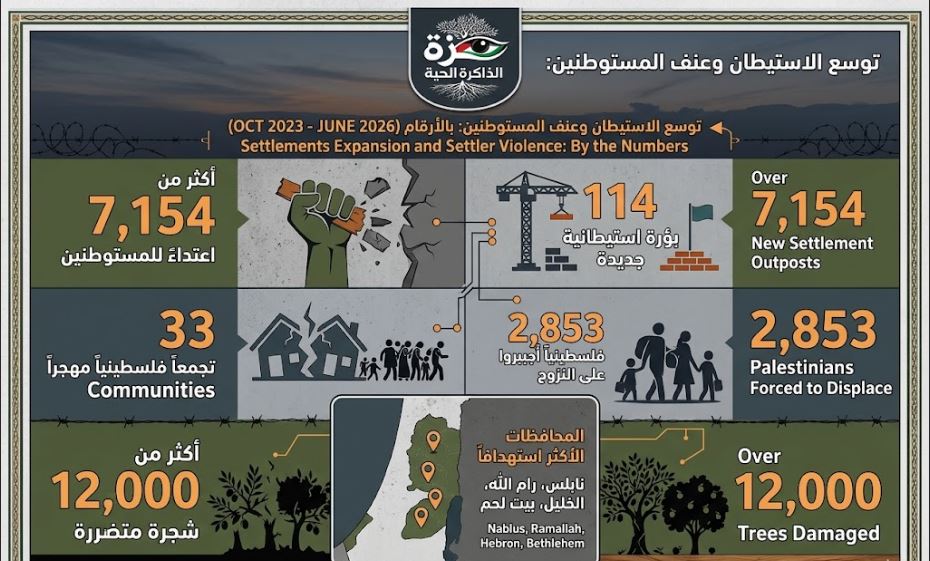
According to data published by the Palestinian Wall and Settlement Resistance Commission, Israeli settlers carried out a total of 7,154 attacks against Palestinians and their property in the West Bank between October 7, 2023 and October 2025, marking the highest level of settler violence recorded during a comparable period. The Commission also documented more than 38,000 violations committed by Israeli occupation forces and settlers combined during the same period, reflecting the scale of escalation that has gripped the West Bank since the outbreak of the war.
An Unprecedented Surge in Settler Attacks
According to the Wall and Settlement Resistance Commission, settler attacks have taken multiple forms, including armed assaults on Palestinian villages, direct shootings at civilians, arson attacks against homes and vehicles, destruction of agricultural land, assaults on farmers and shepherds, and the establishment of new settlement outposts on privately owned Palestinian land.
During the first half of 2025 alone, the Commission recorded 2,153 settler attacks, concentrated primarily in the governorates of Ramallah and Al-Bireh, Hebron, and Nablus, which have become focal points of daily settler violence.
The Commission noted that many of these attacks are no longer carried out by isolated individuals. Instead, they increasingly involve organized groups operating collectively, often under the protection or direct presence of Israeli military forces.
Settlement Outposts: A Tool for Control and Displacement
One of the most significant developments since October 2023 has been the rapid expansion of agricultural and pastoral settlement outposts.
Data from the Wall and Settlement Resistance Commission indicate that settlers established 114 new outposts between October 2023 and October 2025, an unprecedented figure in the history of Israel’s settlement enterprise.
The distribution of these outposts was concentrated in the following areas:
Ramallah and Al-Bireh: 30 outposts
Hebron: 25 outposts
Nablus: 18 outposts
Bethlehem: 14 outposts
Additional outposts across the Jordan Valley, Jerusalem, Qalqilya, and Salfit
Pastoral outposts have emerged as one of the most effective mechanisms of territorial control. Through these outposts, settlers gradually seize extensive grazing lands and agricultural areas while preventing Palestinian owners from accessing their property.
Forced Displacement of Palestinian Communities
The escalation of settler violence has directly contributed to the forced displacement of Palestinian communities, particularly Bedouin and pastoral populations.
According to the Wall and Settlement Resistance Commission, settler attacks and newly established outposts led to the displacement of 33 entire Palestinian communities, comprising 455 families and more than 2,853 individuals.
United Nations documentation similarly indicates that more than 2,200 Palestinians were displaced from 33 communities that were completely emptied of their residents due to settler violence, land seizures, and restrictions on access to water and grazing resources.
The most affected areas include the northern Jordan Valley, Masafer Yatta south of Hebron, eastern Ramallah, and large portions of Area C.
Targeting Agricultural Land and Olive Trees
Agricultural land has become a primary target in efforts to consolidate settler control over territory.
Reports issued by the Wall and Settlement Resistance Commission indicate that settlers and Israeli occupation forces destroyed or damaged more than 12,000 Palestinian trees during the first half of 2025 alone, including over 6,100 olive trees.
The governorates of Bethlehem, Ramallah, and Nablus experienced the highest levels of agricultural destruction.
Documented violations include:
Uprooting olive and fruit trees
Burning agricultural fields
Preventing farmers from reaching their land
Damaging water networks and wells
Releasing livestock into cultivated fields to destroy crops
These actions have caused substantial economic losses for Palestinian families that depend on agriculture as a primary source of income.
Killings and Injuries
According to the Wall and Settlement Resistance Commission, settler attacks resulted in the killing of 33 Palestinians between October 2023 and October 2025.
The victims were distributed across the following governorates:
Nablus: 14 fatalities
Ramallah and Al-Bireh: 12 fatalities
Hebron: 3 fatalities
Bethlehem: 1 fatality
Qalqilya: 1 fatality
Salfit: 1 fatality
In addition, hundreds of Palestinians sustained injuries ranging from minor wounds to life-threatening conditions as a result of shootings, physical assaults, and large-scale attacks on Palestinian communities.
International Documentation of Rising Violence
International organizations have also documented a dramatic increase in settler violence following October 7, 2023.
United Nations agencies recorded 1,732 settler-related incidents resulting in casualties, property damage, or both within a relatively short period. Human rights organizations likewise reported a significant rise in organized attacks targeting Palestinian civilians and infrastructure.
A United Nations investigative body reported in 2026 that settler violence had increased by more than 130 percent compared to previous periods, while identifying patterns suggesting that settlers often received protection or support during attacks.
From Individual Violence to a Policy of Creating Facts on the Ground
Researchers and human rights organizations increasingly argue that the violence witnessed in the West Bank since October 2023 extends beyond isolated acts of extremism. Instead, it appears to form part of a broader strategy aimed at:
Expanding control over Palestinian land
Enlarging existing settlements
Establishing new settlement outposts
Forcing Palestinian communities out of targeted areas
Creating new geographic realities that strengthen Israeli control over Area C
Observers note that the connection between settler violence and settlement expansion has become increasingly evident, with violence functioning as a practical mechanism for territorial acquisition and demographic transformation.
Since October 7, 2023, the occupied West Bank has entered a new phase of settler violence and territorial expansion. Settlers are no longer viewed merely as radical groups carrying out isolated attacks; they have become a central force in shaping realities on the ground.
With more than 7,154 documented attacks, 114 new settlement outposts, 33 displaced Palestinian communities, and vast areas of agricultural land affected, a parallel conflict has unfolded away from the international spotlight. Its impact extends beyond immediate violence, contributing to a profound transformation of Palestinian geography and accelerating the consolidation of Israeli settlement control across the West Bank..