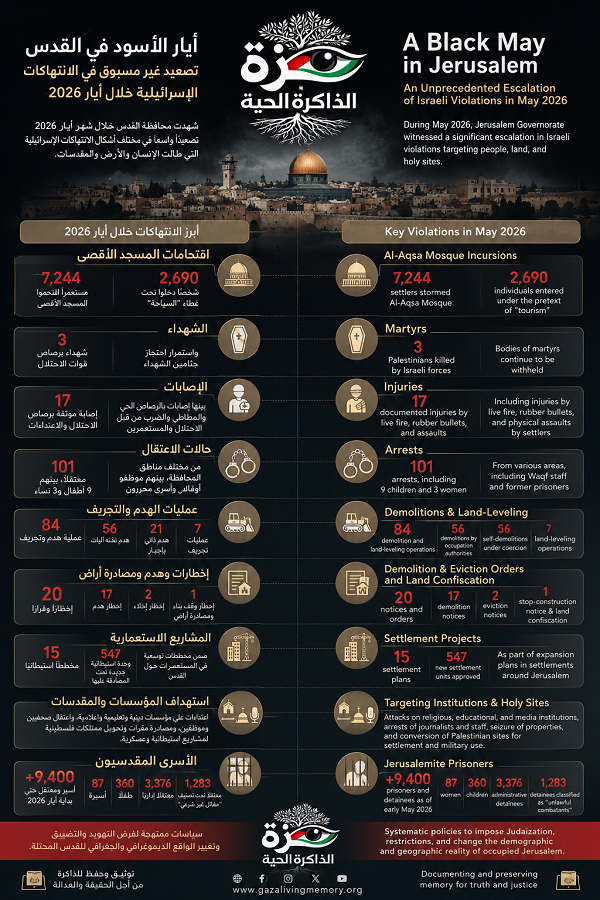
Occupied Jerusalem – May 2026 witnessed a significant escalation of Israeli measures across Jerusalem, affecting holy sites, residential neighborhoods, Palestinian land, and religious and media institutions. Israeli authorities continued implementing policies of demolition, settlement expansion, forced displacement, arrests, and restrictions, reflecting ongoing efforts to reshape realities on the ground and consolidate control over the occupied city.
Record Numbers of Incursions into Al-Aqsa Mosque
According to documented figures, 7,244 Israeli settlers entered the Al-Aqsa Mosque compound during May, in addition to 2,690 visitors who entered under the designation of "tourism." The month recorded one of the highest levels of incursions witnessed in recent years.
These incursions coincided with events marking the so-called "Jerusalem Day" and the Jewish holiday of Shavuot, during which groups performed Talmudic rituals, raised religious-nationalist slogans, and conducted what is known as "epic prostration" inside the compound under the protection of Israeli security forces. Similar activities were also documented during the Islamic Day of Arafah.
Simultaneously, Israeli authorities continued issuing exclusion orders barring Palestinian activists, worshippers, journalists, and employees of the Islamic Waqf from entering Al-Aqsa Mosque for periods ranging from one week to six months.
Three Palestinians Killed
During May, three Palestinians were killed by Israeli forces in Jerusalem Governorate.
Among them was Ayman Al-Hashlamoun, who was shot near Qalandia Refugee Camp, and Zakaria Qdeis, a Palestinian worker who was killed near the Separation Wall in Al-Ram while attempting to reach his workplace.
Israeli authorities also continued withholding the bodies of some Palestinians killed during security incidents.
Several additional injuries were recorded throughout the month due to live ammunition, rubber-coated bullets, and physical assaults by Israeli forces and settlers in areas including Al-Ram, Qalandia, Hizma, Beit Iksa, and Silwan.
Escalating Settler Violence
Jerusalem witnessed a series of attacks carried out by Israeli settlers against Palestinian residents and religious sites.
Among the documented incidents was an attack on St. James Cathedral in the Armenian Quarter, restrictions imposed on farmers attempting to access their lands in Beit Iksa, and assaults against residents in the Old City, Sheikh Jarrah, and rural communities northwest of Jerusalem.
One particularly severe attack targeted Palestinian driver Imad Al-Khatib in Tel Aviv, resulting in multiple fractures and loss of consciousness.
84 Demolitions and Land-Leveling Operations in a Single Month
The report documented 84 demolition and land-leveling operations during May, including:
21 self-demolitions carried out by Palestinian owners under municipal pressure.
56 demolitions directly executed by Israeli authorities.
7 land-leveling operations.
The demolished structures included homes, commercial establishments, agricultural facilities, and industrial properties across Silwan, Al-Ram, Al-Sawahra, Sur Baher, Qalandia, Al-Eizariya, and other communities.
One of the most significant incidents occurred in the Al-Mashtal area of Al-Eizariya, where approximately 40 industrial and commercial facilities were demolished in what observers described as one of the largest collective demolition campaigns in recent years.
By the end of the month, several families in Qalandia were forced to demolish their own homes, while other residences housing dozens of Palestinians were destroyed, highlighting growing concerns regarding forced displacement policies.
Eviction Orders and Land Confiscation
Israeli authorities issued 20 notices and administrative orders during the month, including demolition notices, eviction orders, and land confiscation decisions.
Among the most notable measures was the confiscation of 109.79 dunams of land belonging to the villages of Nabi Samuel and Beit Iksa under the pretext of "public interest" and archaeological development projects.
Human rights observers warned that such measures threaten Palestinian presence in strategically important areas surrounding the historic Nabi Samuel Mosque.
Targeting Institutions and Religious Sites
May also witnessed increased pressure on educational, media, and religious institutions.
Incidents included attacks on journalists, arrests of media workers and Islamic Waqf employees, restrictions on public events, and confiscation of equipment.
Israeli authorities additionally approved plans to transform a former UNRWA facility in Sheikh Jarrah into a military museum, recruitment center, and security complex.
Continued Settlement Expansion
The report recorded 15 settlement-related projects and plans during May.
Israeli planning authorities approved projects involving 547 new settlement housing units, including a major development of 528 units in Gilo settlement.
Additional settlement projects were reported in Ramot, Atarot, French Hill, Neve Yaakov, and Ma’ale Adumim, alongside initiatives affecting Mamilla Cemetery, the surroundings of Al-Aqsa Mosque, Bab Al-Silsila, and lands near Nabi Samuel.
Palestinian Prisoners from Jerusalem
The report documented deteriorating conditions among Palestinian prisoners, including the continued spread of scabies in Ofer Prison and complaints regarding inadequate medical care.
The month also witnessed the release of Jerusalemite parliamentarian Mohammad Abu Teir following six months of administrative detention, while journalist Bayan Al-Jaaba continued to face prosecution, with Israeli authorities seeking a prison sentence of 24 months.
According to the documented figures, the number of Palestinian prisoners held in Israeli prisons exceeded 9,400 detainees by early May 2026, including:
87 women prisoners
360 child detainees
3,376 administrative detainees
1,283 detainees classified as “unlawful combatants”.