Special Report | Gaza: The Living Memory
When Israel began constructing what it called the “security barrier” in June 2002, Palestinians were not simply confronted with a temporary security measure. Instead, they found themselves facing one of the most extensive projects aimed at reshaping Palestinian geography and demographics since the occupation of 1967. More than two decades later, the Separation Wall has become a physical and political reality stretching across most of the occupied West Bank, encircling Jerusalem, and directly affecting the lives of hundreds of thousands of Palestinians.
What began as a system of fences, trenches, military roads, and surveillance infrastructure evolved in many areas into a massive concrete wall reaching heights of up to eight meters. It separates cities from villages, neighborhoods from one another, farmers from their lands, students from their schools, and patients from medical services, while effectively redrawing realities on the ground in ways that reinforce Israel’s settlement project.
How the Project Began
At the height of the Second Palestinian Intifada, the Israeli government announced in 2002 the construction of the wall, arguing that it was necessary to prevent attacks originating from the West Bank.
However, from the earliest stages, the route of the barrier generated significant controversy. Rather than following the Green Line—the 1949 Armistice Line widely recognized internationally as the basis for the boundary between Israel and the territories occupied in 1967—the wall penetrated deep into the West Bank, surrounding major Israeli settlement blocs and isolating extensive areas of Palestinian land.
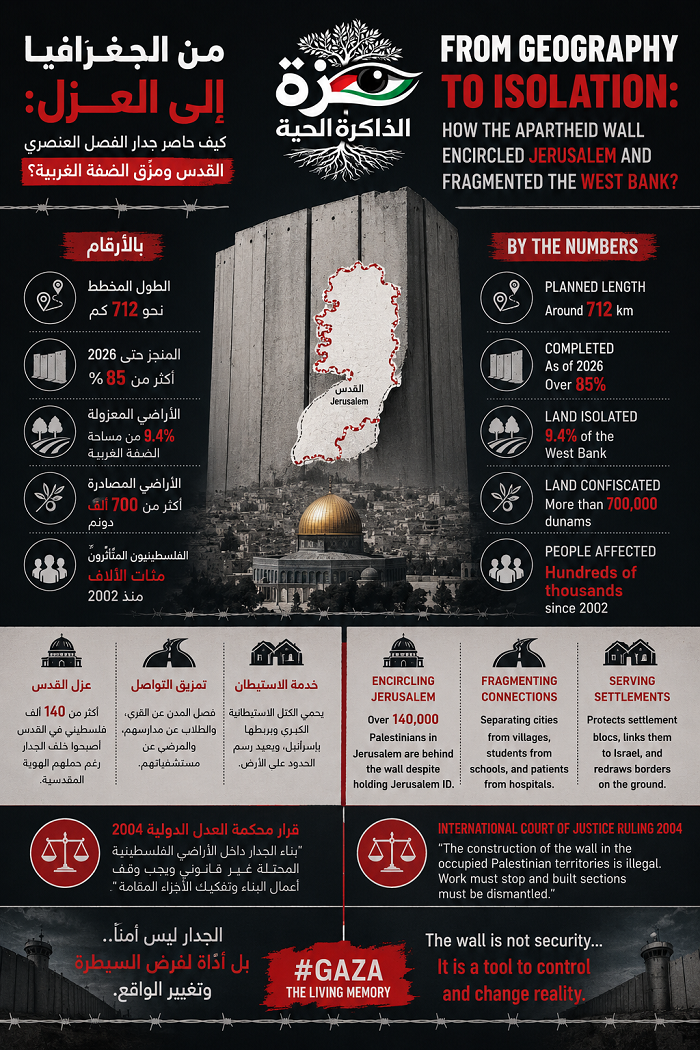
According to the United Nations Office for the Coordination of Humanitarian Affairs (OCHA), the planned route of the wall extends approximately **712 kilometers**, more than double the length of the Green Line itself.
The Wall in Numbers
General Route
* Planned length: approximately **712 km**
* Completed by 2026: more than **85%**
* Height of concrete sections: between **8 and 9 meters**
* Agricultural and military gates: dozens along the route
* Military checkpoints and crossings connected to the wall: dozens
Isolated Land
United Nations estimates indicate that the route of the wall effectively isolates:
* Approximately **9.4% of the West Bank**
* More than **700,000 dunams** of Palestinian land
* Tens of thousands of dunams planted with olive trees, almonds, and seasonal crops
The wall has also affected hundreds of Palestinian communities to varying degrees.
Jerusalem: The Primary Target
Although the wall stretches across the West Bank, Jerusalem has always been at the heart of the project.
From the outset, Israeli governments used the wall as a tool to establish new de facto boundaries for Jerusalem that differ from internationally recognized borders.
The wall forms a near-continuous ring around the city from:
* The north
* The east
* The south
* The northwest
Only limited areas remain connected through Israeli-controlled checkpoints and crossings.
The “Greater Jerusalem” Project
The route of the wall is closely linked to the Israeli concept of “Greater Jerusalem,” which aims to incorporate surrounding settlement blocs into the city and integrate them economically and geographically with West Jerusalem.
Among the major settlement blocs benefiting from the wall are:
* Ma’ale Adumim east of Jerusalem
* Givat Ze’ev northwest of the city
* Gush Etzion south of Jerusalem
These settlement blocs contain dozens of settlements that have become physically connected to Jerusalem through a sophisticated network of roads and infrastructure.
Palestinians Trapped Behind the Wall
One of the most significant consequences of the wall has been the isolation of Palestinian Jerusalem ID holders from the city itself.
Jerusalem institutions estimate that more than **140,000 Palestinians** officially residing within Jerusalem’s municipal boundaries now live on the opposite side of the wall.
Among the most affected areas are:
* Kafr Aqab
* Shuafat Refugee Camp
* Ras Khamis
* Ras Shehadeh
* Dahiyat al-Salam
As a result, many residents continue to carry Jerusalem residency documents and pay municipal taxes while remaining physically disconnected from most municipal services and urban life.
Severing Jerusalem from the West Bank
Before the construction of the wall, Jerusalem served as the natural center of Palestinian life in the West Bank.
It was home to:
* Major hospitals
* Universities
* Religious institutions
* Commercial markets
The wall disrupted these historic links.
Today, cities such as:
* Ramallah
* Bethlehem
* Jericho
are connected to Jerusalem only through Israeli military checkpoints and controlled crossings.
The Agricultural Catastrophe
Agriculture has been among the sectors hardest hit by the wall.
Thousands of Palestinian farmers found themselves separated from their lands, which became trapped behind the barrier.
To access their property, farmers often must:
* Obtain Israeli permits
* Pass through military-controlled gates
* Adhere to limited opening hours
In many cases, gates open only during specific agricultural seasons or for a few hours each day.
Olive Trees Behind Barbed Wire
Palestinian data indicate that tens of thousands of olive trees are now located beyond the wall.
This has led to:
* Reduced agricultural maintenance
* Declining harvests
* Major economic losses
* The gradual abandonment of farmland
The impact has been particularly severe in the governorates of Qalqilya, Salfit, Tulkarm, and Jenin.
The Wall and the Settlement Enterprise
Urban planning experts argue that the route of the wall cannot be separated from Israel’s settlement strategy.
More than **80% of Israeli settlers living in the West Bank** are located either west of the wall or within areas directly connected to it.
The wall has contributed to:
* Protecting major settlement blocs
* Facilitating settlement expansion
* Strengthening Israeli control over surrounding lands
* Fragmenting Palestinian territorial continuity
Enclosed Villages
Dozens of Palestinian villages have become trapped between the wall and the Green Line or between different sections of the barrier.
Some communities can only be reached through military-controlled gates.
This has affected:
* Education
* Healthcare
* Trade
* Social and family life
In many cases, residents must cross checkpoints daily to reach schools, workplaces, and medical facilities.
Impact on Health and Education
The wall has significantly complicated access to Jerusalem’s main hospitals, including:
* Al-Makassed Hospital
* Al-Mutlaa (Augusta Victoria) Hospital
* Augusta Victoria Medical Complex
Thousands of students have also been affected, as access to schools and universities in Jerusalem became increasingly restricted.
The International Court of Justice Ruling
On July 9, 2004, the International Court of Justice (ICJ) issued a landmark advisory opinion declaring that the construction of the wall inside occupied Palestinian territory was contrary to international law.
The Court concluded that:
* The wall violates international law.
* Construction should cease.
* Sections built within occupied territory should be dismantled.
* Palestinians affected by the project should receive compensation.
Despite the ruling, construction and expansion continued.
What Changed After October 7, 2023?
Following the outbreak of the Gaza war, Israel further intensified its reliance on the wall and its associated checkpoint system.
The West Bank experienced:
* Unprecedented movement restrictions
* Closure of numerous agricultural gates
* Increased limitations on Palestinian workers
* Expansion of military checkpoints
The wall became part of a broader system of closures that further isolated Palestinian cities and communities.
A Tool for Redrawing the Map
Legal experts and urban planners argue that the wall’s most profound impact has not been its physical presence alone, but its role in reshaping Palestinian geography.
The wall has:
* Isolated nearly **10% of the West Bank**
* Cut Jerusalem off from its Palestinian surroundings
* Linked major settlement blocs to Israel
* Restricted the movement of hundreds of thousands of Palestinians
* Created new de facto boundaries on the ground
More than twenty years after construction began, the Separation Wall has become one of the most visible and consequential features of the Israeli occupation. It is not merely a structure of concrete and barbed wire, but a comprehensive system that reshapes geography, demographics, mobility, and control over land.
In Jerusalem, the wall has become a mechanism for isolating the city from its Palestinian hinterland while integrating surrounding settlements into the “Greater Jerusalem” framework. Across the West Bank, it has fragmented territorial continuity, disrupted social and economic life, and imposed lasting consequences on Palestinian communities.
Today, the Separation Wall remains one of the most significant symbols of the conflict over land, identity, sovereignty, and the future of Palestine..