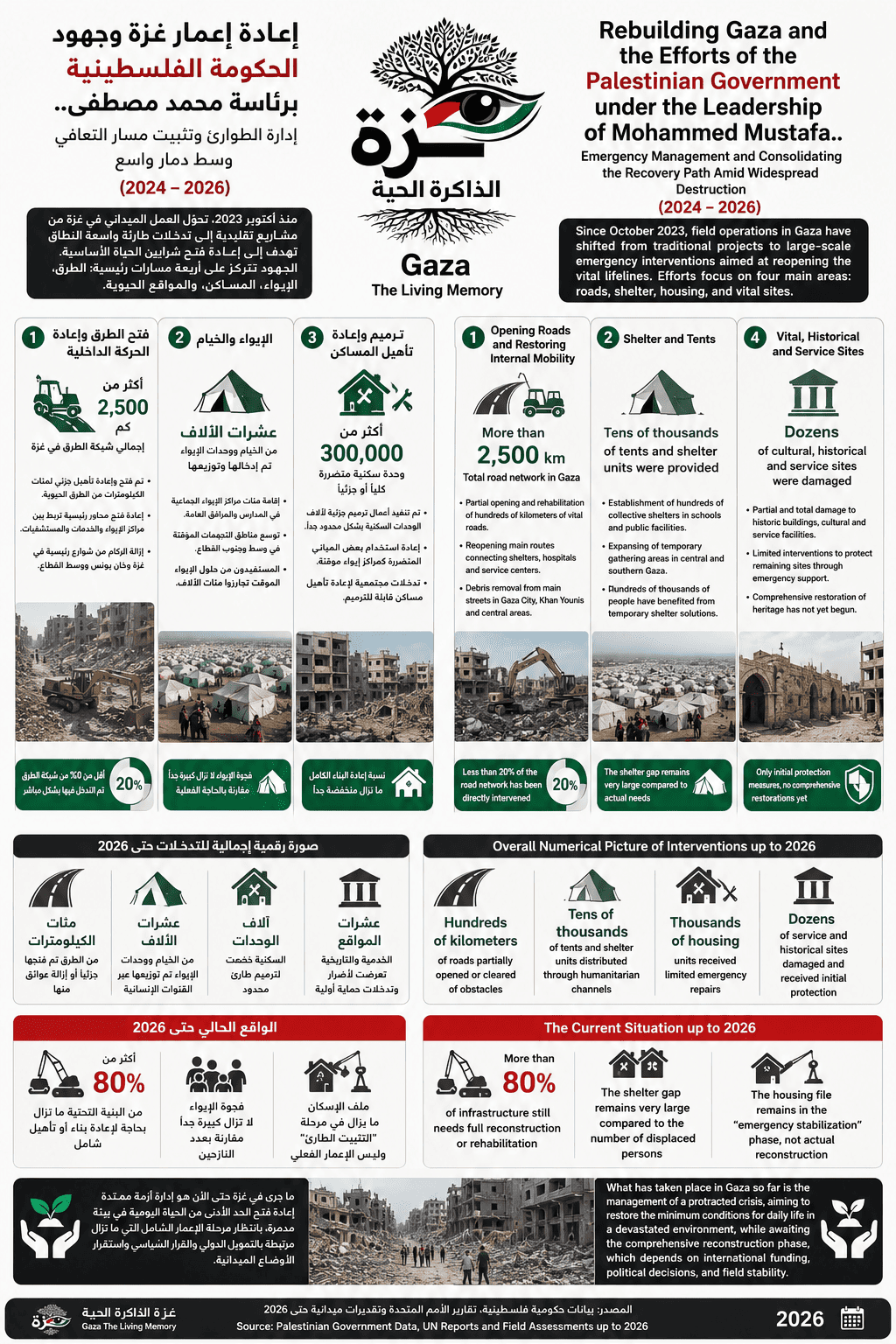
Since the outbreak of the war on the Gaza Strip in October 2023, reconstruction-related fieldwork has shifted from traditional infrastructure projects to large-scale emergency interventions aimed at reopening the basic arteries of life in a largely devastated environment. During the initial phase, efforts have focused on four main tracks: roads, shelter, housing, and essential service and heritage sites.
According to cumulative estimates issued by Palestinian authorities and supported by UN and field reports up to 2026, intervention levels remain partial and limited compared to the scale of destruction, yet they reflect the early stages of reshaping basic services on the ground.
First: Road clearance and restoring internal mobility
Technical estimates indicate that the Gaza Strip has a road network of more than 2,500 kilometers, including main and secondary roads, a large portion of which has been directly damaged or blocked by rubble.
Within emergency reconstruction efforts:
Hundreds of kilometers of key urban roads have been partially reopened or cleared
Main corridors linking shelters, hospitals, and service centers have been reopened
Rubble removal operations have taken place in major streets in Gaza City, Khan Younis, and central Gaza areas
Field estimates suggest that the proportion of roads that have undergone direct intervention (partial clearance or reopening) remains below 20% of the total network, while the majority still requires full reconstruction or major rehabilitation.
Second: Shelter and emergency housing (tents)
With the collapse of the housing sector, shelter has become an urgent humanitarian priority. UN data indicates that hundreds of thousands of families have been internally displaced during the war.
As part of the response:
Tens of thousands of tents and temporary shelter units have been delivered through multiple humanitarian channels
Hundreds of collective shelters have been established in schools, public facilities, and temporary camps
Large-scale informal shelter zones have expanded, particularly in central and southern Gaza
UN estimates suggest that beneficiaries of temporary shelter solutions exceed hundreds of thousands of individuals, while a significant gap remains between actual needs and available capacity, leaving many families without adequate or stable shelter.
Third: Housing rehabilitation and repairs
In the housing sector, the most heavily affected area, estimates indicate:
More than 300,000 housing units have been fully or partially damaged
Tens of thousands of homes have become uninhabitable
Within ongoing interventions:
Limited emergency rehabilitation works have been carried out on thousands of housing units, focusing on basic repairs such as sealing openings, partial wall restoration, and temporary structural stabilization
Some partially damaged buildings have been repurposed as temporary shelters
Community-based and individual efforts have contributed to minor rehabilitation in less affected areas
However, as of mid-2026, the rate of full housing reconstruction remains extremely low compared to the scale of destruction, with efforts largely concentrated on emergency repairs rather than comprehensive rebuilding.
Fourth: Heritage, cultural, and service sites
In addition to residential infrastructure, several cultural, historical, and service-related sites have suffered varying levels of damage, including:
Historical buildings in the old city and central Gaza areas
Cultural centers and community institutions
Older governmental and service buildings with heritage value
According to preliminary estimates from local and international institutions:
Dozens of cultural and historical sites have been recorded as partially or fully damaged
Limited protective interventions have begun to stabilize remaining structures
Comprehensive restoration of heritage assets has not yet started due to ongoing conditions and funding constraints
Fifth: Overall snapshot of interventions
As of 2026, field interventions in Gaza can be summarized as follows:
Hundreds of kilometers of roads have been partially cleared or reopened
Tens of thousands of tents and shelter units have been distributed through humanitarian channels
Thousands of housing units have undergone limited emergency rehabilitation
Dozens of cultural and service sites have received initial protective interventions
At the same time:
More than 80% of infrastructure still requires full reconstruction or major rehabilitation
The shelter gap remains substantial compared to the number of displaced persons
Housing recovery remains at an emergency stabilization stage rather than full reconstruction
Conclusion
Current figures indicate that what has taken place in Gaza is not reconstruction in its conventional sense, but rather an extended crisis management process aimed at restoring minimal daily life functions in a heavily devastated environment. Between partial road clearance, emergency shelter provision, and limited housing repairs, the overall picture remains one of “initial life restoration,” while comprehensive reconstruction remains contingent on international funding, political conditions, and on-the-ground stability..