From a Blockaded Economy to an Economy Under the Rubble: The Economic Losses in the Gaza Strip Since October 7, 2023
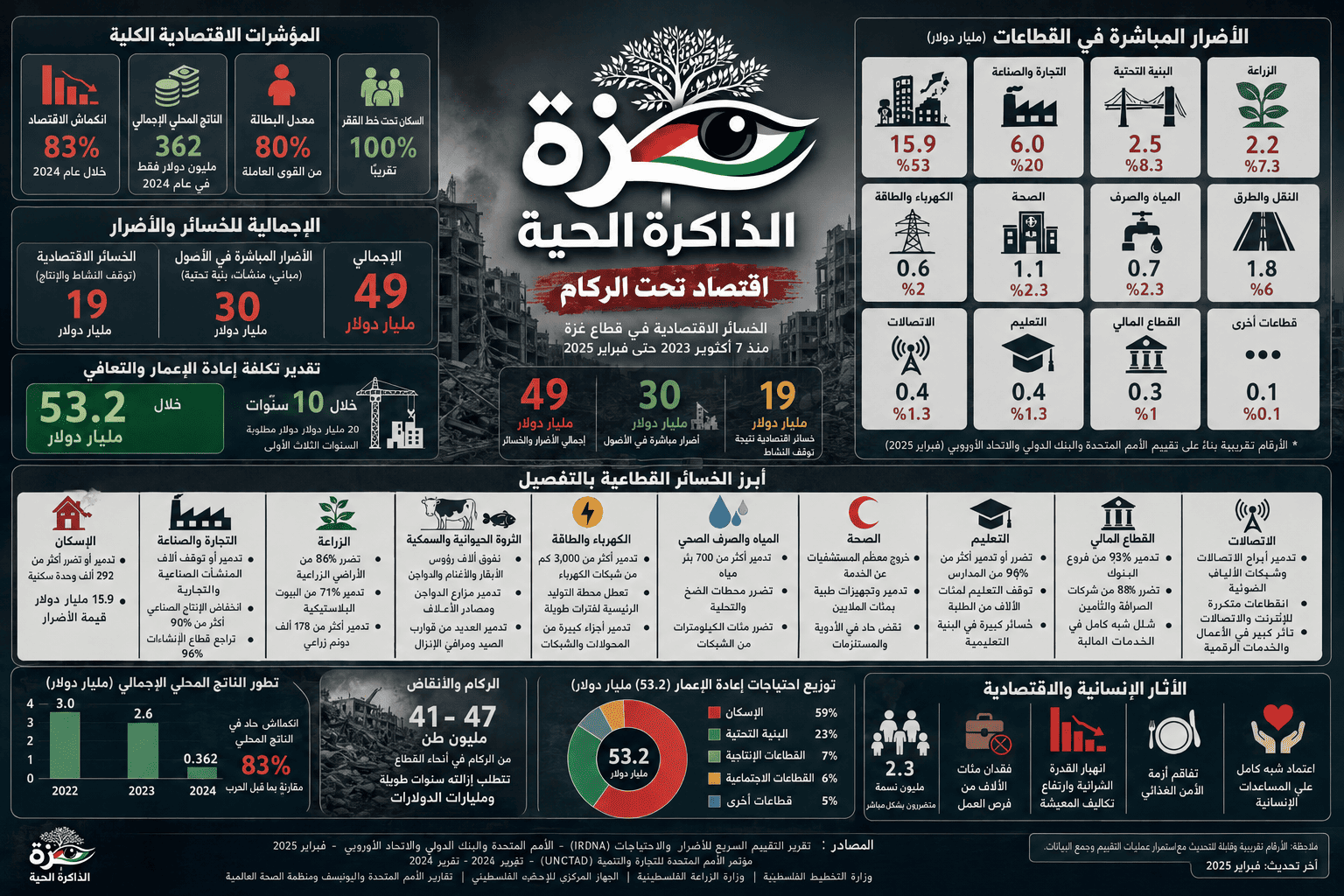
Gaza Al-Thakira Al-Hayya (The Living Memory) – June 9, 2026 – When the war on the Gaza Strip broke out on October 7, 2023, the destruction was not confined to residential buildings or civilian facilities; rather, it extended to obliterate the entire economic infrastructure. Within a few months, the Strip’s economy suffered an unprecedented blow, prompting international institutions to describe what transpired as one of the largest economic collapses the world has witnessed in a geographically limited area during modern history. Gaza, which spans an area of approximately 365 square kilometers and is home to more than 2.3 million people, was already suffering from the effects of a continuous blockade imposed since 2007, an unemployment rate exceeding 45% prior to the war, and a fragile economy heavily reliant on humanitarian aid. With the outbreak of the war, most economic, productive, and service sectors collapsed, and the infrastructure sustained widespread destruction. According to a joint assessment issued by the United Nations, the World Bank, and the European Union in February 2025, the value of direct damages reached approximately $30 billion, while economic losses resulting from the cessation of productive and service activities amounted to around $19 billion, bringing the total damages and losses to nearly $49 billion during the first year of the war alone. Chapter I: An Economy Stripped of Its Vital Capacity Prior to the war, the annual Gross Domestic Product (GDP) of the Gaza Strip stood at approximately $3 billion, despite the blockade and restrictions imposed on movement and trade. However, during 2024, the Gazan economy recorded the largest collapse in its modern history. Data from the United Nations Conference on Trade and Development (UNCTAD) indicates that Gaza's economy contracted by 83% during 2024, while the GDP plummeted to a mere $362 million. This collapse signifies that most economic activities ceased or vanished, leaving thousands of establishments unable to operate or produce. Furthermore, unemployment surged to nearly 80% of the workforce, rendering the majority of the Strip's population dependent on humanitarian and food assistance. United Nations estimates indicate that the war erased nearly seven decades of human and economic development progress in Gaza. Chapter II: Housing and Real Estate... The Destruction of Accumulated Wealth The housing sector stands as the single most affected sector by the war. Real estate in Gaza was not merely shelter; it represented a repository of wealth and the life savings of Palestinian families who invested long years into building their homes, apartments, and properties. According to the World Bank assessment: The value of damages in the housing sector reached approximately $15.9 billion. The residential sector accounted for 53% of the total recorded damages. More than 292,000 housing units were damaged or destroyed. Entire neighborhoods were damaged in Gaza City, Jabalia, Beit Hanoun, Beit Lahia, Khan Younis, and Rafah. UN estimates indicate that more than 70% of the buildings in the Strip sustained varying degrees of destruction or damage. These losses did not only trigger a housing crisis but also led to the collapse of a massive portion of the real estate and construction market, resulting in the loss of tens of thousands of jobs tied to this sector. Chapter III: Trade and Industry... Halting the Engines of Production Before the war, thousands of industrial and commercial establishments formed the backbone of the Gazan economy. Gaza encompassed: Food processing factories. Garment and textile factories. Furniture factories. Plastic industries. Metal industries. Small handicraft workshops. However, the war resulted in: The destruction or closure of thousands of establishments. The destruction of warehouses containing goods and raw materials. A near-total cessation of industrial production. According to international institutional estimates: Industrial production dropped by more than 90%. Construction sector activity plummeted by 96%. The trade and industry sector accounted for roughly 20% of total direct damages. Consequently, this led to the loss of tens of thousands of job opportunities and the collapse of local productive capacity. Chapter IV: Agriculture... The Loss of Land and Food Sources Prior to the war, the agricultural sector constituted a fundamental pillar of the local economy. It contributed nearly 10% to the GDP and provided direct and indirect income for hundreds of thousands of citizens. However, satellite imagery and UN reports revealed a staggering scale of destruction. By 2025: Approximately 86% of agricultural lands were damaged. Only 1.5% of agricultural land remained safely usable. 71% of greenhouses were damaged. More than 80% of agricultural wells were damaged. Estimates from the Palestinian Ministry of Agriculture indicate: The destruction of over 178,000 agricultural dunams. The destruction of nearly 1,000 agricultural wells. The destruction of hundreds of cattle, sheep, and poultry farms. As a result, thousands of farmers lost their sole source of income. Chapter V: Livestock and Fisheries The livestock sector suffered severe losses due to the destruction of farms and the perishing of animals from bombardment and feed shortages. The losses encompass: Thousands of head of cattle. Tens of thousands of sheep and goats. Millions of poultry. Egg and milk production farms. Meanwhile, the marine fishing sector dealt a heavy blow: The destruction of a large number of fishing boats. Damage to ports and fishermen’s harbors. The complete idleness of thousands of fishermen. This sector had previously provided direct and indirect income to approximately 100,000 people prior to the war. Chapter VI: Electricity and Energy Electricity represents the lifeblood of a modern economy, yet this sector suffered comprehensive devastation. Official Palestinian estimates point to: The destruction of thousands of meters of electrical grids. The destruction or damage of major transformers. The prolonged disruption of the sole power plant. Additionally, over 3,000 kilometers of electrical networks were destroyed. This catastrophic failure led to: The idling of factories. The disruption of hospitals. A decline in agricultural production. The collapse of water and telecommunication services. Chapter VII: Water and Sanitation Even before the war, Gaza suffered from a chronic water crisis. However, the war exacerbated the situation to an unprecedented degree. Estimates indicate: The destruction of more than 700 water wells. Damage to pumping stations. The destruction of vast sections of water networks. Damage to desalination plants. Furthermore, hundreds of kilometers of sewage networks were damaged, leading to a severe decline in water supplies and escalating environmental and health hazards. Chapter VIII: The Healthcare Sector The health sector constituted one of the most heavily targeted sectors during the war. According to United Nations estimates: The majority of hospitals sustained severe damage. A large number of hospitals were knocked entirely or partially out of service. Dozens of health centers and clinics were damaged. The sector also lost: Advanced medical equipment. Laboratories. Ambulances. Pharmaceutical warehouses. Total losses are estimated in the hundreds of millions of dollars. Chapter IX: Education... The Loss of Human Capital Prior to the war, Gaza possessed: Hundreds of public and private schools. Universities, colleges, and institutes. However, the war resulted in: The destruction or damage of the vast majority of educational institutions. The suspension of education for extended periods. Stripping hundreds of thousands of students of their right to education. UN estimates indicate that more than 90% of educational buildings sustained destruction or damage. The loss here is not confined to physical structures; it encompasses the loss of entire academic years and long-term consequences for human capital. Chapter X: Roads and Transportation The road network suffered catastrophic damage. Losses include: The destruction of hundreds of kilometers of roads. The destruction of bridges and internal crossings. Damage to transport networks and logistics services. This extensive damage severely hindered the movement of goods, commodities, relief aid, and rescue operations. Chapter XI: Telecommunications and Information Technology Before the war, the telecommunications sector was one of the few sectors exhibiting relative growth. However, the war led to: The destruction of telecom towers. The obliteration of fiber-optic networks. Recurrent blackouts of internet and phone services. Software development companies and digital service providers, which previously provided employment opportunities for the youth, were also severely impacted. Chapter XII: Banking and Financial Services The Palestinian financial system in Gaza sustained unprecedented losses. According to World Bank estimates: Approximately 93% of bank branches were destroyed. 88% of exchange companies were damaged. 88% of insurance companies were damaged. Only a very limited number of Automated Teller Machines (ATMs) remained operational. This led to: Extreme difficulty in accessing funds. The paralysis of commercial transactions. A sharp contraction in banking activity. Chapter XIII: The Labor Market The number of employed individuals in Gaza before the war was close to 500,000 workers, both directly and indirectly. However, the war caused: The loss of hundreds of thousands of jobs. The collapse of entire sectors of employment. A surge in unemployment to roughly 80%. Consequently, the vast majority of families lost their primary sources of income. Chapter XIV: Municipalities and Public Services Municipalities suffered extensive losses that included: Heavy machinery and equipment. Administrative buildings. Road networks. Sanitation and waste management services. This severely crippled the capacity of local government units to deliver essential public services. Chapter XV: Rubble... The Other Face of Losses One of the most telling images reflecting the magnitude of the catastrophe is the mountains of rubble strewn across various parts of the Strip. United Nations estimates point to the existence of between 41 and 47 million tons of debris. This rubble represents: Destroyed homes. Demolished factories. Schools and hospitals. Entire flattened infrastructure networks. The mere removal of this rubble will require years of labor and billions of dollars. Chapter XVI: The Cost of Reconstruction According to the joint assessment of the United Nations, the World Bank, and the European Union: $53.2 billion is required for reconstruction and recovery needs spanning a ten-year period. $20 billion is urgently required within the first three years. Housing and infrastructure comprise the lion's share of this cost. As destruction persisted through 2025 and into 2026, international estimates suggest that the reconstruction bill will climb to significantly higher levels. How Gaza's Economy Was Erased Gaza has not witnessed an economic loss of this magnitude since the beginning of the occupation in 1967. In less than two years, the housing, agriculture, manufacturing, trade, services, and infrastructure sectors collapsed entirely; GDP contracted by 83%, unemployment soared to unprecedented levels, and vast expanses of cities and refugee camps were reduced to ruins. Numbers alone do not capture the true scale of the catastrophe. Behind every destroyed home is a family that lost its life savings; behind every halted factory are workers who lost their livelihoods; and behind every ruined school or university is an entire generation whose educational opportunities have been disrupted. The economic losses in Gaza are not merely figures in billions of dollars; they tell the story of an entire society whose economic and social foundations have been decimated, in one of the greatest economic and humanitarian disasters of the twenty-first century..