The Palestinian Business Sector Under Pressure.. Gaza 2023 and the Reshaping of Capital Between Collapse and Strategic Repositioning (2000–2026)
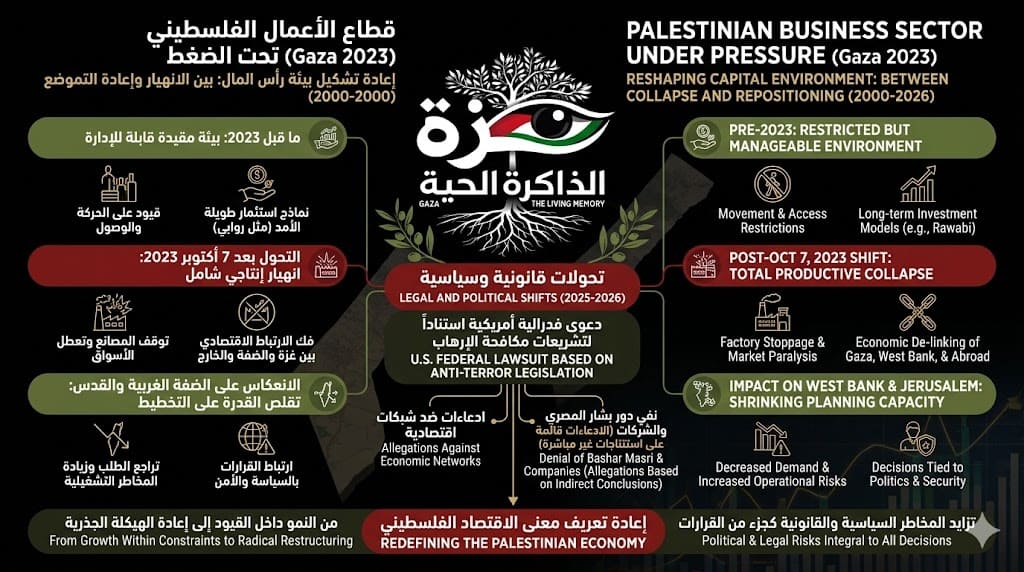
Since October 7, 2023, the Palestinian economy—whether in the Gaza Strip or in its extensions in the West Bank and Jerusalem—has no longer operated within a normal trajectory that can be measured through conventional indicators of growth or contraction. What followed this date was not merely an economic shock linked to war, but a structural transformation in the environment in which Palestinian capital operates, whether at the level of companies, investors, or major projects. Gaza, which before the war represented a relatively limited yet somewhat resilient economy in its core sectors, has entered a phase of full-scale productive collapse. With the suspension of the internal economic cycle, not only factories and markets stopped functioning, but also the invisible networks connecting the Palestinian economy were disrupted—supply chains, financial transfers, trade flows, and employment relations between Gaza, the West Bank, and abroad. Before 2023, the Palestinian private sector operated within a constrained yet manageable environment: restrictions on movement, limited access to crossings, export difficulties, and unequal access to markets. Despite these constraints, this environment still allowed for long-term investment models in real estate, services, and infrastructure, along with attempts to build a local economy driven by private initiatives under conditions of incomplete statehood. However, the war on Gaza completely redefined this equation. With the halt of economic activity in the Strip, the Palestinian economy did not merely lose a geographic market; it lost a functional component of its internal structure, particularly in consumption, production, and the monetary cycle that had also supported sectors in the West Bank. This disruption had a direct impact on the investment climate in the West Bank and Jerusalem, where companies began facing not only declining demand but also increased operational risks and reduced capacity for long-term planning. Over time, investment decisions became increasingly tied to political, security, and financial factors beyond the market itself. Within this context, major investment projects led by Palestinian businessmen emerged over the past two decades in an attempt to promote alternative development models. Among them is Bashar Masri, whose name has been associated with large-scale urban development projects, most notably the city of Rawabi, in addition to investments in various sectors in the West Bank and earlier initiatives linked to economic development models connected to the Gaza Strip. Although these projects are economic in nature, they have always operated within an unstable environment, where investment cannot be separated from political geography, nor economic growth from restrictions on movement, infrastructure, and access to resources. Over time, such projects became part of a broader attempt to build a Palestinian economic model based on private initiative under conditions of incomplete sovereignty. After 2023, with the large-scale collapse in Gaza, this equation entered a more complex phase. The disappearance of Gaza from the active economic cycle did not only result in the loss of a consumer and productive market, but also led to a broader restructuring of risks surrounding the Palestinian economy as a whole, including financing risks, expansion risks, and legal and institutional stability risks for major projects. In this context, legal developments emerged in the international arena related to the war on Gaza. Among them is a civil lawsuit filed in a U.S. federal court in 2025 and 2026 by hundreds of plaintiffs representing families of victims of the October 7, 2023 events, based on provisions of U.S. anti-terrorism legislation. The lawsuit included parties and economic networks allegedly connected to operational environments in the Gaza Strip, including the name of businessman Bashar Masri, within claims concerning the role of certain infrastructure or economic projects in the broader environment in which the events took place. In response, Masri and the companies associated with him categorically deny these allegations, affirming that all investments were purely developmental in nature and aimed at creating jobs and strengthening the local economy, with no connection to any military or security activity. The defense team in this case has moved to dismiss the lawsuit, arguing that it is based on indirect assumptions and that attributing liability to development projects in conflict environments represents an unprecedented expansion in the concept of legal responsibility. What distinguishes such cases is not only their legal content, but also the context in which they emerge, as the Palestinian economic environment has increasingly become part of a more stringent international legal field, where financial compliance considerations, geopolitical risk, and interpretations of the relationship between investment and political context intersect. At the same time, the Palestinian private sector is operating within a broader network of structural constraints, including limited market access, disrupted supply chains, and heavy dependence on an unstable political environment, making any economic expansion conditional on external factors beyond market logic. With the continuation of the war on Gaza since 2023, the discussion is no longer limited to a local economic crisis, but rather extends to a comprehensive restructuring of the role of the Palestinian economy, as production capacity declines, markets shrink, and the gap between economic potential and actual reality deepens. In conclusion, the Palestinian private sector today stands at a fundamentally different stage from the past two decades. The challenge is no longer growth within constraints, but rather redefining the very meaning of “economy” within an environment where the rules of operation and investment are being reshaped dramatically, and where political and legal risks have become an integral part of every economic decision..