On the morning of October 7, 2023, Gaza’s industrial sector was operating under difficult conditions imposed by years of blockade. Yet despite these challenges, it maintained a minimum level of production and economic activity. Hundreds of factories and thousands of workshops produced food, furniture, clothing, plastic products, metal goods, and construction materials, serving as one of the territory’s most important sources of employment and income.
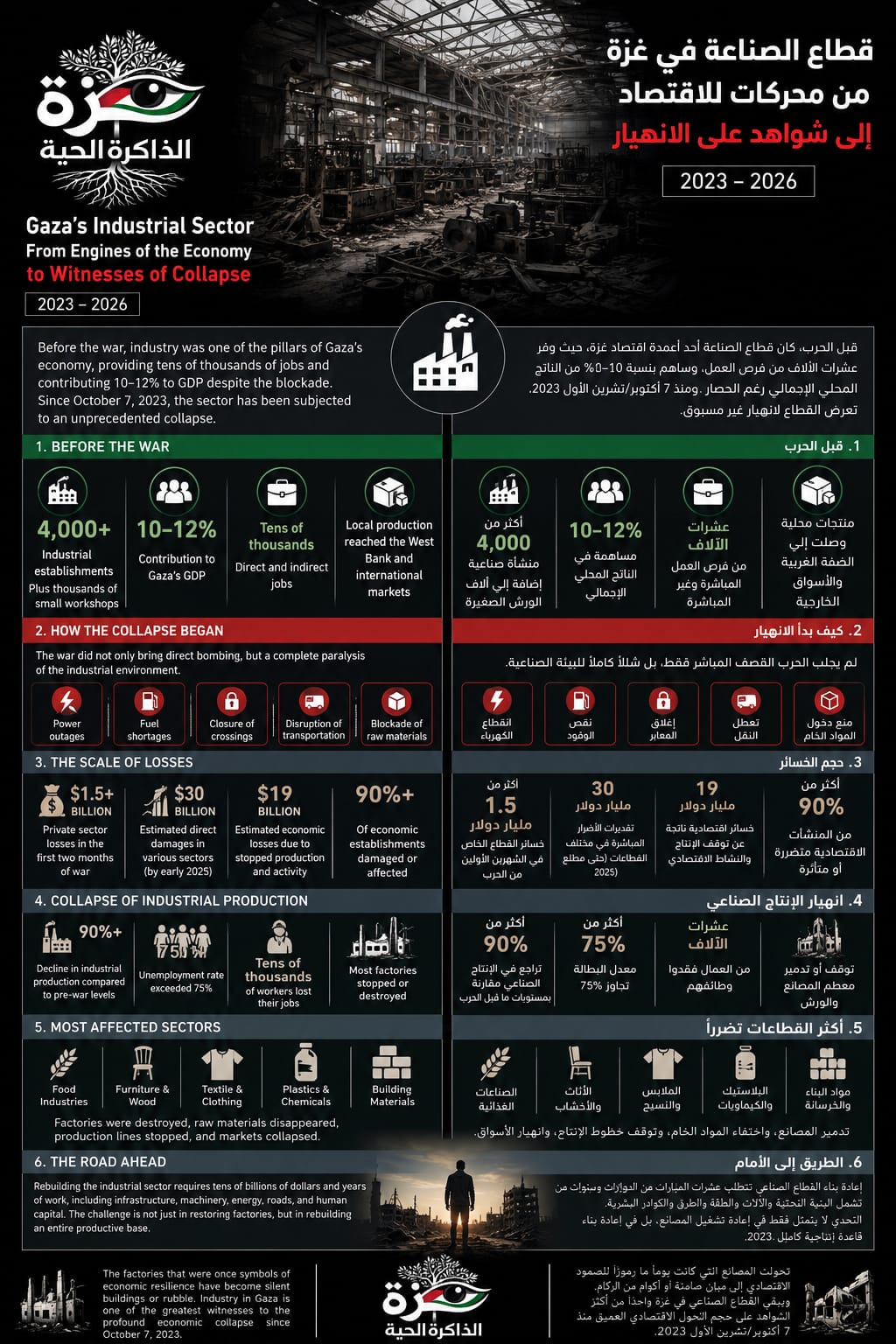
Before the war, Gaza was home to more than 4,000 industrial establishments of varying sizes, in addition to thousands of small workshops and craft businesses. Industry contributed approximately 10–12 percent of Gaza’s gross domestic product and provided tens of thousands of direct and indirect jobs. Despite restrictions on imports and exports, some factories were able to reach markets in the West Bank and abroad, while food processing, construction-related industries, and textile manufacturing formed key pillars of the local economy.
The war that began in October 2023, however, struck not only residential areas and public infrastructure but also the heart of Gaza’s productive economy. Within days, factories began shutting down one after another. The reasons extended far beyond direct bombardment. Electricity supplies collapsed, fuel reserves were depleted, transportation networks were disrupted, border crossings were closed, and the flow of raw materials essential to industrial production was cut off.
During the first weeks of the conflict, hundreds of factories found themselves unable to continue operating. Production lines came to a halt, generators stopped due to fuel shortages, and warehouses filled with goods that could neither be sold nor transported. At the same time, losses across the private sector mounted rapidly. Preliminary estimates indicated that private-sector losses exceeded $1.5 billion during the first two months alone, with industry accounting for a significant share because of the high value of industrial assets, machinery, equipment, warehouses, and production facilities.
As the war expanded throughout 2024, the industrial sector entered a new phase of collapse. The issue was no longer merely the suspension of production; it became the physical destruction of industrial infrastructure itself. Dozens of factories were either directly hit or severely damaged, while entire industrial zones were transformed into devastated landscapes. Aerial imagery documented the disappearance of industrial facilities that had once served as major production centers in Gaza City, Khan Younis, and Rafah.
According to joint assessments by the United Nations, the World Bank, and the European Union, the trade and industrial sectors became among the most heavily affected economic sectors after housing. By early 2025, physical damage across all sectors was estimated at approximately $30 billion, while economic losses resulting from halted production and business activity reached an additional $19 billion.
Within the factories themselves, losses extended far beyond damaged buildings. Entire production lines were destroyed or rendered inoperable. Machinery acquired over many years ceased functioning. Warehouses containing raw materials and finished products were burned, damaged, or destroyed. Thousands of industrial businesses also lost operational records, transportation assets, distribution networks, and critical business infrastructure.
The food manufacturing industry, one of Gaza’s most important productive sectors, suffered particularly severe damage. Dozens of food-processing facilities were destroyed or forced to suspend operations. Dairy plants, juice factories, canning facilities, and bakeries faced immense difficulties in obtaining raw materials and energy supplies. As a result, local food production declined sharply, increasing dependence on humanitarian assistance.
The furniture and woodworking sector, once one of Gaza’s best-known industries, experienced a devastating setback due to the destruction of factories and workshops and the inability to import necessary raw materials. The textile and garment industry, which had employed thousands of workers before the war, also came to a near-complete standstill, with the vast majority of factories ceasing operations.
Plastic and chemical industries faced similar challenges. These sectors rely heavily on imported raw materials, and once supplies stopped entering Gaza, production lines became idle even in facilities that had escaped direct damage. Factories producing construction materials, concrete products, stone, and marble were likewise severely affected by both physical destruction and shortages of essential inputs.
By the end of 2024, international institutions were describing Gaza’s economic collapse as one of the most severe in modern history. Gaza’s economy contracted by more than 80 percent, among the sharpest economic declines recorded globally in recent decades. Economic assessments suggested that industrial output had fallen by more than 90 percent compared to pre-war levels, effectively eliminating most of the territory’s productive capacity.
The crisis also had a profound impact on employment. Tens of thousands of industrial workers lost their jobs as factories and workshops closed. Unemployment became widespread, affecting nearly every family in some form. World Bank estimates indicated that unemployment in Gaza exceeded 75 percent, while jobs directly linked to manufacturing and industrial production virtually disappeared.
As the conflict continued through 2025 and into 2026, the challenge shifted from restarting damaged factories to rebuilding an entire productive base. Many industrial facilities no longer existed, while others required comprehensive reconstruction involving buildings, machinery, electricity networks, water systems, and transportation infrastructure.
Recent economic estimates suggest that more than 90 percent of Gaza’s economic establishments suffered destruction or varying degrees of damage. This figure includes thousands of industrial enterprises that once formed the backbone of local production. Reconstruction of Gaza’s productive economy is expected to require tens of billions of dollars and many years of sustained investment, even if hostilities cease completely.
Today, more than two and a half years after the outbreak of war, the losses suffered by Gaza’s industrial sector can no longer be measured solely by the number of factories destroyed or the value of machinery rendered unusable. The territory has lost a substantial portion of its ability to manufacture food, medicine, clothing, construction materials, and other essential goods. Alongside this, it has lost thousands of skilled workers, technicians, and craftsmen whose expertise had accumulated over decades.
Factories that once symbolized economic resilience have become silent structures or piles of rubble. As the war continues, the industrial sector remains one of the hardest-hit areas of Gaza’s economy and stands as a powerful testament to the profound economic transformation that has unfolded since October 7, 2023—a transformation that will be neither easy nor quick to reverse, even after the guns fall silent..