Special Report | Gaza: The Living Memory
While the world's attention remained focused on the war in the Gaza Strip after October 7, 2023, another battle was unfolding quietly in occupied Jerusalem, largely beyond the spotlight of international media. In the neighborhoods of Sheikh Jarrah and Silwan—long regarded as symbols of the Palestinian struggle for existence in Jerusalem—Palestinians faced an escalation in eviction orders, home demolitions, arrests, and settler takeovers of residential properties. Residents and rights advocates describe this period as one of the most dangerous waves of displacement the city has witnessed in recent years.
What is taking place is not merely a series of isolated property disputes or municipal measures. Rather, it is a struggle over the future of Jerusalem itself. As settler organizations seek to expand their presence inside Palestinian neighborhoods surrounding the Old City and Al-Aqsa Mosque, hundreds of Palestinian families face the possibility of losing homes they have inhabited for generations.
East Jerusalem: The Core of the Settlement Project
Since Israel occupied East Jerusalem in 1967 and later annexed it in a move not recognized by the international community, the city has remained at the center of Israeli settlement policies.
Palestinian neighborhoods surrounding the Old City—particularly Sheikh Jarrah and Silwan—have become strategic targets for settler organizations due to their geographic, political, and religious significance.
Sheikh Jarrah lies on the northern gateway to the Old City, while Silwan stretches directly south of Al-Aqsa Mosque. Control over these areas is widely viewed as a key component of efforts to reshape Jerusalem’s demographic and geographic reality.
After October 7: Reduced International Scrutiny and Increased Pressure
Jerusalem researchers and Palestinian institutions argue that the war in Gaza created conditions that enabled the acceleration of settlement-related measures in Jerusalem.
As international attention shifted toward Gaza, global political pressure and media scrutiny surrounding eviction and demolition cases in Jerusalem significantly declined. This allowed legal and administrative procedures that had previously attracted widespread international criticism to move forward with fewer obstacles.
Residents of Silwan interviewed by United Nations agencies reported that life became increasingly difficult after October 7, with growing fears of protesting or challenging Israeli measures.
Sheikh Jarrah: The Battle That Never Ended
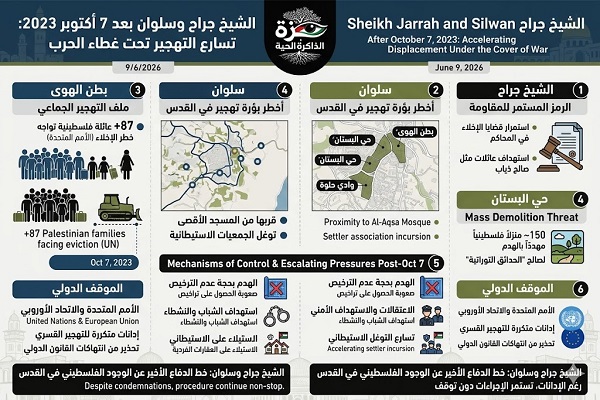
Sheikh Jarrah became an international symbol of resistance against forced displacement in 2021, when attempts to evict Palestinian families sparked global solidarity campaigns and widespread protests.
However, despite the decline in international media attention following the Gaza war, legal proceedings aimed at removing Palestinian families from their homes have continued.
Throughout 2025, Israeli courts continued reviewing eviction cases linked to the settler organization Nahalat Shimon. Among the most prominent was the case involving the family of Saleh Diab, which faced eviction after unsuccessful appeals before Israeli courts.
Human rights organizations emphasize that the struggle in Sheikh Jarrah extends beyond individual families or homes. It is part of a broader effort to strengthen settler presence inside Palestinian neighborhoods of East Jerusalem.
Silwan: The Most Dangerous Frontline in Jerusalem
If Sheikh Jarrah became a symbol of the struggle, Silwan has emerged as its primary battleground.
Located immediately adjacent to Al-Aqsa Mosque, Silwan is home to tens of thousands of Palestinians and is considered one of the most heavily targeted areas for settlement expansion.
Three neighborhoods within Silwan stand at the center of the conflict:
Batn al-Hawa
Al-Bustan
Wadi Hilweh
Settler organizations, most notably Ateret Cohanim and Elad, have pursued long-term campaigns aimed at gaining control over Palestinian properties throughout these areas.
Batn al-Hawa: The Largest Collective Eviction Case
Batn al-Hawa represents one of the largest ongoing forced-displacement cases in occupied Jerusalem.
According to United Nations data, approximately 87 Palestinian families, comprising between 600 and 680 individuals, have faced eviction lawsuits filed by settler organizations claiming ownership of the land.
Since October 7, 2023, the pace of evictions in the neighborhood has increased significantly.
In March 2026, the United Nations reported that 28 Palestinian families, totaling around 160 people, had been forcibly displaced from Batn al-Hawa since the outbreak of the war. The pace of removals accelerated noticeably throughout 2025 and 2026.
In March 2026 alone, 16 Palestinian families were removed from their homes within the span of a few days, marking one of the largest waves of displacement the neighborhood has experienced in years.
Al-Bustan: The Threat of Mass Demolitions
Only a short distance from the walls of Al-Aqsa Mosque lies the neighborhood of Al-Bustan.
For years, Israeli authorities have pursued plans to demolish dozens of Palestinian homes in the area in order to advance tourism and settlement projects associated with what is known as the "City of David" archaeological and biblical park.
Human rights estimates indicate that approximately 150 homes remain at risk of demolition or displacement, affecting nearly 1,500 Palestinians.
Residents fear that projects delayed for years could now be implemented amid reduced international attention resulting from the war.
Home Demolitions as a Demographic Tool
The pressure on Palestinian residents has not been limited to eviction proceedings.
Across East Jerusalem—and particularly in Silwan—Israeli authorities have continued demolishing Palestinian homes on the grounds that they lack building permits.
Palestinians and human rights organizations argue that obtaining Israeli building permits in Jerusalem is extremely difficult, leaving many families with no option but to build without permits and subsequently face demolition orders.
European and United Nations reports have concluded that these policies contribute to reducing the Palestinian presence in Jerusalem and, in some cases, force families to leave the city altogether.
Arrests: Another Mechanism of Control
The expansion of settlement activities has been accompanied by an increase in arrests, interrogations, and legal restrictions targeting Palestinians in Jerusalem.
During the war period, Israeli forces carried out extensive arrest campaigns involving young Palestinians, activists, and residents who protested against demolition or eviction measures.
Human rights organizations have also documented arrests during eviction operations in Silwan, as well as assaults on residents and restrictions imposed on journalists attempting to cover events.
Legal advocates argue that these measures aim to weaken the ability of Jerusalem’s Palestinian community to organize public resistance or document violations.
Settlements Inside Palestinian Neighborhoods
Unlike traditional settlements built on the outskirts of Jerusalem, settlement activity in Sheikh Jarrah and Silwan operates from within Palestinian neighborhoods themselves.
Following many eviction cases, properties are transferred to settler organizations, which then move Israeli settlers into the homes under police protection.
Since 2004, settler groups have taken control of dozens of buildings in Silwan. This process has continued and accelerated during the period following the Gaza war.
Researchers argue that the long-term objective is to establish a continuous ring of settler presence surrounding the Old City and Al-Aqsa Mosque, thereby altering Jerusalem’s demographic balance for generations to come.
International Reactions
Developments in Sheikh Jarrah and Silwan have prompted repeated criticism from the United Nations, the European Union, and international human rights organizations.
In July 2024, the United Nations warned that more than 80 Palestinian families in Silwan faced the risk of forced displacement and described the legal framework used against Palestinians as discriminatory and inconsistent with international law.
UN officials further stated that forced evictions in occupied territory may amount to serious violations of international humanitarian law.
Despite repeated international condemnations, however, demolition orders, settlement expansion, and eviction proceedings have continued.
Jerusalem Between Resilience and Displacement
For Palestinians, Sheikh Jarrah and Silwan are far more than residential neighborhoods. They are viewed as the front line in the struggle to preserve the Palestinian presence in Jerusalem.
Every demolished home, every displaced family, and every property transferred to settler organizations is seen as part of a broader contest over the city’s future identity.
As Palestinian families continue legal battles and grassroots campaigns to defend their homes, concerns are growing that developments since October 7, 2023, could fundamentally reshape the demographic landscape of occupied Jerusalem.
Conclusion
Since the outbreak of the war on Gaza, Sheikh Jarrah and Silwan have witnessed an unprecedented escalation of pressure on Palestinian residents. Forced evictions have accelerated, demolition orders have continued, arrests have increased, and settler organizations have expanded their influence within Palestinian neighborhoods surrounding the Old City.
While the United Nations and international organizations continue to warn of the dangers of mass displacement and demographic transformation, Sheikh Jarrah and Silwan remain symbols of a larger struggle over Jerusalem itself—its identity, its future, and its place at the center of one of the world's most enduring conflicts..