Reports
Press coverage and detailed reports on unfolding events
Death Toll in Gaza Strip Rises to 73,018, Injuries to 173,273 Since Start of Aggression
Gaza— Medical sources in the Gaza Strip announced today, Thursday, that the death toll from the ongoing Israeli occupation aggression on the Strip has risen to 73,018 martyrs and 173,273 injured since the beginning of the aggression on October 7, 2023. The sources reported that over the past 24 hours, hospitals in the Gaza Strip received 2 new martyrs and 8 injuries. They explained that the total number of martyrs since the ceasefire on October 11 has risen to 1,007, and the total number of injuries to 3,165, while 784 bodies have been recovered. The sources indicated that a number of victims still remain under the rubble and on the roads, as ambulance and rescue crews are unable to reach them up to this moment..
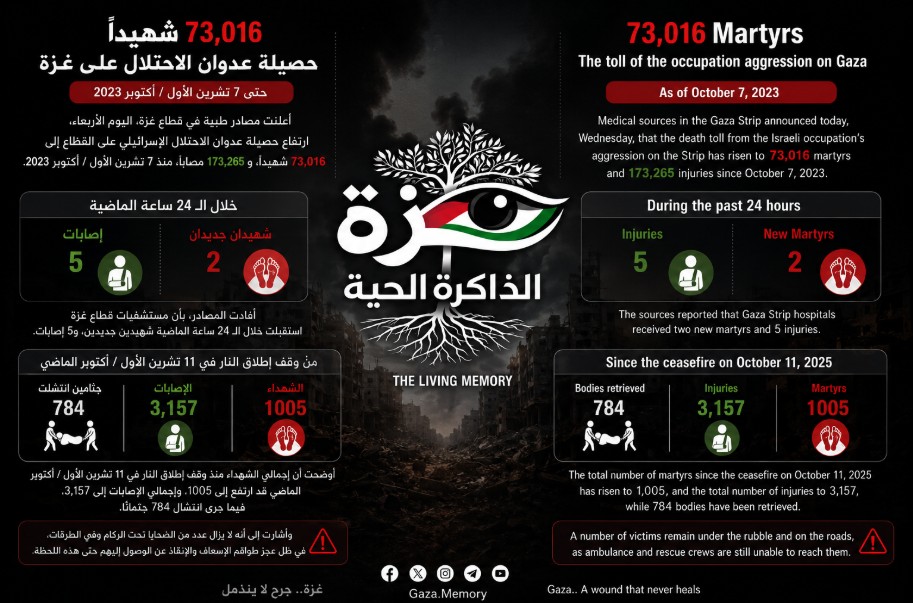
Gaza Death Toll Rises to 73,016 Since the Start of the Israeli Aggression
Medical sources in the Gaza Strip announced today, Wednesday, that the death toll from the ongoing Israeli aggression on the Strip has risen to 73,016 martyrs and 173,265 injured since October 7, 2023. The sources reported that over the past 24 hours, hospitals in the Gaza Strip received two new martyrs alongside 5 injuries. They further clarified that the total number of martyrs since the ceasefire took effect on October 11 has risen to 1,005, with total injuries reaching 3,157, while 784 bodies have been recovered during this period. The same sources indicated that a number of victims remain trapped under the rubble and scattered on the roads, as ambulance and rescue crews are still unable to reach them..
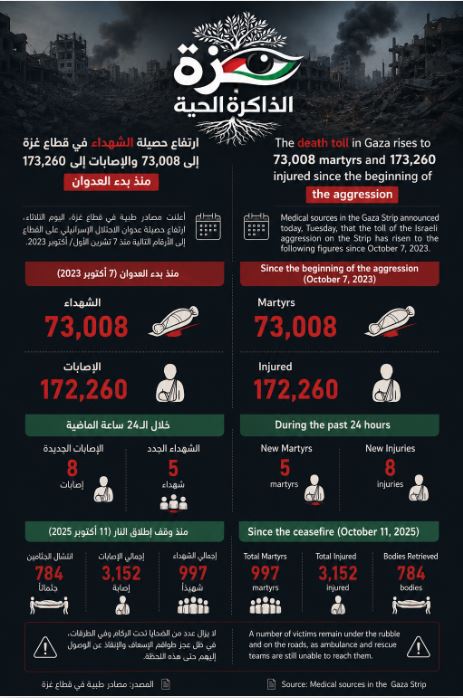
Death Toll in Gaza Strip Rises to 73,008, with 173,260 Injuries Since the Onset of Aggression
GAZA — Medical sources in the Gaza Strip announced today, Tuesday, that the death toll from the ongoing Israeli occupation aggression on the Strip has risen to 73,008 martyrs and 173,260 injured, since the beginning of the aggression on October 7, 2023. The sources reported that over the past 24 hours, hospitals in the Gaza Strip received 5 new martyrs and 8 injuries. They further clarified that the total number of martyrs since the ceasefire on October 11 of last year has risen to 997, while the total number of injuries has reached 3,152, and 784 bodies have been recovered so far. The sources pointed out that a number of victims remain trapped under the rubble and on the roads, as ambulance and rescue crews are still unable to reach them up to this moment..
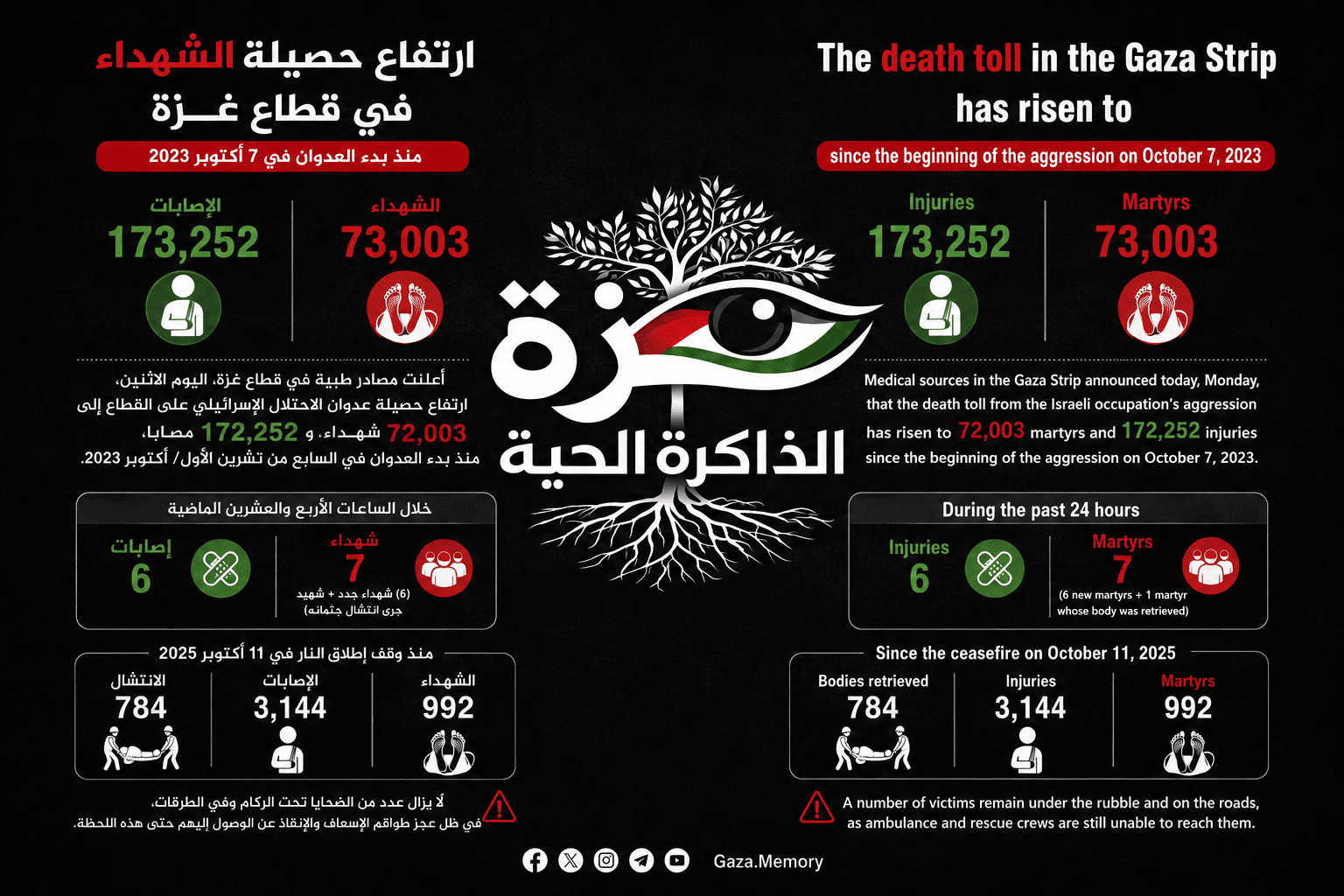
Gaza Death Toll Rises to 73,003, Injuries to 172,252 Since the Start of the Aggression
Medical sources in the Gaza Strip announced today, Monday, that the death toll from the ongoing Israeli aggression on the Strip has risen to 73,003 martyrs and 172,252 injured since the outbreak of the assault on October 7, 2023. The sources reported that over the past 24 hours, hospitals in the Gaza Strip received 7 martyrs (6 newly martyred and one recovered body) alongside 6 injuries. They further indicated that the total number of martyrs since the ceasefire took effect on October 11 has risen to 992, with total injuries reaching 3,144, while 784 bodies have been recovered during this period. The same sources emphasized that a number of victims remain trapped under the rubble and scattered on the roads, as ambulance and rescue crews are still unable to reach them..
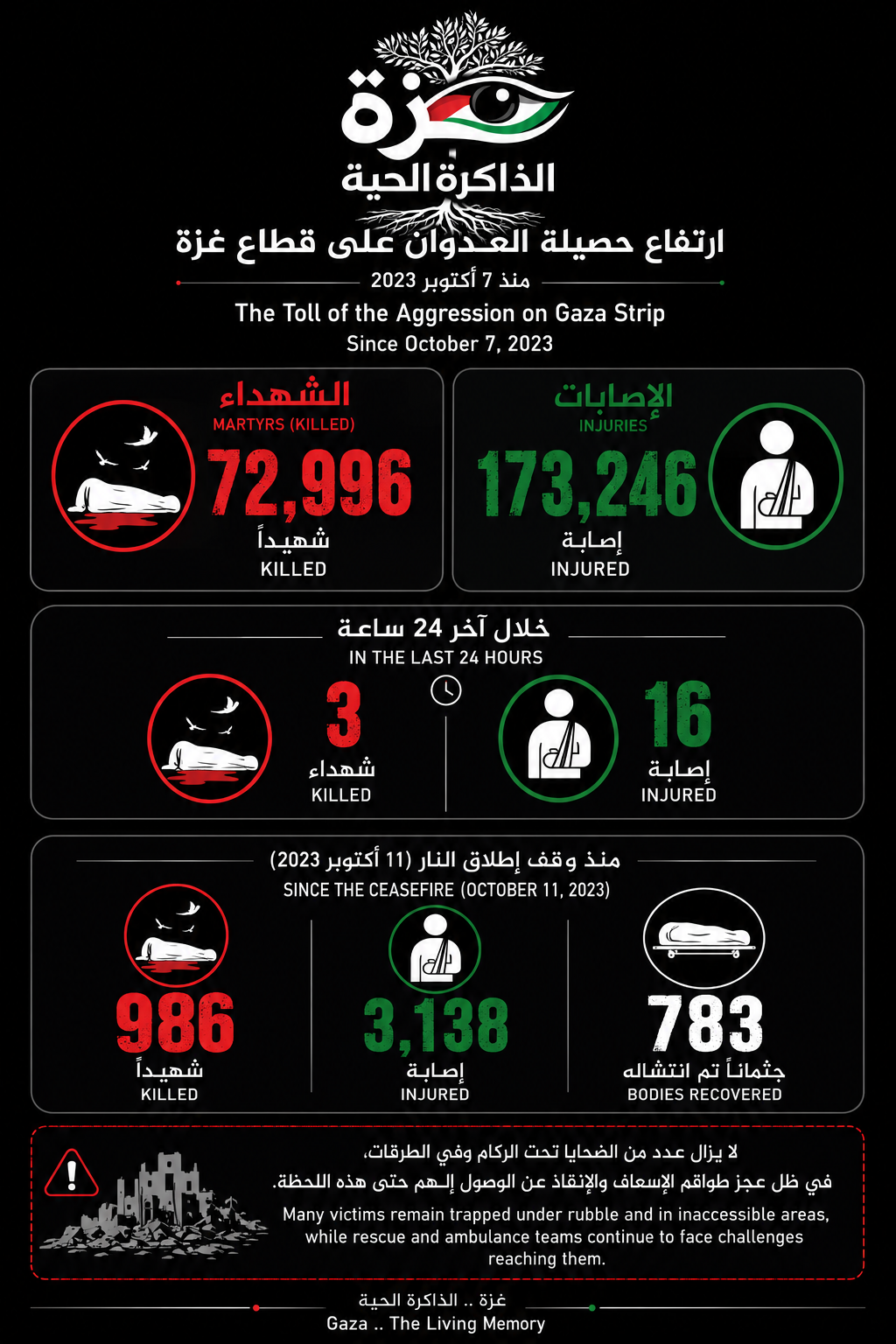
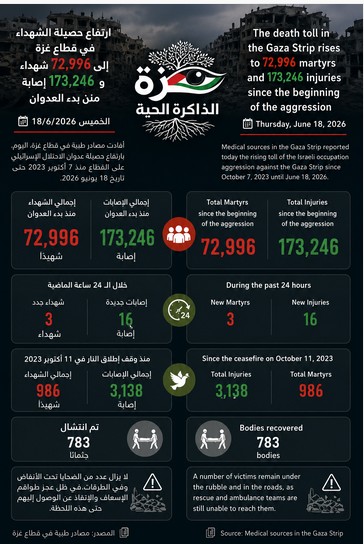
Death Toll in Gaza Strip Rises to 72,996, Injuries to 173,246 Since the Start of the Aggression
Gaza — Medical sources in the Gaza Strip announced today, Sunday, that the death toll from the ongoing Israeli occupation aggression on the Strip has risen to 72,996 martyrs and 173,246 injuries since the beginning of the aggression on October 7, 2023. The sources reported that over the past 24 hours, hospitals in the Gaza Strip received 3 new martyrs and 16 injuries. They also indicated that: The total number of martyrs since the ceasefire on October 11 of last year has risen to 986. The total number of injuries since the ceasefire has reached 3,138. A total of 783 bodies have been recovered during this period. The sources emphasized that a number of victims still remain under the rubble and on the streets, as ambulance and rescue crews are currently unable to reach them..
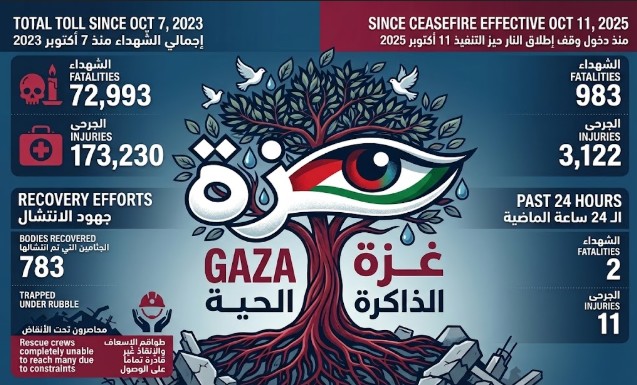
Death Toll in Gaza Strip Rises to 72,993, Injuries to 173,230 Since Onset of Aggression
GAZA, June 13, 2026— Medical sources in the Gaza Strip announced today, Saturday, that the death toll from the ongoing Israeli occupation aggression on the Strip has risen to 72,993 fatalities and 173,230 injuries since the beginning of the aggression on October 7, 2023. The sources reported that hospitals in the Gaza Strip received two fatalities and 11 injuries during the past 24 hours. They indicated that the total number of fatalities since the ceasefire took effect on October 11 last year has risen to 983, while total injuries reached 3,122. Additionally, 783 bodies have been recovered during this period. The sources further noted that a number of victims remain trapped under the rubble and on the roads, as ambulance and rescue crews are still completely unable to reach them up to this moment.
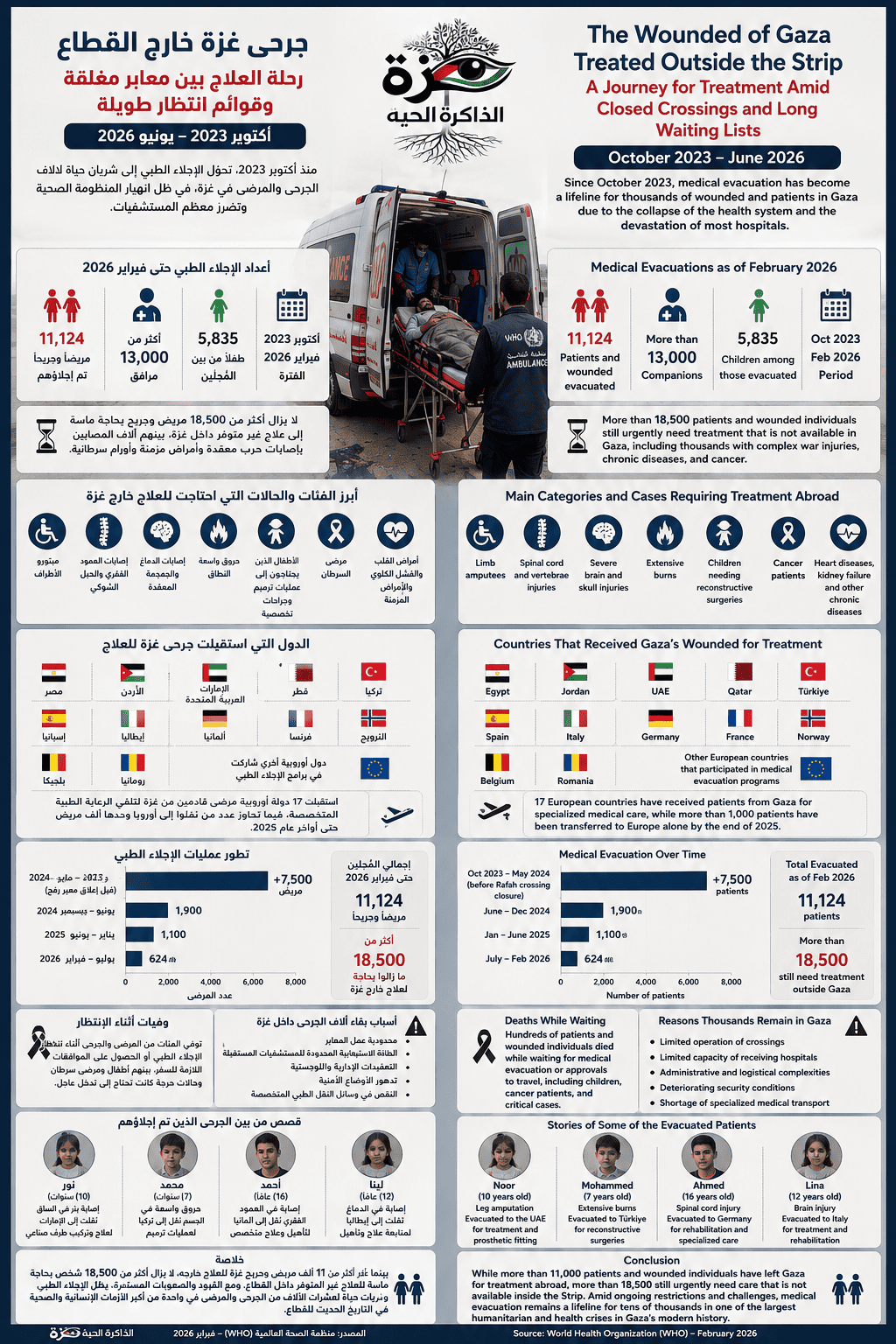
Gaza’s Wounded Abroad: The Medical Evacuation Journey Between Closed Crossings and Long Waiting Lists (October 2023 – June 2026)
Gaza: The Living Memory— Since the outbreak of the war on the Gaza Strip on October 7, 2023, the medical evacuation of the wounded and sick has transformed into one of the most pressing and complex humanitarian issues. With the widespread collapse of the healthcare system and damage sustained by most hospitals, treating severely injured individuals inside the Strip was no longer viable, making external medical evacuation the sole option to save many lives. However, the path to receiving treatment outside Gaza has been fraught with difficulties. Between closed border crossings, logistical constraints, and a shortage of available beds in receiving international hospitals, tens of thousands of patients found themselves stranded on long waiting lists as their health conditions deteriorated day after day. According to data from the World Health Organization (WHO) up to February 2026, at least 11,124 patients and wounded individuals have been evacuated from the Gaza Strip since the start of the war, accompanied by more than 13,000 caregivers. Among the patients who managed to leave the Strip were approximately 5,835 children. The data shows that the vast majority of evacuations took place during the initial months of the war, prior to the closure of the Rafah crossing in May 2024, during which more than 7,500 patients left the Strip. Following the closure, evacuation rates plummeted drastically, shifting from hundreds of cases per week to extremely limited numbers. According to the WHO, more than 18,500 patients and wounded individuals remain in desperate need of medical treatment that is unavailable inside Gaza. This includes thousands of individuals suffering from complex war injuries, chronic diseases, and cancerous tumors. --- ### Who Needed Treatment Outside Gaza? The medical evacuation waiting lists encompass diverse categories of casualties, most notably: * Amputees requiring reconstructive surgeries and advanced prosthetic limbs. * Patients with severe spinal cord and vertebral injuries. * Complex traumatic brain and cranial injury cases. * Individuals with extensive, large-scale burn injuries. * Children requiring specialized surgical and reconstructive interventions. * Cancer patients whose treatment regimens were entirely halted. * Patients suffering from heart disease, kidney failure, and other chronic illnesses. WHO estimates indicate that thousands of the wounded suffer from "life-altering" injuries—traumas that will stay with them for years and demand specialized treatment and rehabilitation currently unavailable inside the Gaza Strip. --- ### Where Were the Wounded Transferred? Several countries received patients arriving from Gaza, most notably: * Egypt * Jordan * The United Arab Emirates * Qatar * Turkey * Spain * Italy * Germany * France * Norway * Belgium * Romania * Other European nations participating in medical evacuation programs. According to the WHO, 17 European countries have received patients from Gaza to provide specialized medical care, with the number of individuals transferred to Europe alone surpassing 1,000 patients by late 2025. --- ### Gaza's Children at the Top of Evacuation Lists Children constituted the largest percentage of many medical evacuation operations, given the critical nature of their injuries and their acute need for complex surgical interventions. WHO data indicates that thousands of children were placed on waiting lists for treatment abroad, while substantial numbers were successfully evacuated to specialized hospitals across Europe and the Arab world. --- ### Fatalities While Waiting One of the most tragic dimensions of this issue involves the patients who were unable to leave the Strip in time. International reports highlight the deaths of hundreds of patients and wounded individuals while waiting for medical evacuation or awaiting the necessary travel clearances, including children, cancer patients, and critical cases that required immediate medical intervention. --- ### Why Did Thousands of Wounded Remain Inside Gaza? Despite ongoing evacuation efforts, the number of individuals who managed to leave the Strip represents only a fraction of the actual needs. The primary reasons for this shortfall include: * The restricted and limited operation of border crossings. * The constrained receiving capacity of host hospitals. * Pervasive administrative and logistical complexities. * Deteriorating security conditions on the ground. * A severe shortage of specialized medical transportation vehicles. --- International organizations have documented cases of children who lost limbs or suffered severe burns and deformities being transferred for treatment abroad only after months of waiting. Evacuation operations also included patients with complex brain injuries, paralysis resulting from spinal cord trauma, and individuals requiring dozens of successive reconstructive surgeries. More than two and a half years since the outbreak of the war, the medical evacuation file remains wide open. While over 11,000 sick and wounded individuals left the Strip for external medical care, more than 18,500 people are still in need of specialized treatment unavailable within Gaza. Medical estimates suggest that clearing this backlog of cases could take years, even if evacuation operations are significantly scaled up. Consequently, receiving treatment outside Gaza is no longer merely a medical procedure; it has become a vital lifeline for tens of thousands of wounded and sick individuals facing one of the largest healthcare and medical referral crises in the modern history of the Strip..
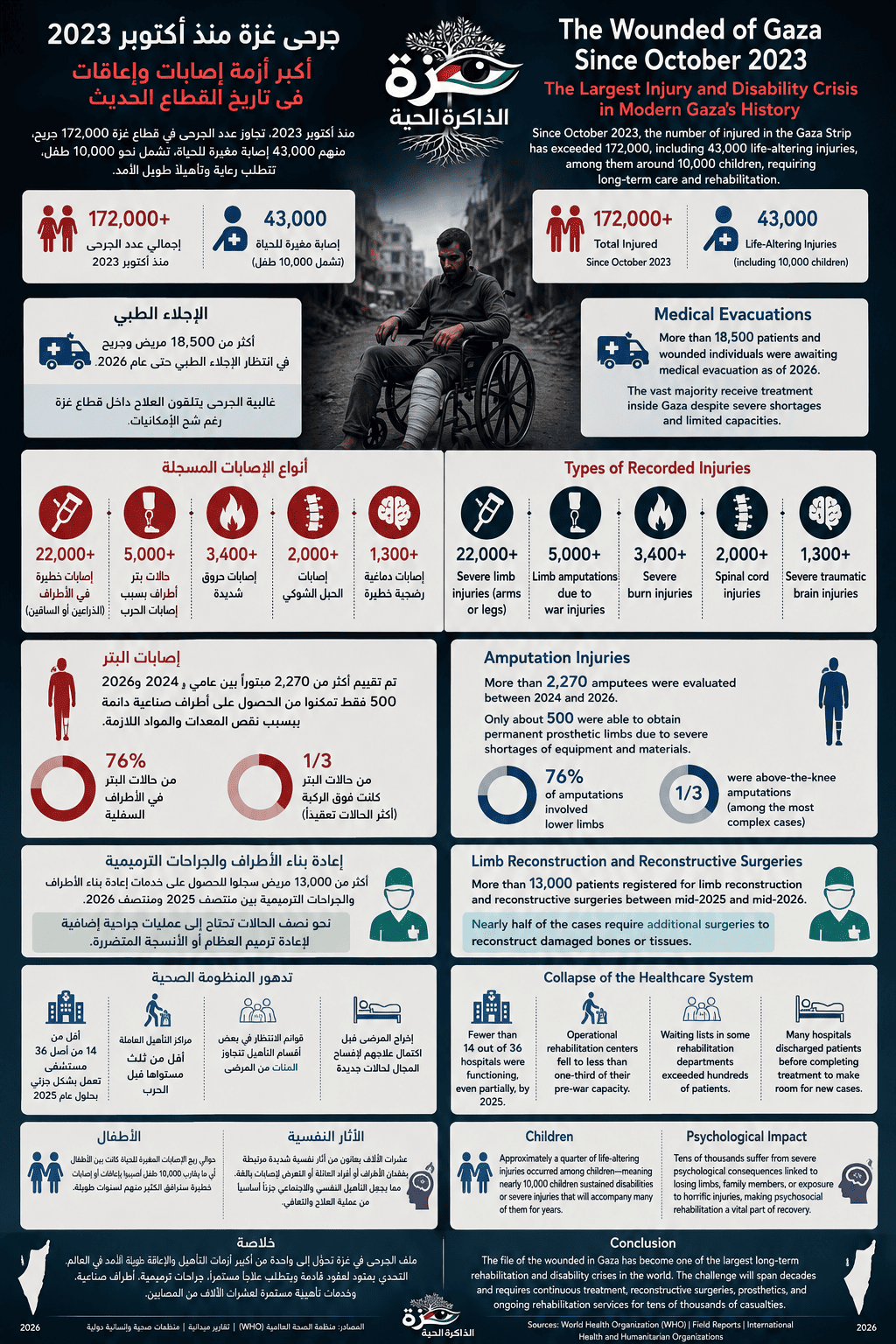
Gaza’s Wounded: An Ongoing War and Injuries Outlasting Decades Thousands of Amputations and Disabilities Amid a Collapsed Healthcare System
Gaza: The Living Memory— Latest estimates from the World Health Organization (WHO) indicate that the number of injured individuals in Gaza since October 2023 has exceeded 172,000. Among them, approximately 43,000 people, including around 10,000 children, have suffered "life-altering" injuries that require long-term care and rehabilitation. Despite limited medical evacuations abroad, the vast majority of the wounded received treatment inside the Gaza Strip, within hospitals and medical centers already suffering from acute shortages of beds, medications, surgical supplies, and specialized medical personnel. The WHO notes that more than 18,500 patients and wounded individuals were awaiting medical evacuation as of 2026, meaning that tens of thousands were forced to seek treatment locally despite severely restricted capacities. Regarding the nature of the injuries, WHO data reveals that limb injuries constituted the largest category among the wounded, with more than 22,000 people sustaining severe injuries to the arms or legs, many resulting in extensive damage to bones, tissues, and nerves. Additionally, more than 5,000 cases of limb amputations directly linked to war injuries were recorded, along with over 3,400 severe burn injuries, more than 2,000 spinal cord injuries, and over 1,300 severe traumatic brain injuries. Amputation injuries remain one of the most complex files. According to WHO data, more than 2,270 amputees were evaluated between 2024 and 2026; however, only about 500 were able to secure permanent prosthetic limbs due to severe shortages of necessary equipment and materials. Furthermore, 76% of the recorded amputations involved the lower limbs, with nearly a third being above-the-knee amputations—which are among the most complex cases in terms of rehabilitation and mobility restoration. Spinal cord injuries, which exceeded 2,000 cases, have left thousands of patients requiring specialized care and rehabilitation for years to come. Health reports indicate that a portion of these patients suffer from permanent or partial mobility disabilities, demanding wheelchairs, assistive devices, and continuous rehabilitation services at a time when rehabilitation centers in Gaza face extreme shortages of equipment. In the burns file, over 3,400 severe burn injuries were documented, many among women and children. These cases require recurrent surgical interventions, skin grafts, and long-term treatment, compounding the immense pressure on hospitals operating under extraordinary circumstances. The WHO also documented more than 13,000 patients registered for limb reconstruction and reconstructive surgeries between mid-2025 and mid-2026. Evaluations revealed that nearly half of these cases require additional surgeries to reconstruct damaged bones or tissues. On the healthcare services front, the challenge was not limited to the volume of casualties, but extended to the collapse of a massive portion of the healthcare system itself. By 2025, fewer than 14 out of 36 hospitals were functioning, and even then, only partially. Meanwhile, the number of operational rehabilitation centers plummeted to less than a third of their pre-war capacity. Waiting lists in some rehabilitation departments exceeded hundreds of patients, forcing many hospitals to discharge patients before completing their treatment to make room for new influxes. Regarding children, international data indicates that approximately a quarter of the life-altering injuries occurred among children—meaning that nearly 10,000 children sustained disabilities or severe injuries that will accompany many of them for years. Medical data from field hospitals supported by Médecins Sans Frontières (MSF / Doctors Without Borders) showed that children accounted for a significant percentage of injury cases requiring long-term follow-up. The suffering of the wounded is not confined to physical trauma alone. Health and humanitarian organizations emphasize that tens of thousands suffer from severe psychological impacts linked to losing limbs, family members, or enduring horrific injuries, making psychological and social rehabilitation an indispensable pillar of the treatment and recovery process. More than two and a half years since the outbreak of the war, the file of the wounded in Gaza is no longer an emergency medical crisis; it has transformed into one of the largest long-term rehabilitation and disability crises in the world. Amid more than 172,000 injured, 43,000 life-altering conditions, and thousands of amputations, spinal cord injuries, burns, and brain traumas, Gaza's healthcare system faces a challenge that spans decades into the future—even after military operations cease—driven by the critical need for continuous treatment, reconstructive surgeries, prosthetics, and ongoing rehabilitation for tens of thousands of casualties..
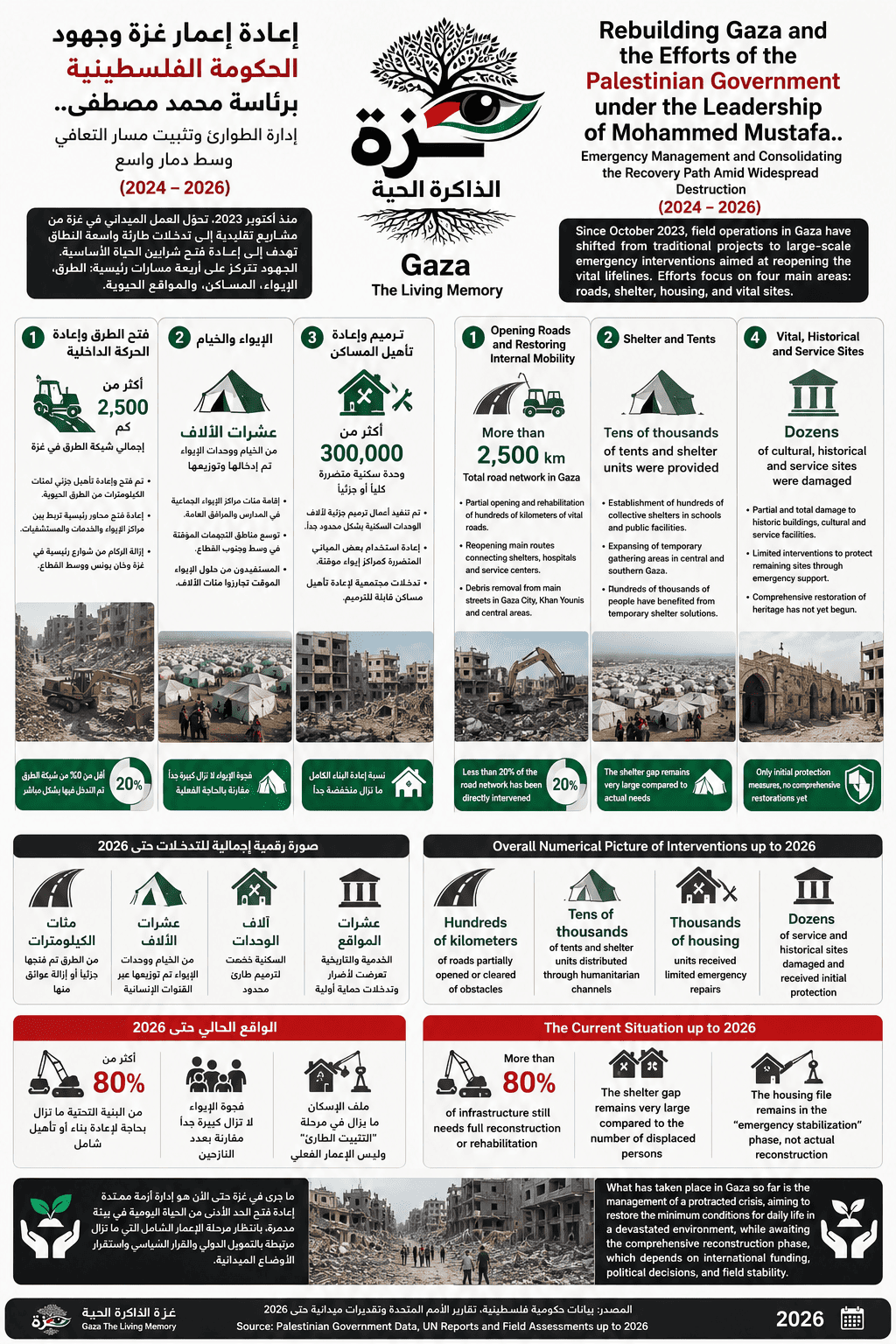
Gaza Reconstruction and the Efforts of the Palestinian Government under Prime Minister Mohammad Mustafa.. Emergency Management and Stabilizing the Recovery Path Amid Widespread Destruction (2024–2026)
Since the outbreak of the war on the Gaza Strip in October 2023, reconstruction-related fieldwork has shifted from traditional infrastructure projects to large-scale emergency interventions aimed at reopening the basic arteries of life in a largely devastated environment. During the initial phase, efforts have focused on four main tracks: roads, shelter, housing, and essential service and heritage sites. According to cumulative estimates issued by Palestinian authorities and supported by UN and field reports up to 2026, intervention levels remain partial and limited compared to the scale of destruction, yet they reflect the early stages of reshaping basic services on the ground. First: Road clearance and restoring internal mobility Technical estimates indicate that the Gaza Strip has a road network of more than 2,500 kilometers, including main and secondary roads, a large portion of which has been directly damaged or blocked by rubble. Within emergency reconstruction efforts: Hundreds of kilometers of key urban roads have been partially reopened or cleared Main corridors linking shelters, hospitals, and service centers have been reopened Rubble removal operations have taken place in major streets in Gaza City, Khan Younis, and central Gaza areas Field estimates suggest that the proportion of roads that have undergone direct intervention (partial clearance or reopening) remains below 20% of the total network, while the majority still requires full reconstruction or major rehabilitation. Second: Shelter and emergency housing (tents) With the collapse of the housing sector, shelter has become an urgent humanitarian priority. UN data indicates that hundreds of thousands of families have been internally displaced during the war. As part of the response: Tens of thousands of tents and temporary shelter units have been delivered through multiple humanitarian channels Hundreds of collective shelters have been established in schools, public facilities, and temporary camps Large-scale informal shelter zones have expanded, particularly in central and southern Gaza UN estimates suggest that beneficiaries of temporary shelter solutions exceed hundreds of thousands of individuals, while a significant gap remains between actual needs and available capacity, leaving many families without adequate or stable shelter. Third: Housing rehabilitation and repairs In the housing sector, the most heavily affected area, estimates indicate: More than 300,000 housing units have been fully or partially damaged Tens of thousands of homes have become uninhabitable Within ongoing interventions: Limited emergency rehabilitation works have been carried out on thousands of housing units, focusing on basic repairs such as sealing openings, partial wall restoration, and temporary structural stabilization Some partially damaged buildings have been repurposed as temporary shelters Community-based and individual efforts have contributed to minor rehabilitation in less affected areas However, as of mid-2026, the rate of full housing reconstruction remains extremely low compared to the scale of destruction, with efforts largely concentrated on emergency repairs rather than comprehensive rebuilding. Fourth: Heritage, cultural, and service sites In addition to residential infrastructure, several cultural, historical, and service-related sites have suffered varying levels of damage, including: Historical buildings in the old city and central Gaza areas Cultural centers and community institutions Older governmental and service buildings with heritage value According to preliminary estimates from local and international institutions: Dozens of cultural and historical sites have been recorded as partially or fully damaged Limited protective interventions have begun to stabilize remaining structures Comprehensive restoration of heritage assets has not yet started due to ongoing conditions and funding constraints Fifth: Overall snapshot of interventions As of 2026, field interventions in Gaza can be summarized as follows: Hundreds of kilometers of roads have been partially cleared or reopened Tens of thousands of tents and shelter units have been distributed through humanitarian channels Thousands of housing units have undergone limited emergency rehabilitation Dozens of cultural and service sites have received initial protective interventions At the same time: More than 80% of infrastructure still requires full reconstruction or major rehabilitation The shelter gap remains substantial compared to the number of displaced persons Housing recovery remains at an emergency stabilization stage rather than full reconstruction Conclusion Current figures indicate that what has taken place in Gaza is not reconstruction in its conventional sense, but rather an extended crisis management process aimed at restoring minimal daily life functions in a heavily devastated environment. Between partial road clearance, emergency shelter provision, and limited housing repairs, the overall picture remains one of “initial life restoration,” while comprehensive reconstruction remains contingent on international funding, political conditions, and on-the-ground stability..
.png)
Gaza Reconstruction.. Between International Funding Commitments, Complex Governance, and Multipolar Decision-Making (2023–2026)
Since October 7, 2023, the file of Gaza’s reconstruction has shifted from a humanitarian headline focused on rebuilding what the war has destroyed into a broad international political and economic dossier. It now involves intertwined calculations of financing and governance arrangements, with roles distributed among the United Nations, the World Bank, the European Union, and Arab states, alongside official Palestinian actors—primarily the Palestinian Authority in Ramallah—and advanced discussions about a possible transitional administrative mechanism within the Gaza Strip. This transformation is not merely procedural; it is directly linked to the unprecedented scale of destruction documented by multiple international reports. According to the joint assessment issued by the United Nations, the World Bank, and the European Union in 2026, Gaza’s recovery and reconstruction needs are estimated at around $71.4 billion over ten years. Of this, approximately $26.3 billion is required urgently within the first 18 months to restore minimum essential services and critical infrastructure. The same estimates indicate that direct physical damages amount to about $35.2 billion, in addition to $22.7 billion in economic and social losses resulting from halted production and the complete disruption of the economic cycle. These figures, according to the United Nations, do not merely reflect the scale of physical destruction; they also highlight the nature of the coming phase, in which reconstruction is no longer an engineering project but a comprehensive process of rebuilding an entire system of life, economy, and institutions. On the ground, UN reports indicate that hundreds of thousands of housing units across the Gaza Strip have been fully or partially destroyed, while a large share of hospitals, schools, and public service facilities have gone out of service. Water, sewage, and electricity networks have also suffered extensive damage, to the point where large parts of the Strip now require complete reconstruction of infrastructure rather than simple rehabilitation. At this level of collapse, the first phase of reconstruction begins with what international institutions describe as the “debris removal phase,” which is considered one of the most complex stages in logistical and engineering terms, due to the estimated tens of millions of tons of rubble, and the need for heavy machinery, safe access routes, and designated waste processing sites—elements that remain largely unavailable at present. In parallel, the international financing framework has begun to take shape. The United Nations, in cooperation with the World Bank and the European Union, is leading the process of needs assessment and program design through what are known as Damage and Needs Assessment reports. These reports have become the primary reference for defining reconstruction priorities and allocating resources, and they form the basis of the $71.4 billion estimate. Within this context, the World Bank has proposed establishing a multi-donor reconstruction fund for Gaza, designed as a centralized financial platform to pool international contributions and channel them into targeted projects, including infrastructure, housing, private sector support, and the restoration of essential services. This model aims to reduce fragmentation in funding while linking expenditures to strict international oversight mechanisms. At the Arab level, parallel reconstruction initiatives have emerged, led primarily by Egypt alongside several Gulf states, within a multi-year vision aimed at rebuilding the Strip in phases. Some Arab proposals estimate the total financing requirement at over $50 billion, distributed across projects involving rubble removal, residential rehabilitation, infrastructure repair, and support for key economic sectors. However, despite their political and financial announcements, these initiatives remain contingent on several practical conditions, foremost among them the existence of a clear administrative framework to manage Gaza during the reconstruction phase, as well as transparent mechanisms for fund allocation and project implementation. As a result, a significant portion of these commitments remains in a phase of political and organizational suspension. Against this backdrop, governance emerges as the most complex challenge in the reconstruction process. Managing a project of this magnitude is not only about financing, but about determining who holds executive authority on the ground, how projects are distributed, and who oversees implementation. Currently, multiple layers of governance intersect in this file: the Palestinian Authority alongside UN agencies managing humanitarian and service sectors, the World Bank handling financial and technical aspects, in addition to the formation of a “National Committee for Gaza Administration.” At the level of actual funding, there remains a clear gap between announced financial commitments and funds that have been effectively disbursed into on-the-ground projects. A significant portion of international and Arab pledges still exists as political declarations, while actual disbursement is tied to conditions related to security stability, administrative structures, and oversight mechanisms. In this context, funding is no longer merely a financial figure but a complex political and administrative process shaped by international and regional balances and managed through multiple channels, which slows implementation during the early stages of reconstruction. Economically, Gaza’s reconstruction cannot be separated from the restoration of its economic cycle. The local market, which has collapsed due to the war, requires full reactivation of productive sectors such as agriculture, industry, trade, and services. However, this process depends on the availability of raw materials, the reopening of supply chains, and the stability of transportation and trade flows—all of which remain tied to the broader political and security environment. UN estimates indicate that the housing and infrastructure sectors account for the largest share of reconstruction costs, followed by essential services. This reflects the priorities of the initial phase, which focuses on restoring minimum living conditions before transitioning to long-term development projects. In conclusion, Gaza’s reconstruction after 2023 appears not as a technical or engineering project, but as a comprehensive restructuring of the entire system of life in the Strip, where geography, economics, politics, and international administration intersect. Amid massive figures, complex governance structures, and multiple actors, the core challenge lies not only in securing funding, but in the ability to translate that funding into effective implementation on the ground within a still-unstable environment governed by multiple and evolving political and administrative scenarios..