Reports
Press coverage and detailed reports on unfolding events
Gaza's Energy Sector: How an Entire City Was Plunged into Darkness
When the evening of October 7, 2023, arrived, residents of the Gaza Strip did not realize that one of the longest periods of darkness in modern Palestinian history had just begun. Within a few days, the energy system—which had already been suffering from chronic crises for years—collapsed, plunging Gaza into an unprecedented phase of near-total power outages, turning fuel into a scarce commodity, and making energy the epicenter of a humanitarian, economic, and health crisis that extended to every home, institution, and hospital. The destruction of the energy sector was not merely a technical or economic loss; rather, it dealt a direct blow to the foundations of civil life in the Strip, where all vital sectors rely on electricity: water, sanitation, hospitals, communications, education, as well as industrial and food production. --- First: The Reality of Energy in Gaza Before the War Prior to October 2023, the Gaza Strip was already suffering from a chronic electricity deficit. The Strip's daily requirements ranged between $500$ and $600\text{ MW}$, while the actual available supply did not exceed $220\text{ MW}$ under the best circumstances. **The primary sources of electricity were:** * **The Gaza Power Plant:** * Established in 2002. * Original design capacity: approximately $140\text{ MW}$. * Relied entirely on imported industrial fuel. * **Israeli Feeder Lines:** * 10 main supply lines. * A total capacity of nearly $120\text{ MW}$. * **Egyptian Lines:** * Capacity ranging between $15$ and $20\text{ MW}$. * Served parts of the southern Gaza Strip. Despite these sources, residents lived under a daily rationing system that involved 8 to 12 hours of power outages even before the war. Second: The Early Days of the War.. The Onset of Collapse Between October 7 and 11, 2023, the energy system suffered its first major shock. The Israeli authorities announced the cessation of electricity and fuel supplies to Gaza, and the feeder lines gradually stopped operating. On October 11, 2023, the Palestinian Energy Authority announced the total shutdown of the sole power plant after its fuel reserves were completely depleted. **From that moment onward:** * Electricity was cut off across the vast majority of the Strip. * Hospitals became entirely dependent on emergency generators. * Thousands of economic facilities ceased operations. * Gaza entered a phase of "complete reliance on limited humanitarian fuel". Third: The Destruction of the Electrical Grid The crisis was not confined to fuel shortages; the grid itself sustained extensive destruction. By the end of 2024, assessment teams indicated that the majority of the electrical infrastructure had been destroyed or severely damaged. Key Documented Damages: * **Transmission and Distribution Networks:** * 🔴 Destruction of more than 3,080 kilometers of electricity lines. * 🔴 Damage to thousands of electrical poles. * 🔴 Extensive destruction of underground cables. * 🔴 Dozens of transformer stations rendered out of service. * **Electrical Transformers:** * 🔴 Destruction or damage of approximately: * 1,980 overhead transformers. * 125 ground transformers. * **Operational Facilities:** * 🔴 Severe damage to: * Control centers. * The electricity company’s warehouses. * Maintenance workshops. * The technical vehicle fleet. Fourth: Direct Financial Losses According to technical studies issued by experts from the Electricity Distribution Company, the financial losses are detailed as follows: | Item | Loss Value | | --- | --- | | **Damage to Networks and Facilities** | $259.85 million | | **Loss of Revenue** | $212.3 million | | **Total Direct Losses** | **$472.15 million** | However, these figures do not include: * National economic losses. * Indirect damages. * Full reconstruction costs. Consequently, more recent estimates indicate that the bill for the electricity sector alone may exceed **$700 million** once the assessment is fully completed. Fifth: The Fuel Crisis If the destruction of the grid represents one side of the crisis, the fuel shortage is the other. Since October 2023 and up to the present day: * Fuel supplies have faced recurrent interruptions. * Entering quantities have been subjected to severe restrictions. * Priority has been strictly given to hospitals and water plants. **This crisis has led to:** * **Hospitals:** Scaling back surgical operations, shutting down certain departments, and threatening the functionality of intensive care units. * **Water:** A decline in the production of desalinated water, the shutdown of numerous wells, and a reduction in water pumping to households. * **Communications:** Recurrent disruptions to telephone and internet services, and the halting of numerous transmission stations. Sixth: Solar Energy.. The Last Resort Before the war, thousands of homes and institutions relied partially on solar energy. However, the war resulted in: * 🔴 The destruction of a large number of solar panels. * 🔴 The theft or loss of batteries due to displacement and widespread destruction. * 🔴 System failures due to the total absence of maintenance. Despite this, solar energy remained one of the most critical, yet limited, sources of electricity available to the population during the war years. Seventh: The Impact of Energy Collapse on the Health Sector The health sector serves as the clearest example of the gravity of the electricity collapse. Modern hospitals rely on electricity for: * Operating rooms. * Mechanical ventilators. * X-ray and imaging machines. * Laboratories. * Incubators for premature babies. * Kidney dialysis units. During the war, generators turned into a lifeline, while fuel became a decisive factor in keeping hospitals operational. Eighth: Impact of the Crisis on Water and Sanitation Before the war, desalination and wastewater treatment plants consumed a significant portion of the electricity generated in Gaza. With the collapse of energy: * Numerous stations shut down completely. * The production of clean water declined sharply. * Environmental pollution risks escalated significantly. * Quantities of untreated sewage flowed directly into the sea. Consequently, securing water became one of the most prominent daily challenges for the population. Ninth: The Economy in the Dark The energy crisis cannot be separated from the broader economic collapse. Electricity serves as the primary engine for all economic activity. With its collapse: * 📌 Factories shut down. * 📌 Production workshops were disrupted. * 📌 Food industries suffered severe declines. * 📌 Cold chains completely collapsed. * 📌 Production costs soared at unprecedented rates. Operating a private generator for just a few hours a day became a financial burden that exceeded the capacity of most enterprises. Tenth: Reconstruction and Future Challenges According to estimates by the World Bank, the United Nations, and the European Union, Gaza requires more than **$53 billion** for reconstruction and recovery. The energy sector will be one of the most costly and complex sectors due to the following reasons: * Widespread destruction of grids. * The need to replace thousands of transformers. * Rehabilitating the sole power plant. * Upgrading transmission and distribution systems. * Introducing large-scale renewable energy solutions. Energy experts believe that rebuilding the electrical system could take many years, even if full funding is secured. More than two and a half years after the outbreak of the war, the electricity crisis in Gaza is no longer just a service disruption; it has become one of the defining features of the war itself. Behind every number related to energy lies the story of a hospital fighting to survive, a water well that ceased to function, a factory that shut its doors, or a family that spent endless nights in total darkness. Electricity in Gaza has transformed from a public utility into an element of sheer survival. The collapse of the energy sector stands as one of the most stark indicators of the scale of destruction inflicted upon the Strip since October 7, 2023, in a war that has reshaped infrastructure, daily life, and the Palestinian economy in an unprecedented manner..
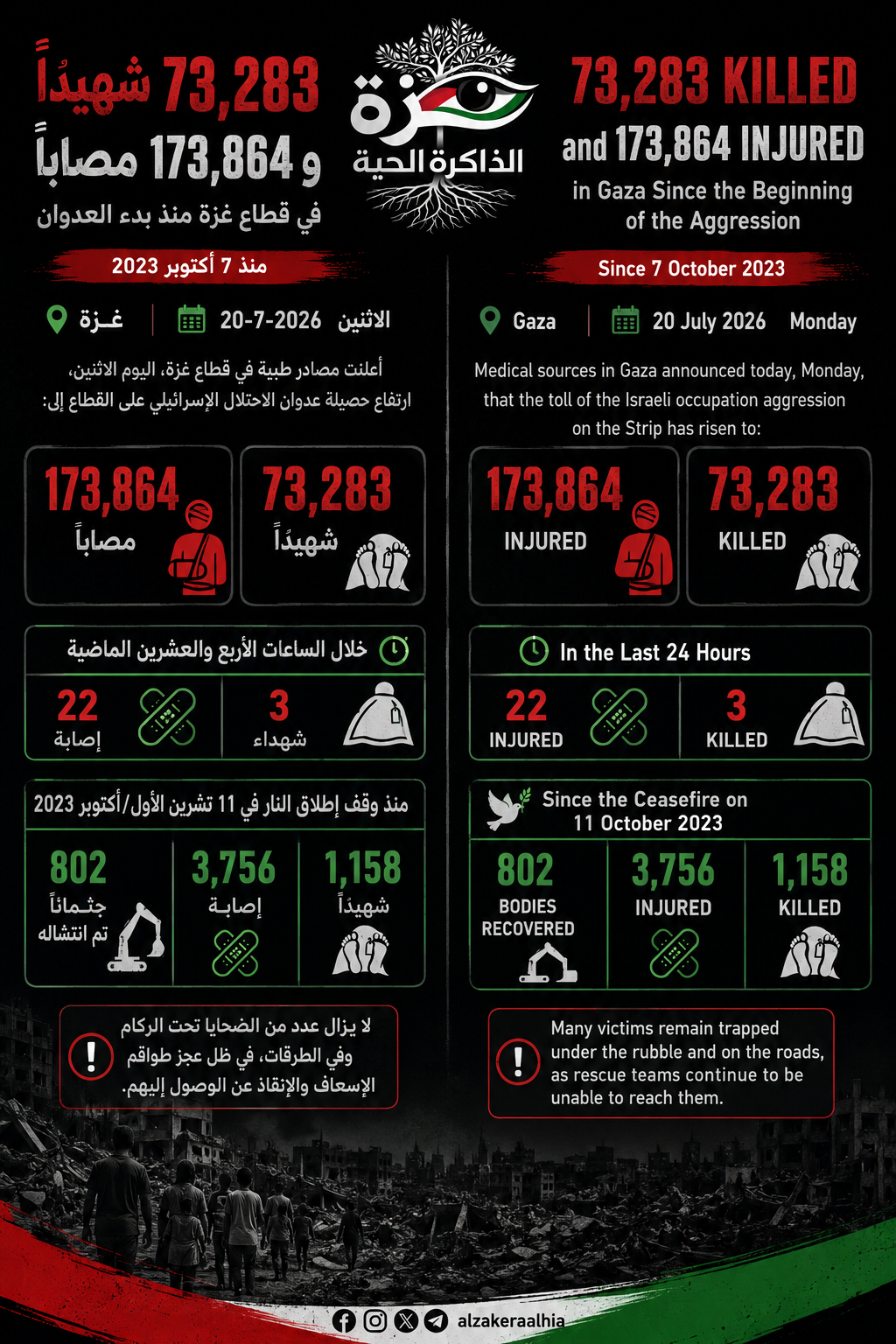
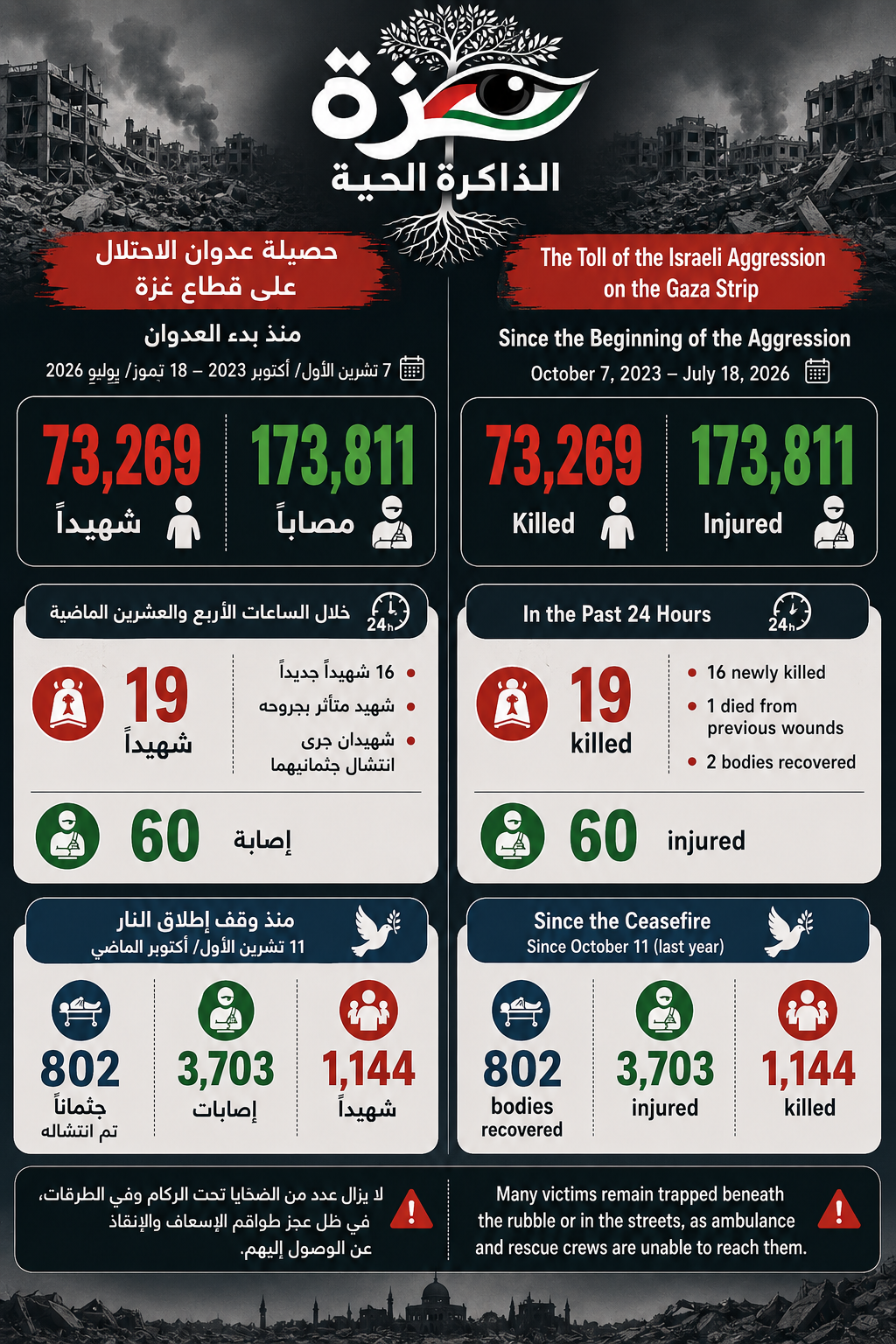
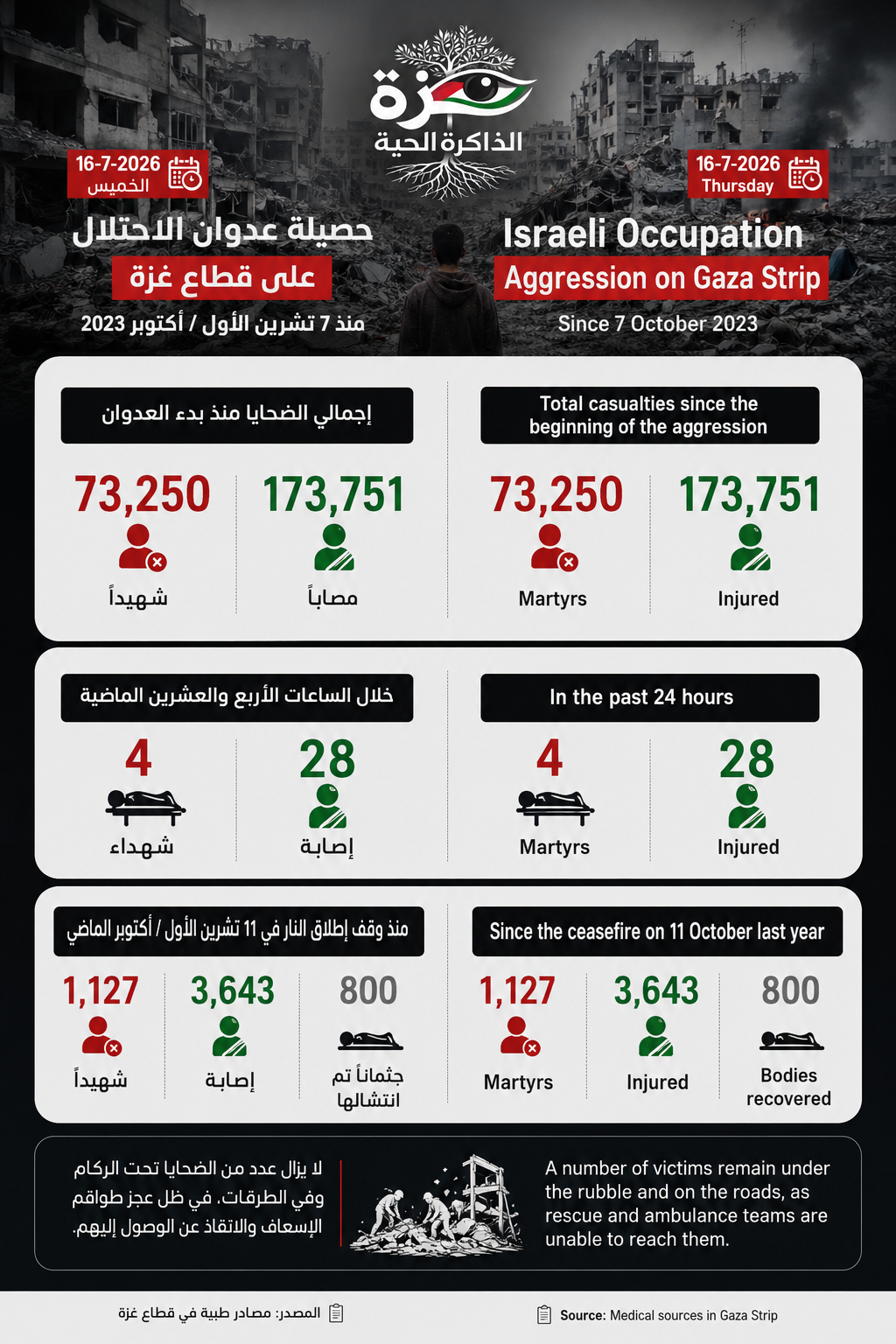
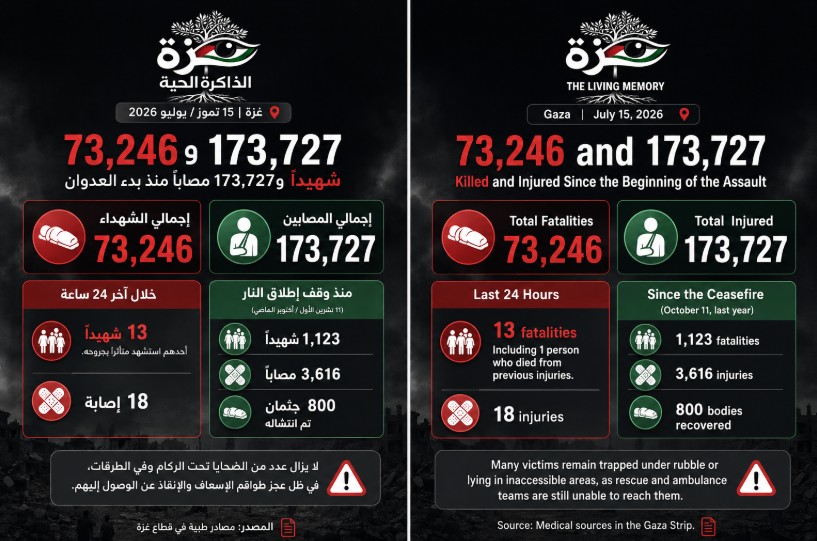
Death Toll in Gaza Strip Rises to 72,991, Injuries to 173,219 Since Onset of Aggression
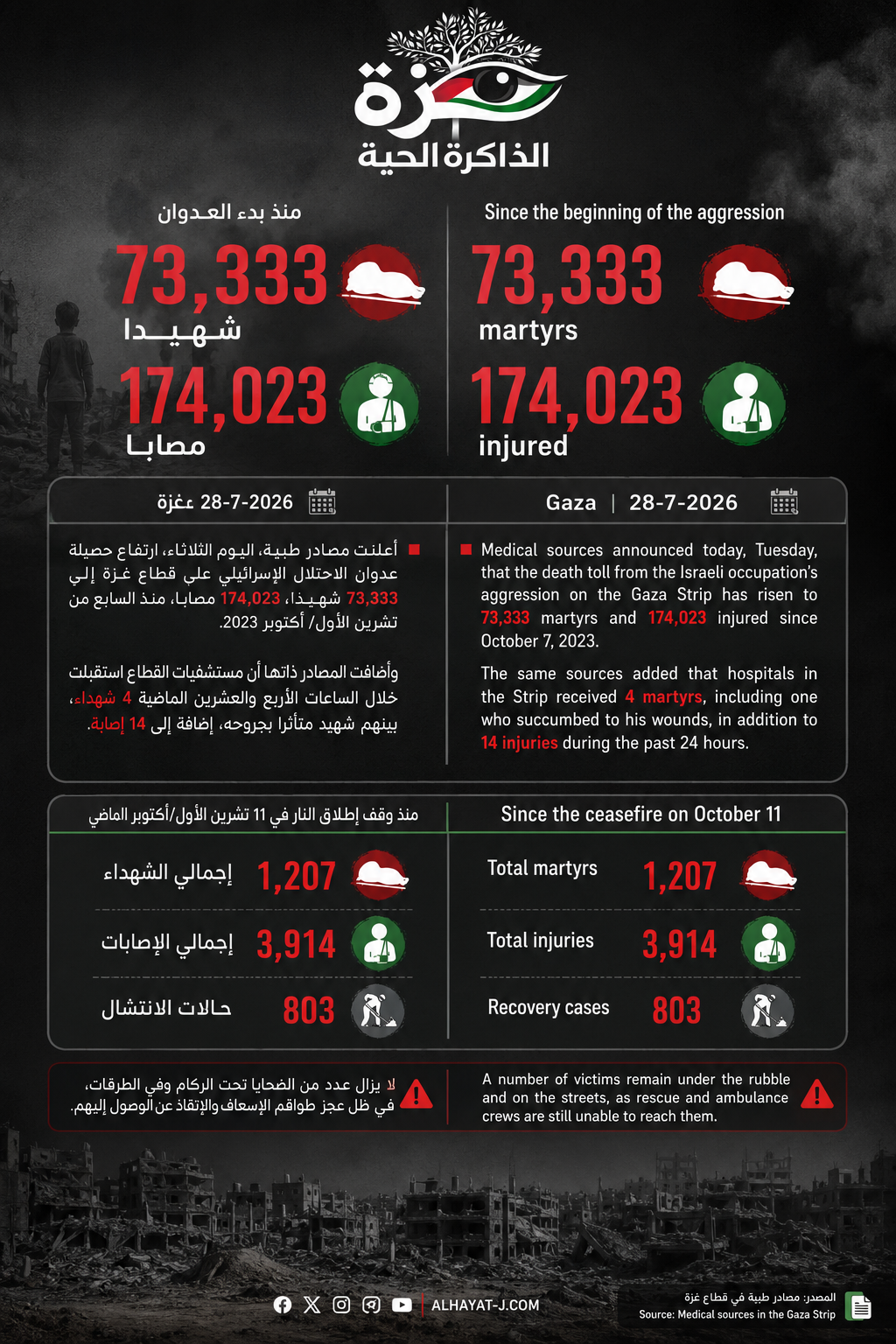
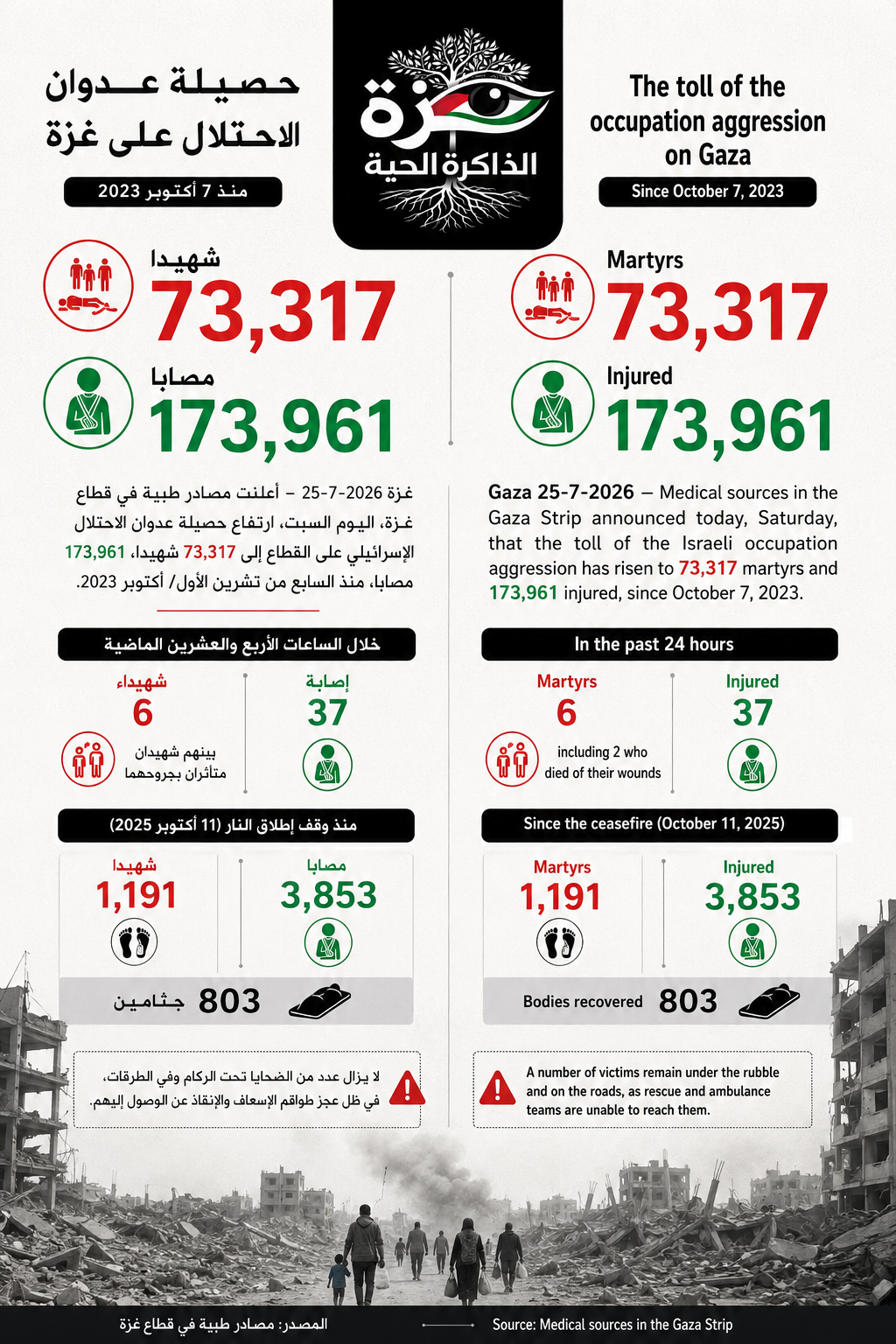
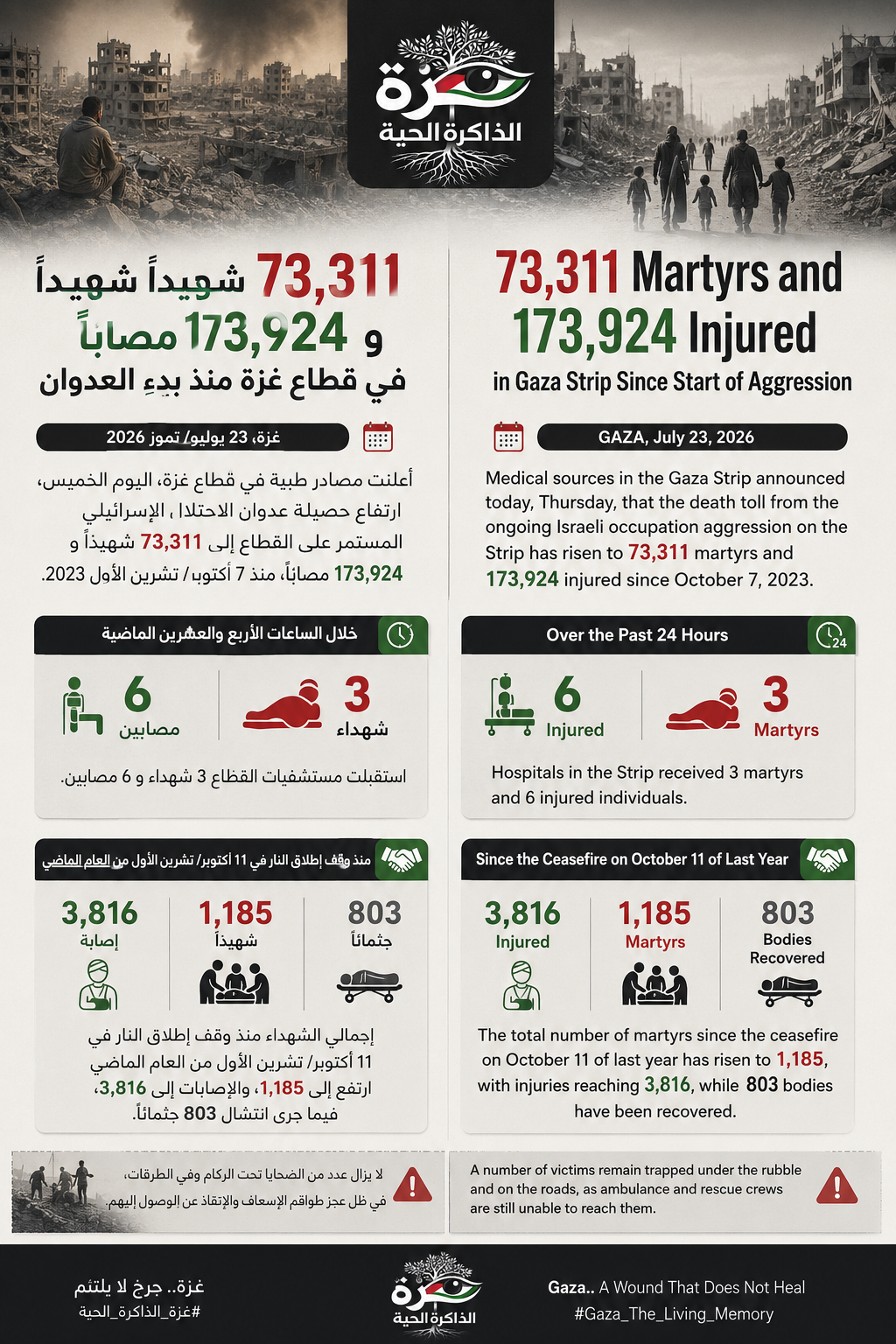
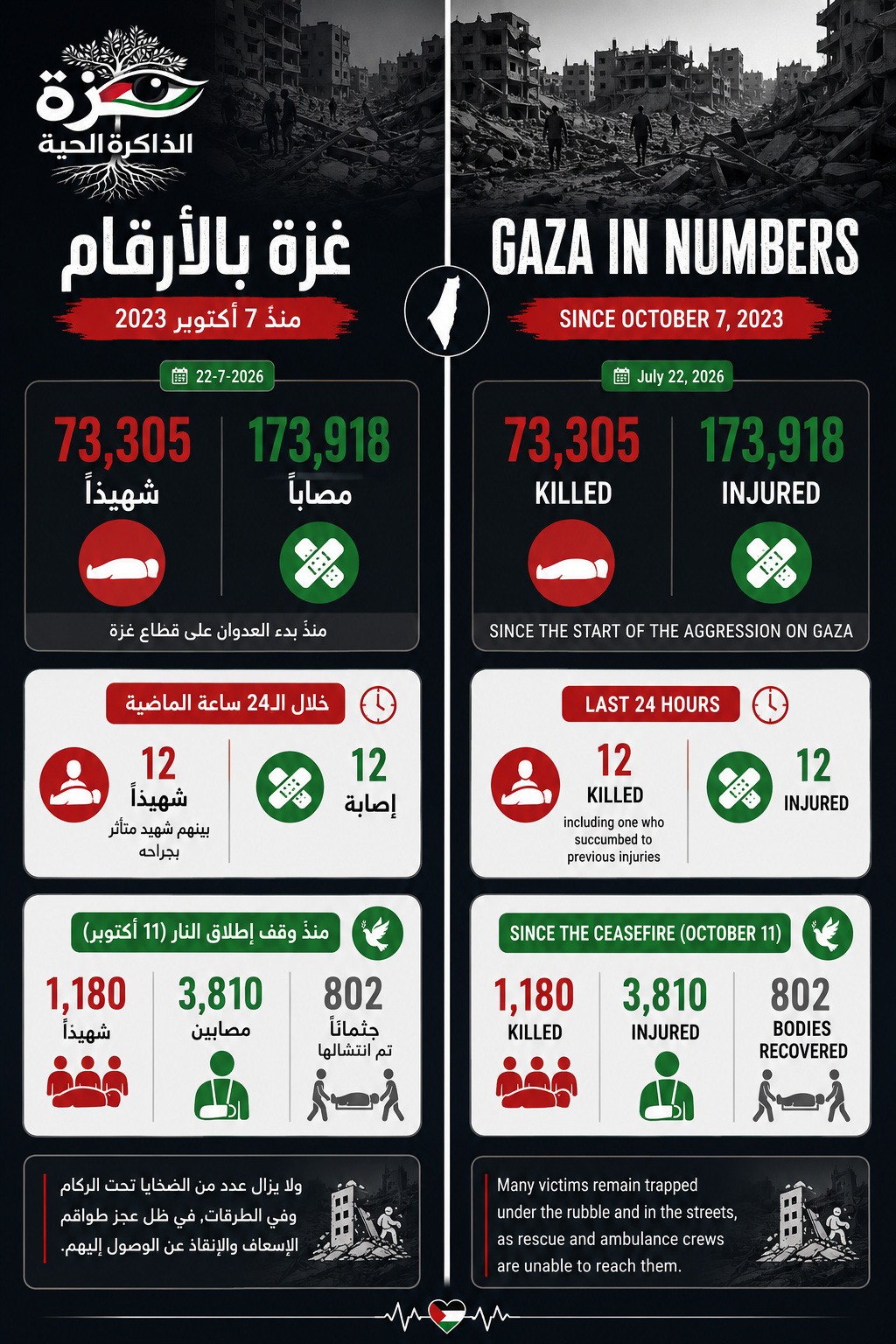
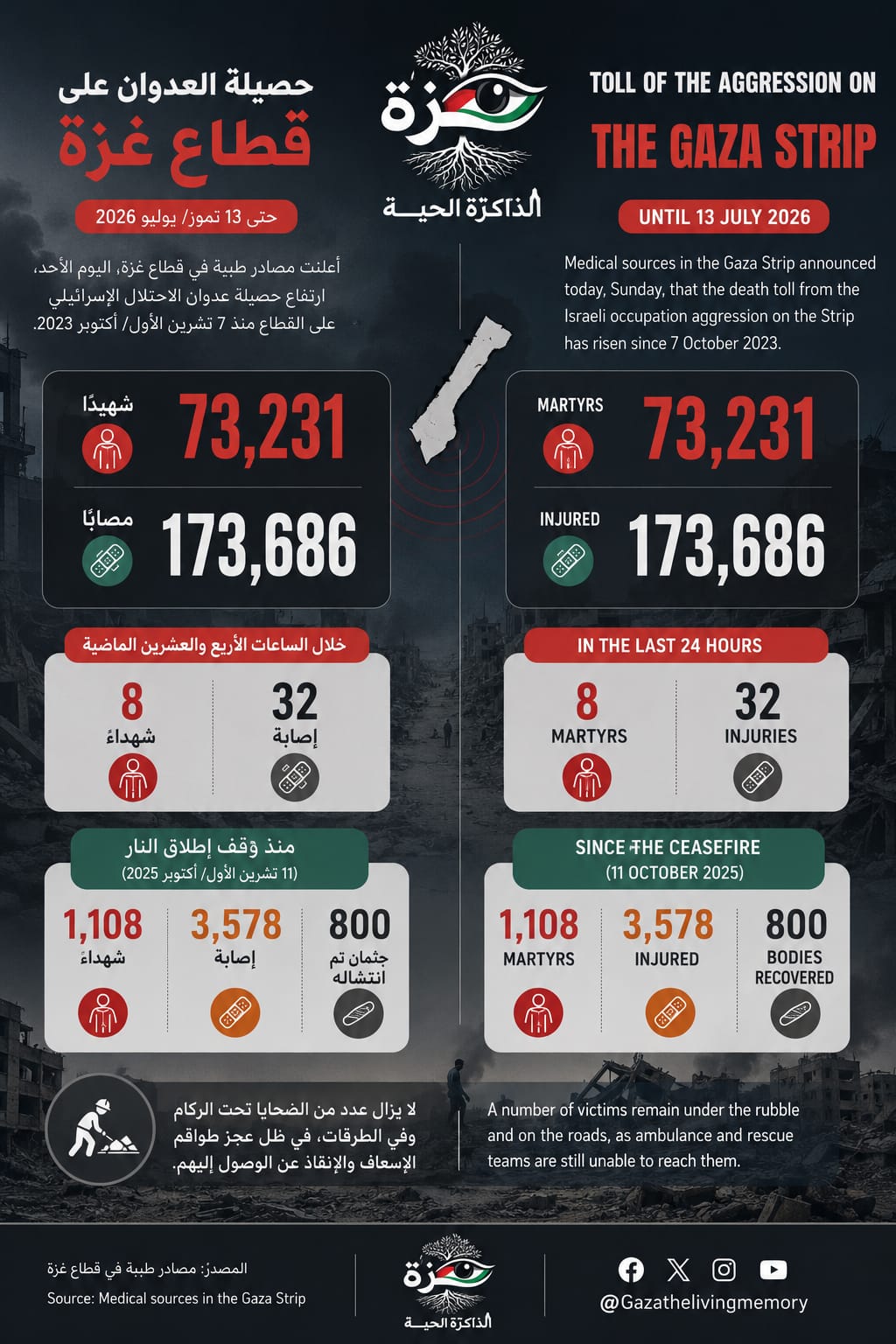
GAZA, June 11, 2026 – Medical sources in the Gaza Strip announced today, Thursday, that the death toll from the ongoing Israeli occupation aggression on the Strip has risen to 72,991 fatalities and 173,219 injuries since the outbreak of the aggression on October 7, 2023. The sources reported that hospitals across the Gaza Strip received 7 injuries over the past 24 hours. They further noted that the total number of fatalities since the ceasefire took effect on October 11 of last year has risen to 981, while total injuries reached 3,111, with 783 bodies recovered during this period. The sources pointed out that a number of victims remain trapped under the rubble and on the roads, as ambulance and rescue crews are still unable to reach them up to this moment..
An Economy Under Siege: The West Bank and East Jerusalem Between Income Loss, Mobility Paralysis, and the Clearance Revenues Crisis Since October 7, 2023
Gaza: The Living Memory Since October 7, 2023, the Palestinian economy in the West Bank and East Jerusalem has entered an unprecedented phase of economic contraction. This is the result of three overlapping major shocks: the loss of the labor market inside Israel, the tightening of movement restrictions within the West Bank, and the escalating financial crisis of the Palestinian Authority (PA) due to the withholding of clearance revenues. Data issued by the World Bank, the United Nations Conference on Trade and Development (UNCTAD), and the International Labour Organization (ILO) indicate that the Palestinian economy has suffered one of the deepest contractions in its modern history, with protracted effects impacting the labor market, production, consumption, and public finance. ### I. A Historic Economic Contraction Data from the World Bank and UNCTAD indicate that during 2024, the Palestinian economy recorded a contraction of approximately 27%, representing one of the highest rates of decline recorded in the region within a short timeframe. Furthermore, the Gross Domestic Product (GDP) dropped to about 70% of its 2022 level, while per capita income plummeted to levels reminiscent of the early 2000s—amounting to the loss of more than 22 years of economic progress. In the West Bank specifically, contraction estimates ranged between 19% and 23%, driven by declining local consumption, the suspension of a broad segment of investments, and the disruption of internal commercial activity between cities and villages. ### II. The Labor Market: Loss of Tens of Thousands of Jobs Prior to October 7, 2023, approximately 177,000 Palestinian workers from the West Bank were employed inside Israel and the settlements, serving as one of the most vital income sources for the Palestinian economy. Following the outbreak of the war, the number of workers permitted to work dropped to only about 24,000. This signifies a direct loss of approximately 153,000 job opportunities, representing a decline of nearly 86%. World Bank estimates indicate that the Palestinian economy loses approximately $25.5 million daily in workers' income, which translates to about $765 million per month, and roughly $9.3 billion annually in lost wages. This decline has directly impacted household purchasing power, increased debt levels, and weakened demand in local markets, while placing growing pressure on the banking system. ### III. Unemployment: A Deepening Crisis in the Labor Market According to data from the ILO and the Palestinian Central Bureau of Statistics (PCBS), unemployment rates in the West Bank spiked from about 13% prior to the war to a peak of around 35% during the initial months of the crisis, before later stabilizing at levels between 28% and 29% during 2025. Based on estimates of the West Bank labor force size—which stands at nearly 900,000 workers—these percentages translate to between 250,000 and 315,000 unemployed individuals, a level unprecedented in the Palestinian market in recent years. ### IV. Clearance Revenues: The Severest Financial Crisis Clearance revenues—which Israel collects on behalf of the Palestinian Authority—form the backbone of public revenues, accounting for more than 65% of the Palestinian treasury's income. In official statements, the Palestinian Minister of Finance noted that Israel is withholding and deducting a large portion of these clearance revenues, estimating the total frozen and withheld funds at between $4.4 billion and $5 billion. This reflects the magnitude of the compounding financial crisis facing the Palestinian Authority over the last two years. The Ministry of Finance confirms that these deductions have accumulated in recent years, leading to a severe liquidity crisis that has disrupted regular salary payments. Consequently, partial salaries have been paid across multiple periods, alongside an expanded reliance on borrowing from local banks and delaying obligations toward the private sector. Furthermore, estimates from the World Bank and UNCTAD indicate that total Israeli deductions from clearance revenues between 2019 and 2025 range between $1.7 billion and $2.0 billion, rendering the clearance revenues file one of the most dangerous sources of financial pressure on the Palestinian economy. ### V. Checkpoints, Closures, and the Fragmentation of Economic Geography Data from the United Nations Office for the Coordination of Humanitarian Affairs (OCHA) shows that the number of obstacles and checkpoints in the West Bank rose from about 642 in mid-2023 to around 793 in 2024, and reached approximately 925 by 2025—reflecting an increase of nearly 43%. These restrictions have lengthened travel times between Palestinian cities by two to five times, driven up transport and freight costs, disrupted internal supply chains, and transformed the West Bank into semi-isolated economic zones, directly impacting trade and production. ### VI. The Private Sector: Broad Contraction in Economic Activity Economic surveys indicate that approximately 95% of Palestinian businesses recorded a decrease in sales, while 76% reported experiencing transport and distribution issues. Furthermore, nearly 29% of businesses indicated they were forced into partial or full closure during periods of the crisis. This reflects a widespread decline in economic activity resulting from falling demand and deteriorating purchasing power. ### VII. Construction and Agriculture Sectors The construction sector is among the hardest hit due to its heavy reliance on Palestinian workers employed inside Israel. The suspension of workers' entry into Israel has led to partial paralysis in the sector, halting or slowing down thousands of residential projects, alongside falling demand for construction materials and losses estimated at hundreds of millions of dollars. As for the agricultural sector, it has been severely impacted by the denial of access to lands near the separation wall and settlements, alongside a decline in production seasons—particularly the olive harvest in 2023 and 2024. This is compounded by difficulties in marketing and transport, leading to accumulated losses in farmers' incomes. ### VIII. Military Incursions and Indirect Economic Impacts Frequent military incursions into West Bank cities and camps have led to recurring market closures and the disruption of educational and economic institutions for hours or days. Additionally, damage to infrastructure—including roads, water, electricity, and telecommunications—has caused daily indirect operational losses. While these are difficult to quantify precisely, they recur systematically across several areas. ### IX. East Jerusalem: An Economy Under Pressure East Jerusalem has witnessed a marked decline in economic activity, particularly within the domestic and religious tourism sectors. Market activity in the Old City has dropped, alongside the closure or downscaling of hundreds of commercial establishments, and a decline in the performance of the hotel and restaurant sectors due to diminished traffic arriving from the West Bank. --- The aggregate economic data indicates that since October 7, 2023, the Palestinian economy in the West Bank and East Jerusalem has entered a phase of deep and interconnected contraction. The loss of tens of thousands of jobs has coincided with a severe liquidity crisis caused by the withholding of clearance revenues, alongside the restriction of internal movement via checkpoints and closures. According to the World Bank, the continuation of these conditions could entrench a state of long-term economic stagnation that will be difficult to reverse, even in the event of subsequent political or security improvements. This makes the current crisis one of the most dangerous economic shifts the Palestinian economy has witnessed in its modern history..
Death toll in Gaza strip rises to 72,991, with injuries reaching 173,212 since the beginning of the aggression
GAZA, June 10, 2026 – Medical sources in the Gaza Strip announced today, Wednesday, that the death toll from the ongoing Israeli occupation aggression on the Strip has risen to 72,991 martyrs, and 173,212 injuries, since the start of the aggression on October 7, 2023. The sources reported that hospitals in the Gaza Strip received 3 martyrs and 5 injuries over the past 24 hours. They pointed out that the total number of martyrs since the ceasefire on October 11 last year has risen to 981, and total injuries to 3,104, while 783 bodies have been recovered. The sources further indicated that a number of victims remain under the rubble and on the roads, as ambulance and rescue crews are still unable to reach them up to this moment..
From a Blockaded Economy to an Economy Under the Rubble: The Economic Losses in the Gaza Strip Since October 7, 2023
Gaza Al-Thakira Al-Hayya (The Living Memory) – June 9, 2026 – When the war on the Gaza Strip broke out on October 7, 2023, the destruction was not confined to residential buildings or civilian facilities; rather, it extended to obliterate the entire economic infrastructure. Within a few months, the Strip’s economy suffered an unprecedented blow, prompting international institutions to describe what transpired as one of the largest economic collapses the world has witnessed in a geographically limited area during modern history. Gaza, which spans an area of approximately 365 square kilometers and is home to more than 2.3 million people, was already suffering from the effects of a continuous blockade imposed since 2007, an unemployment rate exceeding 45% prior to the war, and a fragile economy heavily reliant on humanitarian aid. With the outbreak of the war, most economic, productive, and service sectors collapsed, and the infrastructure sustained widespread destruction. According to a joint assessment issued by the United Nations, the World Bank, and the European Union in February 2025, the value of direct damages reached approximately $30 billion, while economic losses resulting from the cessation of productive and service activities amounted to around $19 billion, bringing the total damages and losses to nearly $49 billion during the first year of the war alone. Chapter I: An Economy Stripped of Its Vital Capacity Prior to the war, the annual Gross Domestic Product (GDP) of the Gaza Strip stood at approximately $3 billion, despite the blockade and restrictions imposed on movement and trade. However, during 2024, the Gazan economy recorded the largest collapse in its modern history. Data from the United Nations Conference on Trade and Development (UNCTAD) indicates that Gaza's economy contracted by 83% during 2024, while the GDP plummeted to a mere $362 million. This collapse signifies that most economic activities ceased or vanished, leaving thousands of establishments unable to operate or produce. Furthermore, unemployment surged to nearly 80% of the workforce, rendering the majority of the Strip's population dependent on humanitarian and food assistance. United Nations estimates indicate that the war erased nearly seven decades of human and economic development progress in Gaza. Chapter II: Housing and Real Estate... The Destruction of Accumulated Wealth The housing sector stands as the single most affected sector by the war. Real estate in Gaza was not merely shelter; it represented a repository of wealth and the life savings of Palestinian families who invested long years into building their homes, apartments, and properties. According to the World Bank assessment: The value of damages in the housing sector reached approximately $15.9 billion. The residential sector accounted for 53% of the total recorded damages. More than 292,000 housing units were damaged or destroyed. Entire neighborhoods were damaged in Gaza City, Jabalia, Beit Hanoun, Beit Lahia, Khan Younis, and Rafah. UN estimates indicate that more than 70% of the buildings in the Strip sustained varying degrees of destruction or damage. These losses did not only trigger a housing crisis but also led to the collapse of a massive portion of the real estate and construction market, resulting in the loss of tens of thousands of jobs tied to this sector. Chapter III: Trade and Industry... Halting the Engines of Production Before the war, thousands of industrial and commercial establishments formed the backbone of the Gazan economy. Gaza encompassed: Food processing factories. Garment and textile factories. Furniture factories. Plastic industries. Metal industries. Small handicraft workshops. However, the war resulted in: The destruction or closure of thousands of establishments. The destruction of warehouses containing goods and raw materials. A near-total cessation of industrial production. According to international institutional estimates: Industrial production dropped by more than 90%. Construction sector activity plummeted by 96%. The trade and industry sector accounted for roughly 20% of total direct damages. Consequently, this led to the loss of tens of thousands of job opportunities and the collapse of local productive capacity. Chapter IV: Agriculture... The Loss of Land and Food Sources Prior to the war, the agricultural sector constituted a fundamental pillar of the local economy. It contributed nearly 10% to the GDP and provided direct and indirect income for hundreds of thousands of citizens. However, satellite imagery and UN reports revealed a staggering scale of destruction. By 2025: Approximately 86% of agricultural lands were damaged. Only 1.5% of agricultural land remained safely usable. 71% of greenhouses were damaged. More than 80% of agricultural wells were damaged. Estimates from the Palestinian Ministry of Agriculture indicate: The destruction of over 178,000 agricultural dunams. The destruction of nearly 1,000 agricultural wells. The destruction of hundreds of cattle, sheep, and poultry farms. As a result, thousands of farmers lost their sole source of income. Chapter V: Livestock and Fisheries The livestock sector suffered severe losses due to the destruction of farms and the perishing of animals from bombardment and feed shortages. The losses encompass: Thousands of head of cattle. Tens of thousands of sheep and goats. Millions of poultry. Egg and milk production farms. Meanwhile, the marine fishing sector dealt a heavy blow: The destruction of a large number of fishing boats. Damage to ports and fishermen’s harbors. The complete idleness of thousands of fishermen. This sector had previously provided direct and indirect income to approximately 100,000 people prior to the war. Chapter VI: Electricity and Energy Electricity represents the lifeblood of a modern economy, yet this sector suffered comprehensive devastation. Official Palestinian estimates point to: The destruction of thousands of meters of electrical grids. The destruction or damage of major transformers. The prolonged disruption of the sole power plant. Additionally, over 3,000 kilometers of electrical networks were destroyed. This catastrophic failure led to: The idling of factories. The disruption of hospitals. A decline in agricultural production. The collapse of water and telecommunication services. Chapter VII: Water and Sanitation Even before the war, Gaza suffered from a chronic water crisis. However, the war exacerbated the situation to an unprecedented degree. Estimates indicate: The destruction of more than 700 water wells. Damage to pumping stations. The destruction of vast sections of water networks. Damage to desalination plants. Furthermore, hundreds of kilometers of sewage networks were damaged, leading to a severe decline in water supplies and escalating environmental and health hazards. Chapter VIII: The Healthcare Sector The health sector constituted one of the most heavily targeted sectors during the war. According to United Nations estimates: The majority of hospitals sustained severe damage. A large number of hospitals were knocked entirely or partially out of service. Dozens of health centers and clinics were damaged. The sector also lost: Advanced medical equipment. Laboratories. Ambulances. Pharmaceutical warehouses. Total losses are estimated in the hundreds of millions of dollars. Chapter IX: Education... The Loss of Human Capital Prior to the war, Gaza possessed: Hundreds of public and private schools. Universities, colleges, and institutes. However, the war resulted in: The destruction or damage of the vast majority of educational institutions. The suspension of education for extended periods. Stripping hundreds of thousands of students of their right to education. UN estimates indicate that more than 90% of educational buildings sustained destruction or damage. The loss here is not confined to physical structures; it encompasses the loss of entire academic years and long-term consequences for human capital. Chapter X: Roads and Transportation The road network suffered catastrophic damage. Losses include: The destruction of hundreds of kilometers of roads. The destruction of bridges and internal crossings. Damage to transport networks and logistics services. This extensive damage severely hindered the movement of goods, commodities, relief aid, and rescue operations. Chapter XI: Telecommunications and Information Technology Before the war, the telecommunications sector was one of the few sectors exhibiting relative growth. However, the war led to: The destruction of telecom towers. The obliteration of fiber-optic networks. Recurrent blackouts of internet and phone services. Software development companies and digital service providers, which previously provided employment opportunities for the youth, were also severely impacted. Chapter XII: Banking and Financial Services The Palestinian financial system in Gaza sustained unprecedented losses. According to World Bank estimates: Approximately 93% of bank branches were destroyed. 88% of exchange companies were damaged. 88% of insurance companies were damaged. Only a very limited number of Automated Teller Machines (ATMs) remained operational. This led to: Extreme difficulty in accessing funds. The paralysis of commercial transactions. A sharp contraction in banking activity. Chapter XIII: The Labor Market The number of employed individuals in Gaza before the war was close to 500,000 workers, both directly and indirectly. However, the war caused: The loss of hundreds of thousands of jobs. The collapse of entire sectors of employment. A surge in unemployment to roughly 80%. Consequently, the vast majority of families lost their primary sources of income. Chapter XIV: Municipalities and Public Services Municipalities suffered extensive losses that included: Heavy machinery and equipment. Administrative buildings. Road networks. Sanitation and waste management services. This severely crippled the capacity of local government units to deliver essential public services. Chapter XV: Rubble... The Other Face of Losses One of the most telling images reflecting the magnitude of the catastrophe is the mountains of rubble strewn across various parts of the Strip. United Nations estimates point to the existence of between 41 and 47 million tons of debris. This rubble represents: Destroyed homes. Demolished factories. Schools and hospitals. Entire flattened infrastructure networks. The mere removal of this rubble will require years of labor and billions of dollars. Chapter XVI: The Cost of Reconstruction According to the joint assessment of the United Nations, the World Bank, and the European Union: $53.2 billion is required for reconstruction and recovery needs spanning a ten-year period. $20 billion is urgently required within the first three years. Housing and infrastructure comprise the lion's share of this cost. As destruction persisted through 2025 and into 2026, international estimates suggest that the reconstruction bill will climb to significantly higher levels. How Gaza's Economy Was Erased Gaza has not witnessed an economic loss of this magnitude since the beginning of the occupation in 1967. In less than two years, the housing, agriculture, manufacturing, trade, services, and infrastructure sectors collapsed entirely; GDP contracted by 83%, unemployment soared to unprecedented levels, and vast expanses of cities and refugee camps were reduced to ruins. Numbers alone do not capture the true scale of the catastrophe. Behind every destroyed home is a family that lost its life savings; behind every halted factory are workers who lost their livelihoods; and behind every ruined school or university is an entire generation whose educational opportunities have been disrupted. The economic losses in Gaza are not merely figures in billions of dollars; they tell the story of an entire society whose economic and social foundations have been decimated, in one of the greatest economic and humanitarian disasters of the twenty-first century..
From Geography to Isolation: How the Separation Wall Encircled Jerusalem and Fragmented the West Bank
Special Report | Gaza: The Living Memory When Israel began constructing what it called the “security barrier” in June 2002, Palestinians were not simply confronted with a temporary security measure. Instead, they found themselves facing one of the most extensive projects aimed at reshaping Palestinian geography and demographics since the occupation of 1967. More than two decades later, the Separation Wall has become a physical and political reality stretching across most of the occupied West Bank, encircling Jerusalem, and directly affecting the lives of hundreds of thousands of Palestinians. What began as a system of fences, trenches, military roads, and surveillance infrastructure evolved in many areas into a massive concrete wall reaching heights of up to eight meters. It separates cities from villages, neighborhoods from one another, farmers from their lands, students from their schools, and patients from medical services, while effectively redrawing realities on the ground in ways that reinforce Israel’s settlement project. How the Project Began At the height of the Second Palestinian Intifada, the Israeli government announced in 2002 the construction of the wall, arguing that it was necessary to prevent attacks originating from the West Bank. However, from the earliest stages, the route of the barrier generated significant controversy. Rather than following the Green Line—the 1949 Armistice Line widely recognized internationally as the basis for the boundary between Israel and the territories occupied in 1967—the wall penetrated deep into the West Bank, surrounding major Israeli settlement blocs and isolating extensive areas of Palestinian land. According to the United Nations Office for the Coordination of Humanitarian Affairs (OCHA), the planned route of the wall extends approximately **712 kilometers**, more than double the length of the Green Line itself. The Wall in Numbers General Route * Planned length: approximately **712 km** * Completed by 2026: more than **85%** * Height of concrete sections: between **8 and 9 meters** * Agricultural and military gates: dozens along the route * Military checkpoints and crossings connected to the wall: dozens Isolated Land United Nations estimates indicate that the route of the wall effectively isolates: * Approximately **9.4% of the West Bank** * More than **700,000 dunams** of Palestinian land * Tens of thousands of dunams planted with olive trees, almonds, and seasonal crops The wall has also affected hundreds of Palestinian communities to varying degrees. Jerusalem: The Primary Target Although the wall stretches across the West Bank, Jerusalem has always been at the heart of the project. From the outset, Israeli governments used the wall as a tool to establish new de facto boundaries for Jerusalem that differ from internationally recognized borders. The wall forms a near-continuous ring around the city from: * The north * The east * The south * The northwest Only limited areas remain connected through Israeli-controlled checkpoints and crossings. The “Greater Jerusalem” Project The route of the wall is closely linked to the Israeli concept of “Greater Jerusalem,” which aims to incorporate surrounding settlement blocs into the city and integrate them economically and geographically with West Jerusalem. Among the major settlement blocs benefiting from the wall are: * Ma’ale Adumim east of Jerusalem * Givat Ze’ev northwest of the city * Gush Etzion south of Jerusalem These settlement blocs contain dozens of settlements that have become physically connected to Jerusalem through a sophisticated network of roads and infrastructure. Palestinians Trapped Behind the Wall One of the most significant consequences of the wall has been the isolation of Palestinian Jerusalem ID holders from the city itself. Jerusalem institutions estimate that more than **140,000 Palestinians** officially residing within Jerusalem’s municipal boundaries now live on the opposite side of the wall. Among the most affected areas are: * Kafr Aqab * Shuafat Refugee Camp * Ras Khamis * Ras Shehadeh * Dahiyat al-Salam As a result, many residents continue to carry Jerusalem residency documents and pay municipal taxes while remaining physically disconnected from most municipal services and urban life. Severing Jerusalem from the West Bank Before the construction of the wall, Jerusalem served as the natural center of Palestinian life in the West Bank. It was home to: * Major hospitals * Universities * Religious institutions * Commercial markets The wall disrupted these historic links. Today, cities such as: * Ramallah * Bethlehem * Jericho are connected to Jerusalem only through Israeli military checkpoints and controlled crossings. The Agricultural Catastrophe Agriculture has been among the sectors hardest hit by the wall. Thousands of Palestinian farmers found themselves separated from their lands, which became trapped behind the barrier. To access their property, farmers often must: * Obtain Israeli permits * Pass through military-controlled gates * Adhere to limited opening hours In many cases, gates open only during specific agricultural seasons or for a few hours each day. Olive Trees Behind Barbed Wire Palestinian data indicate that tens of thousands of olive trees are now located beyond the wall. This has led to: * Reduced agricultural maintenance * Declining harvests * Major economic losses * The gradual abandonment of farmland The impact has been particularly severe in the governorates of Qalqilya, Salfit, Tulkarm, and Jenin. The Wall and the Settlement Enterprise Urban planning experts argue that the route of the wall cannot be separated from Israel’s settlement strategy. More than **80% of Israeli settlers living in the West Bank** are located either west of the wall or within areas directly connected to it. The wall has contributed to: * Protecting major settlement blocs * Facilitating settlement expansion * Strengthening Israeli control over surrounding lands * Fragmenting Palestinian territorial continuity Enclosed Villages Dozens of Palestinian villages have become trapped between the wall and the Green Line or between different sections of the barrier. Some communities can only be reached through military-controlled gates. This has affected: * Education * Healthcare * Trade * Social and family life In many cases, residents must cross checkpoints daily to reach schools, workplaces, and medical facilities. Impact on Health and Education The wall has significantly complicated access to Jerusalem’s main hospitals, including: * Al-Makassed Hospital * Al-Mutlaa (Augusta Victoria) Hospital * Augusta Victoria Medical Complex Thousands of students have also been affected, as access to schools and universities in Jerusalem became increasingly restricted. The International Court of Justice Ruling On July 9, 2004, the International Court of Justice (ICJ) issued a landmark advisory opinion declaring that the construction of the wall inside occupied Palestinian territory was contrary to international law. The Court concluded that: * The wall violates international law. * Construction should cease. * Sections built within occupied territory should be dismantled. * Palestinians affected by the project should receive compensation. Despite the ruling, construction and expansion continued. What Changed After October 7, 2023? Following the outbreak of the Gaza war, Israel further intensified its reliance on the wall and its associated checkpoint system. The West Bank experienced: * Unprecedented movement restrictions * Closure of numerous agricultural gates * Increased limitations on Palestinian workers * Expansion of military checkpoints The wall became part of a broader system of closures that further isolated Palestinian cities and communities. A Tool for Redrawing the Map Legal experts and urban planners argue that the wall’s most profound impact has not been its physical presence alone, but its role in reshaping Palestinian geography. The wall has: * Isolated nearly **10% of the West Bank** * Cut Jerusalem off from its Palestinian surroundings * Linked major settlement blocs to Israel * Restricted the movement of hundreds of thousands of Palestinians * Created new de facto boundaries on the ground More than twenty years after construction began, the Separation Wall has become one of the most visible and consequential features of the Israeli occupation. It is not merely a structure of concrete and barbed wire, but a comprehensive system that reshapes geography, demographics, mobility, and control over land. In Jerusalem, the wall has become a mechanism for isolating the city from its Palestinian hinterland while integrating surrounding settlements into the “Greater Jerusalem” framework. Across the West Bank, it has fragmented territorial continuity, disrupted social and economic life, and imposed lasting consequences on Palestinian communities. Today, the Separation Wall remains one of the most significant symbols of the conflict over land, identity, sovereignty, and the future of Palestine..
Sheikh Jarrah and Silwan After October 7, 2023: How Displacement, Demolitions, and Settlement Expansion Accelerated in the Heart of Jerusalem Under the Cover of War
Special Report | Gaza: The Living Memory While the world's attention remained focused on the war in the Gaza Strip after October 7, 2023, another battle was unfolding quietly in occupied Jerusalem, largely beyond the spotlight of international media. In the neighborhoods of Sheikh Jarrah and Silwan—long regarded as symbols of the Palestinian struggle for existence in Jerusalem—Palestinians faced an escalation in eviction orders, home demolitions, arrests, and settler takeovers of residential properties. Residents and rights advocates describe this period as one of the most dangerous waves of displacement the city has witnessed in recent years. What is taking place is not merely a series of isolated property disputes or municipal measures. Rather, it is a struggle over the future of Jerusalem itself. As settler organizations seek to expand their presence inside Palestinian neighborhoods surrounding the Old City and Al-Aqsa Mosque, hundreds of Palestinian families face the possibility of losing homes they have inhabited for generations. East Jerusalem: The Core of the Settlement Project Since Israel occupied East Jerusalem in 1967 and later annexed it in a move not recognized by the international community, the city has remained at the center of Israeli settlement policies. Palestinian neighborhoods surrounding the Old City—particularly Sheikh Jarrah and Silwan—have become strategic targets for settler organizations due to their geographic, political, and religious significance. Sheikh Jarrah lies on the northern gateway to the Old City, while Silwan stretches directly south of Al-Aqsa Mosque. Control over these areas is widely viewed as a key component of efforts to reshape Jerusalem’s demographic and geographic reality. After October 7: Reduced International Scrutiny and Increased Pressure Jerusalem researchers and Palestinian institutions argue that the war in Gaza created conditions that enabled the acceleration of settlement-related measures in Jerusalem. As international attention shifted toward Gaza, global political pressure and media scrutiny surrounding eviction and demolition cases in Jerusalem significantly declined. This allowed legal and administrative procedures that had previously attracted widespread international criticism to move forward with fewer obstacles. Residents of Silwan interviewed by United Nations agencies reported that life became increasingly difficult after October 7, with growing fears of protesting or challenging Israeli measures. Sheikh Jarrah: The Battle That Never Ended Sheikh Jarrah became an international symbol of resistance against forced displacement in 2021, when attempts to evict Palestinian families sparked global solidarity campaigns and widespread protests. However, despite the decline in international media attention following the Gaza war, legal proceedings aimed at removing Palestinian families from their homes have continued. Throughout 2025, Israeli courts continued reviewing eviction cases linked to the settler organization Nahalat Shimon. Among the most prominent was the case involving the family of Saleh Diab, which faced eviction after unsuccessful appeals before Israeli courts. Human rights organizations emphasize that the struggle in Sheikh Jarrah extends beyond individual families or homes. It is part of a broader effort to strengthen settler presence inside Palestinian neighborhoods of East Jerusalem. Silwan: The Most Dangerous Frontline in Jerusalem If Sheikh Jarrah became a symbol of the struggle, Silwan has emerged as its primary battleground. Located immediately adjacent to Al-Aqsa Mosque, Silwan is home to tens of thousands of Palestinians and is considered one of the most heavily targeted areas for settlement expansion. Three neighborhoods within Silwan stand at the center of the conflict: Batn al-Hawa Al-Bustan Wadi Hilweh Settler organizations, most notably Ateret Cohanim and Elad, have pursued long-term campaigns aimed at gaining control over Palestinian properties throughout these areas. Batn al-Hawa: The Largest Collective Eviction Case Batn al-Hawa represents one of the largest ongoing forced-displacement cases in occupied Jerusalem. According to United Nations data, approximately 87 Palestinian families, comprising between 600 and 680 individuals, have faced eviction lawsuits filed by settler organizations claiming ownership of the land. Since October 7, 2023, the pace of evictions in the neighborhood has increased significantly. In March 2026, the United Nations reported that 28 Palestinian families, totaling around 160 people, had been forcibly displaced from Batn al-Hawa since the outbreak of the war. The pace of removals accelerated noticeably throughout 2025 and 2026. In March 2026 alone, 16 Palestinian families were removed from their homes within the span of a few days, marking one of the largest waves of displacement the neighborhood has experienced in years. Al-Bustan: The Threat of Mass Demolitions Only a short distance from the walls of Al-Aqsa Mosque lies the neighborhood of Al-Bustan. For years, Israeli authorities have pursued plans to demolish dozens of Palestinian homes in the area in order to advance tourism and settlement projects associated with what is known as the "City of David" archaeological and biblical park. Human rights estimates indicate that approximately 150 homes remain at risk of demolition or displacement, affecting nearly 1,500 Palestinians. Residents fear that projects delayed for years could now be implemented amid reduced international attention resulting from the war. Home Demolitions as a Demographic Tool The pressure on Palestinian residents has not been limited to eviction proceedings. Across East Jerusalem—and particularly in Silwan—Israeli authorities have continued demolishing Palestinian homes on the grounds that they lack building permits. Palestinians and human rights organizations argue that obtaining Israeli building permits in Jerusalem is extremely difficult, leaving many families with no option but to build without permits and subsequently face demolition orders. European and United Nations reports have concluded that these policies contribute to reducing the Palestinian presence in Jerusalem and, in some cases, force families to leave the city altogether. Arrests: Another Mechanism of Control The expansion of settlement activities has been accompanied by an increase in arrests, interrogations, and legal restrictions targeting Palestinians in Jerusalem. During the war period, Israeli forces carried out extensive arrest campaigns involving young Palestinians, activists, and residents who protested against demolition or eviction measures. Human rights organizations have also documented arrests during eviction operations in Silwan, as well as assaults on residents and restrictions imposed on journalists attempting to cover events. Legal advocates argue that these measures aim to weaken the ability of Jerusalem’s Palestinian community to organize public resistance or document violations. Settlements Inside Palestinian Neighborhoods Unlike traditional settlements built on the outskirts of Jerusalem, settlement activity in Sheikh Jarrah and Silwan operates from within Palestinian neighborhoods themselves. Following many eviction cases, properties are transferred to settler organizations, which then move Israeli settlers into the homes under police protection. Since 2004, settler groups have taken control of dozens of buildings in Silwan. This process has continued and accelerated during the period following the Gaza war. Researchers argue that the long-term objective is to establish a continuous ring of settler presence surrounding the Old City and Al-Aqsa Mosque, thereby altering Jerusalem’s demographic balance for generations to come. International Reactions Developments in Sheikh Jarrah and Silwan have prompted repeated criticism from the United Nations, the European Union, and international human rights organizations. In July 2024, the United Nations warned that more than 80 Palestinian families in Silwan faced the risk of forced displacement and described the legal framework used against Palestinians as discriminatory and inconsistent with international law. UN officials further stated that forced evictions in occupied territory may amount to serious violations of international humanitarian law. Despite repeated international condemnations, however, demolition orders, settlement expansion, and eviction proceedings have continued. Jerusalem Between Resilience and Displacement For Palestinians, Sheikh Jarrah and Silwan are far more than residential neighborhoods. They are viewed as the front line in the struggle to preserve the Palestinian presence in Jerusalem. Every demolished home, every displaced family, and every property transferred to settler organizations is seen as part of a broader contest over the city’s future identity. As Palestinian families continue legal battles and grassroots campaigns to defend their homes, concerns are growing that developments since October 7, 2023, could fundamentally reshape the demographic landscape of occupied Jerusalem. Conclusion Since the outbreak of the war on Gaza, Sheikh Jarrah and Silwan have witnessed an unprecedented escalation of pressure on Palestinian residents. Forced evictions have accelerated, demolition orders have continued, arrests have increased, and settler organizations have expanded their influence within Palestinian neighborhoods surrounding the Old City. While the United Nations and international organizations continue to warn of the dangers of mass displacement and demographic transformation, Sheikh Jarrah and Silwan remain symbols of a larger struggle over Jerusalem itself—its identity, its future, and its place at the center of one of the world's most enduring conflicts..
Al-Aqsa Mosque Since October 7, 2023: Closures, Raids, Ramadan Restrictions, and Attempts to Impose a New Reality in the Most Dangerous Phase the Holy Sanctuary Has Faced in Decades
Special Report | Gaza: The Living Memory Since October 7, 2023, Al-Aqsa Mosque has entered an unprecedented phase of escalation, coinciding with Israel's war on the Gaza Strip and the broader military escalation across the occupied Palestinian territories. Over the course of more than two years, Israeli measures at Al-Aqsa evolved from temporary security restrictions into a sustained policy characterized by repeated closures, severe limitations on Muslim worshippers, large-scale settler incursions, and the increasing presence of Israeli ministers and officials inside the mosque compound, most notably Israeli National Security Minister Itamar Ben-Gvir. Experts on Jerusalem affairs argue that the period following October 2023 represents one of the most dangerous phases for Al-Aqsa Mosque since Israel occupied East Jerusalem in 1967. The concern stems not only from the unprecedented number of settler incursions but also from growing efforts to normalize Jewish religious rituals inside the compound and expand restrictions on Muslim worshippers, particularly during the holy month of Ramadan. Al-Aqsa: Religious and Symbolic Significance Al-Aqsa Mosque occupies a unique position in Islam. It is the first qibla (direction of prayer), the third holiest site in Islam after Mecca and Medina, and the destination of the Prophet Muhammad’s Night Journey and Ascension (Isra and Mi'raj). The Al-Aqsa compound encompasses approximately 144 dunams (about 35 acres) within Jerusalem’s Old City, including Al-Qibli Mosque, the Dome of the Rock, prayer halls, courtyards, arcades, and historic structures. Jordan, through the Islamic Waqf, maintains custodianship over the holy site and regards the entire compound as an exclusively Muslim place of worship. Palestinian and Jordanian authorities have consistently rejected Israeli efforts to alter the historical and legal status quo governing the site. The First Days of the War: Near-Total Closure Immediately following the outbreak of war on October 7, 2023, Israeli authorities imposed unprecedented restrictions on Jerusalem and Al-Aqsa Mosque. Large numbers of Muslim worshippers were denied access to the mosque. Military checkpoints multiplied throughout the Old City, and most Palestinians from the occupied West Bank were prevented from entering Jerusalem. Even Palestinian residents of Jerusalem faced heightened restrictions and security checks. Jerusalem-based institutions described this period as one of the strictest closures imposed on Al-Aqsa in years, resulting in a dramatic decline in attendance compared to the pre-war period. A Surge in Settler Incursions While international attention focused primarily on Gaza, Al-Aqsa Mosque witnessed a sharp escalation in settler incursions. According to Palestinian monitoring organizations, the number of settlers entering the compound exceeded 124,000 between October 2023 and August 2025. The year 2024 alone recorded approximately 58,000 settlers, making it the highest annual figure since systematic documentation of incursions began. The first months of 2025 saw tens of thousands of additional incursions, further cementing the post-October 2023 period as the most intensive phase of settler activity in the modern history of Al-Aqsa Mosque. From Visits to Religious Rituals The incursions have not been limited to tours or visits. Palestinian institutions have documented a significant increase in the performance of Jewish religious rituals inside the mosque compound. These activities have included collective prayers, the recitation of religious texts, the raising of Israeli flags, and acts such as "epic prostration" performed by settler groups. The Islamic Waqf and Palestinian authorities view these practices as direct violations of the historical status quo governing the site. Researchers argue that the most significant shift is not merely the increase in the number of settlers entering the compound but the transformation of these incursions into attempts to establish a permanent Jewish religious presence within the sanctuary. Itamar Ben-Gvir: The Face of Al-Aqsa Incursions Since assuming office as Israel’s National Security Minister, Itamar Ben-Gvir has become the political figure most closely associated with incursions into Al-Aqsa Mosque. Since the outbreak of the war, Ben-Gvir has entered the compound at least 13 times, bringing his total number of visits since taking office in late 2022 to approximately 16 incursions. During several of these visits, Ben-Gvir was seen participating in Jewish prayers and religious rituals within the compound. His appearances sparked widespread condemnation from Palestinians, Jordan, Arab governments, and Islamic organizations. Palestinian officials view these visits as carrying political significance beyond their religious dimension, interpreting them as attempts to reinforce Israeli claims of sovereignty over the site. Jewish Holidays and Peak Incursion Seasons Jewish religious holidays have become periods of intensified activity at Al-Aqsa Mosque. During Passover, Sukkot, and commemorations associated with the destruction of the Jewish Temple, the compound has witnessed some of the largest settler gatherings in recent years. Israeli ministers, members of the Knesset, and prominent rabbis have participated in these events, which frequently include collective prayers, religious chants, and symbolic ceremonies inside the compound. Palestinians regard these occasions as flashpoints capable of triggering broader unrest in Jerusalem and beyond. Ramadan Under Restrictions Ramadan holds exceptional significance at Al-Aqsa Mosque. For decades, hundreds of thousands of Palestinians gathered at the site during Fridays, the last ten nights of Ramadan, and Laylat al-Qadr (the Night of Power). However, Ramadan during the war years unfolded under unprecedented restrictions. In both Ramadan 2024 and Ramadan 2025, Israeli authorities imposed severe limitations on access to Jerusalem for Palestinians from the West Bank. Entry was conditioned on age restrictions and special permits. During Ramadan 2025, only men above the age of 55 and women above the age of 50 were generally allowed entry under specific conditions, while all worshippers were subjected to extensive security checks. Military checkpoints surrounding Jerusalem and the Old City further restricted access for tens of thousands of Palestinians seeking to pray at Al-Aqsa. I'tikaf and Laylat al-Qadr I'tikaf—the practice of spiritual retreat during the final ten days of Ramadan—has long been one of the most important traditions associated with Al-Aqsa Mosque. During the war period, Jerusalem institutions documented repeated restrictions on worshippers seeking to observe I'tikaf. Security measures inside the compound intensified, while arrests and exclusion orders targeted worshippers, activists, guards, and employees of the Islamic Waqf. Despite these measures, large crowds continued to attend prayers during Ramadan, especially on Laylat al-Qadr, reflecting the profound religious and national significance of the mosque. Arrests and Exclusion Orders The escalation at Al-Aqsa was accompanied by an expansion of Israeli policies aimed at restricting Palestinian presence at the site. Dozens of exclusion orders were issued against mosque guards, Waqf employees, activists, and worshippers, preventing them from entering the compound for varying periods. Arrests at the gates of Al-Aqsa and throughout Jerusalem’s Old City also increased, often targeting Palestinians attempting to access the mosque. Human rights advocates argue that these policies are intended to weaken local Palestinian presence and limit documentation of Israeli actions at the site. Jordan: Al-Aqsa Belongs Exclusively to Muslims As custodian of Jerusalem’s Islamic and Christian holy sites, Jordan repeatedly condemned settler incursions and visits by Israeli officials. Jordan’s Ministry of Foreign Affairs consistently reaffirmed that the entire 144-dunam compound constitutes an exclusively Muslim place of worship and warned that any attempt to alter its legal and historical status violates international law. Jordan also lodged repeated diplomatic protests against visits by Ben-Gvir and other Israeli officials. Palestinian, Arab, and Islamic Condemnations The Palestinian Authority, the Islamic Waqf, Palestinian political factions, the Arab League, and the Organization of Islamic Cooperation have all repeatedly condemned developments at Al-Aqsa. These institutions argue that continued incursions constitute a provocation to Muslims worldwide and a violation of international law and established agreements governing the site. They have warned that any change to the status quo at Al-Aqsa carries consequences extending far beyond Palestine and could destabilize the broader region. The United Nations and International Responses The United Nations, the European Union, and numerous governments have expressed concern regarding rising tensions at Al-Aqsa Mosque. International bodies have repeatedly warned that any attempt to alter the status quo in the Holy Sanctuary could trigger wider instability in Jerusalem, the occupied Palestinian territories, and the region as a whole. However, Palestinian institutions maintain that international condemnations have failed to halt incursions or ease restrictions imposed on Muslim worshippers. The Most Significant Transformation in Decades Experts on Jerusalem increasingly argue that the most consequential development since October 2023 is not any single measure but the convergence of multiple trends: Record-breaking numbers of settler incursions. Increased performance of Jewish religious rituals inside the compound. Repeated visits by senior Israeli ministers. Expanded restrictions on Muslim worshippers. Increased use of arrests and exclusion orders. Efforts to establish a new religious and political reality within the sanctuary. Taken together, these developments represent a qualitative shift compared to previous years. Conclusion Since October 7, 2023, Al-Aqsa Mosque has become one of the central arenas of conflict in occupied Jerusalem. Between repeated closures, restrictions on worshippers, settler incursions exceeding 124,000 individuals, and the recurring visits of Itamar Ben-Gvir and other Israeli officials, the mosque has entered what many Palestinians describe as its most dangerous period in decades. As Muslims continue to regard Al-Aqsa as a sacred religious, historical, and national symbol, concerns are growing that ongoing Israeli policies may fundamentally alter the historical status quo that has governed the site for generations. Such changes would carry profound religious, political, and regional implications extending far beyond Jerusalem and Palestine, resonating throughout the Muslim world..
Between Condemnation and Limited Sanctions: How the International Community Responded to Israeli Settlement Expansion After October 7, 2023
Gaza: The Living Memory Since the outbreak of the war on October 7, 2023, developments have not been confined to the Gaza Strip. The occupied West Bank has witnessed one of the largest waves of settlement expansion in decades, accompanied by an unprecedented rise in settler violence, land confiscation, and the establishment of new settlement outposts. In response, international and regional actors issued a series of statements rejecting Israeli settlement activities. However, a significant gap has remained between political positions and concrete actions, raising questions about the international community’s ability to halt settlement expansion or mitigate its consequences. United Nations: Settlements Are Illegal and Undermine the Two-State Solution Since the beginning of the war, the United Nations has repeatedly reaffirmed its long-standing position that all Israeli settlements in the occupied Palestinian territory are illegal under international law. UN Secretary-General António Guterres has stated on multiple occasions that settlement expansion constitutes a violation of international law and represents a major obstacle to peace. The Office of the United Nations High Commissioner for Human Rights has also warned that the rapid growth of settlements and the establishment of new outposts are contributing to the displacement of Palestinians and undermining the viability of an independent and geographically contiguous Palestinian state. Successive UN reports have documented significant increases in settlement construction and settler violence across the West Bank since October 2023. International Court of Justice: Occupation and Settlements Violate International Law In July 2024, the International Court of Justice (ICJ) issued a landmark advisory opinion concluding that Israel’s continued occupation of Palestinian territory, including its settlement activities, is contrary to international law. The Court affirmed that Israeli settlements in the occupied Palestinian territory violate international legal obligations and called for an end to policies that alter the demographic composition and character of the occupied territory. Although the advisory opinion is not legally binding, it has become a significant legal reference point for subsequent international positions regarding Israeli settlement policies. European Union: A Consistent Rejection of Settlements The European Union has maintained its long-standing opposition to Israeli settlement activities. The EU has repeatedly emphasized that all settlements in the occupied West Bank, including East Jerusalem, are illegal under international law. European officials have consistently condemned Israeli decisions authorizing thousands of new settlement housing units, arguing that such measures directly threaten the viability of the two-state solution. Throughout 2024 and 2025, the European Union also discussed additional measures against settlers involved in violence against Palestinians and supported sanctions targeting individuals and entities linked to serious settler attacks. France: Settlement Expansion Threatens Peace France has adopted one of the clearest European positions regarding Israeli settlement activities. The French government has repeatedly declared that settlements are illegal under international law and constitute a major obstacle to peace. Paris has condemned Israeli decisions to expand settlements and legalize new outposts, arguing that these measures seriously undermine prospects for a just and lasting political solution. France has also called for an immediate halt to all settlement activities and urged greater protection for Palestinian civilians living in areas affected by settler violence. United Kingdom: Sanctions on Violent Settlers The United Kingdom took unprecedented practical steps during 2024 and 2025. In addition to condemning settlement expansion, London imposed sanctions on several Israeli settlers and organizations linked to violent attacks against Palestinians in the West Bank. These measures included asset freezes and travel bans, reflecting growing concern over the impact of settler violence on regional stability. The British government has repeatedly reaffirmed that settlements are illegal under international law and remain a major obstacle to peace. Spain: One of the Strongest Critics of Settlement Policies Spain emerged as one of the most vocal European critics of Israeli settlement expansion following the war. The Spanish government has consistently linked settlement growth to the deterioration of prospects for a negotiated political solution. Madrid has supported European sanctions against violent settlers and called for stronger international measures to prevent the confiscation of Palestinian land and the continued expansion of settlements. This position forms part of Spain’s broader policy of support for Palestinian rights during the post-war period. Germany: Support for the Two-State Solution and Diplomatic Pressure Despite its close relationship with Israel, Germany has repeatedly stated that settlement activities violate international law. Berlin has expressed concern regarding the sharp increase in settlement construction and condemned attacks carried out by settlers against Palestinian civilians. However, Germany has generally favored diplomatic engagement and political pressure rather than broad sanctions targeting settlement activities. United States: Growing Criticism and Limited Measures While maintaining strong political and military support for Israel, the United States adopted a more critical tone regarding settler violence after October 2023. The administration of President Joe Biden imposed sanctions on several Israeli settlers accused of involvement in attacks against Palestinians. Washington also criticized the expansion of settlements and the legalization of new outposts, arguing that such actions undermine the prospects for peace. However, the United States stopped short of imposing comprehensive sanctions on the settlement enterprise itself, leading critics to view the measures as limited in scope and impact. Arab League: Condemnation and Diplomatic Action The Arab League has consistently reaffirmed its rejection of Israeli settlement policies. Through a series of statements and resolutions, the organization described settlement expansion as a blatant violation of international law and United Nations resolutions. The League has repeatedly called on the international community to take concrete measures to halt settlement construction and hold Israel accountable for policies involving land confiscation and the displacement of Palestinians. Settlement expansion has remained a permanent item on the agenda of Arab ministerial meetings since the outbreak of the war. Organization of Islamic Cooperation: Warning Against Demographic Transformation The Organization of Islamic Cooperation (OIC) has strongly condemned Israeli settlement activities, describing them as part of a broader effort to alter the geographic and demographic character of the occupied Palestinian territory. The organization has called upon the international community to provide protection for the Palestinian people and to ensure the immediate cessation of all settlement activities. Between International Positions and Reality on the Ground Despite broad international consensus regarding the illegality of Israeli settlements, settlement expansion has continued at an accelerated pace since October 2023. During this period, Israeli authorities approved tens of thousands of new settlement housing units, legalized and established numerous settlement outposts, and oversaw a period marked by unprecedented levels of settler violence. This reality suggests that most international responses have remained largely confined to political condemnation and limited diplomatic pressure, without producing substantial changes on the ground. From the United Nations and the European Union to France, the United Kingdom, Spain, the Arab League, and the Organization of Islamic Cooperation, there is near-universal international agreement that Israeli settlements violate international law and threaten the prospects for peace. Yet the gap between diplomatic condemnation and developments on the ground continues to widen. While governments and international organizations issue statements of concern, settlement expansion proceeds, reshaping the geography of the occupied West Bank and raising fundamental questions about the effectiveness of the international response in one of the world's longest-running conflicts..
More Than 7,000 Attacks and 114 New Settlement Outposts: Settler Violence in the West Bank Since October 7, 2023 – A Parallel War Against Land and People
Special Report | Gaza: The Living Memory Since October 7, 2023, the repercussions of the war have extended far beyond the Gaza Strip. While international attention has focused on the military campaign and humanitarian catastrophe in Gaza, the occupied West Bank has witnessed an unprecedented escalation in violence carried out by Israeli settlers. What was once described as sporadic settler attacks has evolved into a systematic and organized campaign targeting Palestinian communities, their lands, livelihoods, and property. According to data published by the Palestinian Wall and Settlement Resistance Commission, Israeli settlers carried out a total of 7,154 attacks against Palestinians and their property in the West Bank between October 7, 2023 and October 2025, marking the highest level of settler violence recorded during a comparable period. The Commission also documented more than 38,000 violations committed by Israeli occupation forces and settlers combined during the same period, reflecting the scale of escalation that has gripped the West Bank since the outbreak of the war. An Unprecedented Surge in Settler Attacks According to the Wall and Settlement Resistance Commission, settler attacks have taken multiple forms, including armed assaults on Palestinian villages, direct shootings at civilians, arson attacks against homes and vehicles, destruction of agricultural land, assaults on farmers and shepherds, and the establishment of new settlement outposts on privately owned Palestinian land. During the first half of 2025 alone, the Commission recorded 2,153 settler attacks, concentrated primarily in the governorates of Ramallah and Al-Bireh, Hebron, and Nablus, which have become focal points of daily settler violence. The Commission noted that many of these attacks are no longer carried out by isolated individuals. Instead, they increasingly involve organized groups operating collectively, often under the protection or direct presence of Israeli military forces. Settlement Outposts: A Tool for Control and Displacement One of the most significant developments since October 2023 has been the rapid expansion of agricultural and pastoral settlement outposts. Data from the Wall and Settlement Resistance Commission indicate that settlers established 114 new outposts between October 2023 and October 2025, an unprecedented figure in the history of Israel’s settlement enterprise. The distribution of these outposts was concentrated in the following areas: Ramallah and Al-Bireh: 30 outposts Hebron: 25 outposts Nablus: 18 outposts Bethlehem: 14 outposts Additional outposts across the Jordan Valley, Jerusalem, Qalqilya, and Salfit Pastoral outposts have emerged as one of the most effective mechanisms of territorial control. Through these outposts, settlers gradually seize extensive grazing lands and agricultural areas while preventing Palestinian owners from accessing their property. Forced Displacement of Palestinian Communities The escalation of settler violence has directly contributed to the forced displacement of Palestinian communities, particularly Bedouin and pastoral populations. According to the Wall and Settlement Resistance Commission, settler attacks and newly established outposts led to the displacement of 33 entire Palestinian communities, comprising 455 families and more than 2,853 individuals. United Nations documentation similarly indicates that more than 2,200 Palestinians were displaced from 33 communities that were completely emptied of their residents due to settler violence, land seizures, and restrictions on access to water and grazing resources. The most affected areas include the northern Jordan Valley, Masafer Yatta south of Hebron, eastern Ramallah, and large portions of Area C. Targeting Agricultural Land and Olive Trees Agricultural land has become a primary target in efforts to consolidate settler control over territory. Reports issued by the Wall and Settlement Resistance Commission indicate that settlers and Israeli occupation forces destroyed or damaged more than 12,000 Palestinian trees during the first half of 2025 alone, including over 6,100 olive trees. The governorates of Bethlehem, Ramallah, and Nablus experienced the highest levels of agricultural destruction. Documented violations include: Uprooting olive and fruit trees Burning agricultural fields Preventing farmers from reaching their land Damaging water networks and wells Releasing livestock into cultivated fields to destroy crops These actions have caused substantial economic losses for Palestinian families that depend on agriculture as a primary source of income. Killings and Injuries According to the Wall and Settlement Resistance Commission, settler attacks resulted in the killing of 33 Palestinians between October 2023 and October 2025. The victims were distributed across the following governorates: Nablus: 14 fatalities Ramallah and Al-Bireh: 12 fatalities Hebron: 3 fatalities Bethlehem: 1 fatality Qalqilya: 1 fatality Salfit: 1 fatality In addition, hundreds of Palestinians sustained injuries ranging from minor wounds to life-threatening conditions as a result of shootings, physical assaults, and large-scale attacks on Palestinian communities. International Documentation of Rising Violence International organizations have also documented a dramatic increase in settler violence following October 7, 2023. United Nations agencies recorded 1,732 settler-related incidents resulting in casualties, property damage, or both within a relatively short period. Human rights organizations likewise reported a significant rise in organized attacks targeting Palestinian civilians and infrastructure. A United Nations investigative body reported in 2026 that settler violence had increased by more than 130 percent compared to previous periods, while identifying patterns suggesting that settlers often received protection or support during attacks. From Individual Violence to a Policy of Creating Facts on the Ground Researchers and human rights organizations increasingly argue that the violence witnessed in the West Bank since October 2023 extends beyond isolated acts of extremism. Instead, it appears to form part of a broader strategy aimed at: Expanding control over Palestinian land Enlarging existing settlements Establishing new settlement outposts Forcing Palestinian communities out of targeted areas Creating new geographic realities that strengthen Israeli control over Area C Observers note that the connection between settler violence and settlement expansion has become increasingly evident, with violence functioning as a practical mechanism for territorial acquisition and demographic transformation. Since October 7, 2023, the occupied West Bank has entered a new phase of settler violence and territorial expansion. Settlers are no longer viewed merely as radical groups carrying out isolated attacks; they have become a central force in shaping realities on the ground. With more than 7,154 documented attacks, 114 new settlement outposts, 33 displaced Palestinian communities, and vast areas of agricultural land affected, a parallel conflict has unfolded away from the international spotlight. Its impact extends beyond immediate violence, contributing to a profound transformation of Palestinian geography and accelerating the consolidation of Israeli settlement control across the West Bank..