Analytical Reports
Press coverage and detailed reports on unfolding events
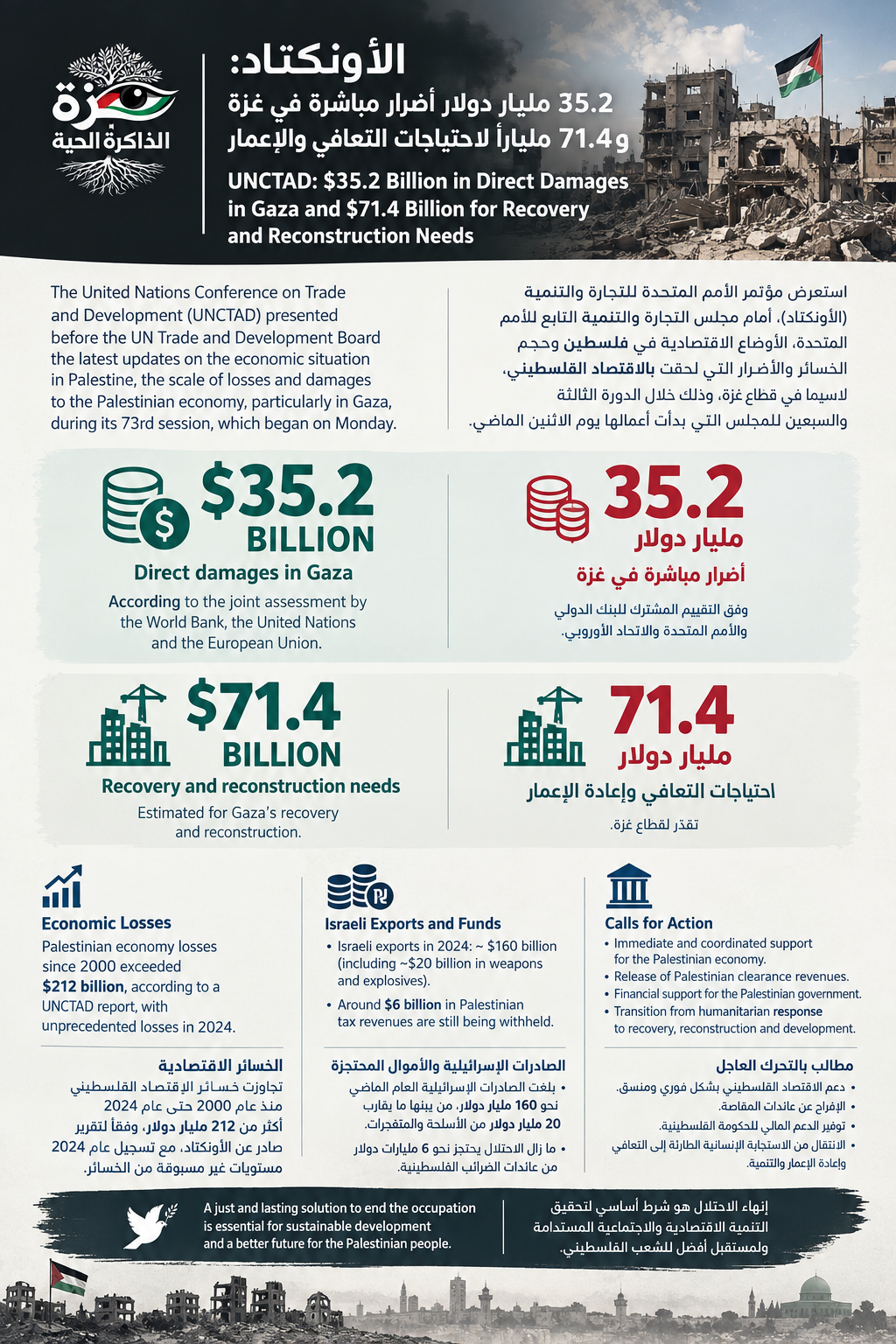
UNCTAD: $35.2 Billion in Direct Damages in Gaza and $71.4 Billion for Recovery and Reconstruction Needs
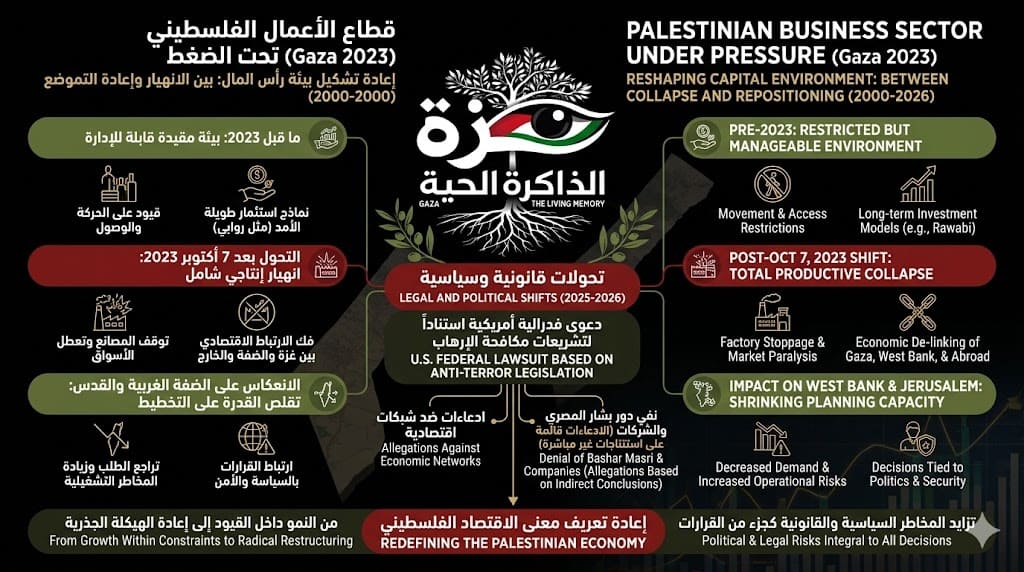
The Palestinian Business Sector Under Pressure.. Gaza 2023 and the Reshaping of Capital Between Collapse and Strategic Repositioning (2000–2026)
Since October 7, 2023, the Palestinian economy—whether in the Gaza Strip or in its extensions in the West Bank and Jerusalem—has no longer operated within a normal trajectory that can be measured through conventional indicators of growth or contraction. What followed this date was not merely an economic shock linked to war, but a structural transformation in the environment in which Palestinian capital operates, whether at the level of companies, investors, or major projects. Gaza, which before the war represented a relatively limited yet somewhat resilient economy in its core sectors, has entered a phase of full-scale productive collapse. With the suspension of the internal economic cycle, not only factories and markets stopped functioning, but also the invisible networks connecting the Palestinian economy were disrupted—supply chains, financial transfers, trade flows, and employment relations between Gaza, the West Bank, and abroad. Before 2023, the Palestinian private sector operated within a constrained yet manageable environment: restrictions on movement, limited access to crossings, export difficulties, and unequal access to markets. Despite these constraints, this environment still allowed for long-term investment models in real estate, services, and infrastructure, along with attempts to build a local economy driven by private initiatives under conditions of incomplete statehood. However, the war on Gaza completely redefined this equation. With the halt of economic activity in the Strip, the Palestinian economy did not merely lose a geographic market; it lost a functional component of its internal structure, particularly in consumption, production, and the monetary cycle that had also supported sectors in the West Bank. This disruption had a direct impact on the investment climate in the West Bank and Jerusalem, where companies began facing not only declining demand but also increased operational risks and reduced capacity for long-term planning. Over time, investment decisions became increasingly tied to political, security, and financial factors beyond the market itself. Within this context, major investment projects led by Palestinian businessmen emerged over the past two decades in an attempt to promote alternative development models. Among them is Bashar Masri, whose name has been associated with large-scale urban development projects, most notably the city of Rawabi, in addition to investments in various sectors in the West Bank and earlier initiatives linked to economic development models connected to the Gaza Strip. Although these projects are economic in nature, they have always operated within an unstable environment, where investment cannot be separated from political geography, nor economic growth from restrictions on movement, infrastructure, and access to resources. Over time, such projects became part of a broader attempt to build a Palestinian economic model based on private initiative under conditions of incomplete sovereignty. After 2023, with the large-scale collapse in Gaza, this equation entered a more complex phase. The disappearance of Gaza from the active economic cycle did not only result in the loss of a consumer and productive market, but also led to a broader restructuring of risks surrounding the Palestinian economy as a whole, including financing risks, expansion risks, and legal and institutional stability risks for major projects. In this context, legal developments emerged in the international arena related to the war on Gaza. Among them is a civil lawsuit filed in a U.S. federal court in 2025 and 2026 by hundreds of plaintiffs representing families of victims of the October 7, 2023 events, based on provisions of U.S. anti-terrorism legislation. The lawsuit included parties and economic networks allegedly connected to operational environments in the Gaza Strip, including the name of businessman Bashar Masri, within claims concerning the role of certain infrastructure or economic projects in the broader environment in which the events took place. In response, Masri and the companies associated with him categorically deny these allegations, affirming that all investments were purely developmental in nature and aimed at creating jobs and strengthening the local economy, with no connection to any military or security activity. The defense team in this case has moved to dismiss the lawsuit, arguing that it is based on indirect assumptions and that attributing liability to development projects in conflict environments represents an unprecedented expansion in the concept of legal responsibility. What distinguishes such cases is not only their legal content, but also the context in which they emerge, as the Palestinian economic environment has increasingly become part of a more stringent international legal field, where financial compliance considerations, geopolitical risk, and interpretations of the relationship between investment and political context intersect. At the same time, the Palestinian private sector is operating within a broader network of structural constraints, including limited market access, disrupted supply chains, and heavy dependence on an unstable political environment, making any economic expansion conditional on external factors beyond market logic. With the continuation of the war on Gaza since 2023, the discussion is no longer limited to a local economic crisis, but rather extends to a comprehensive restructuring of the role of the Palestinian economy, as production capacity declines, markets shrink, and the gap between economic potential and actual reality deepens. In conclusion, the Palestinian private sector today stands at a fundamentally different stage from the past two decades. The challenge is no longer growth within constraints, but rather redefining the very meaning of “economy” within an environment where the rules of operation and investment are being reshaped dramatically, and where political and legal risks have become an integral part of every economic decision..

An Economy Under Siege: The West Bank and East Jerusalem Between Income Loss, Mobility Paralysis, and the Clearance Revenues Crisis Since October 7, 2023
Gaza: The Living Memory Since October 7, 2023, the Palestinian economy in the West Bank and East Jerusalem has entered an unprecedented phase of economic contraction. This is the result of three overlapping major shocks: the loss of the labor market inside Israel, the tightening of movement restrictions within the West Bank, and the escalating financial crisis of the Palestinian Authority (PA) due to the withholding of clearance revenues. Data issued by the World Bank, the United Nations Conference on Trade and Development (UNCTAD), and the International Labour Organization (ILO) indicate that the Palestinian economy has suffered one of the deepest contractions in its modern history, with protracted effects impacting the labor market, production, consumption, and public finance. ### I. A Historic Economic Contraction Data from the World Bank and UNCTAD indicate that during 2024, the Palestinian economy recorded a contraction of approximately 27%, representing one of the highest rates of decline recorded in the region within a short timeframe. Furthermore, the Gross Domestic Product (GDP) dropped to about 70% of its 2022 level, while per capita income plummeted to levels reminiscent of the early 2000s—amounting to the loss of more than 22 years of economic progress. In the West Bank specifically, contraction estimates ranged between 19% and 23%, driven by declining local consumption, the suspension of a broad segment of investments, and the disruption of internal commercial activity between cities and villages. ### II. The Labor Market: Loss of Tens of Thousands of Jobs Prior to October 7, 2023, approximately 177,000 Palestinian workers from the West Bank were employed inside Israel and the settlements, serving as one of the most vital income sources for the Palestinian economy. Following the outbreak of the war, the number of workers permitted to work dropped to only about 24,000. This signifies a direct loss of approximately 153,000 job opportunities, representing a decline of nearly 86%. World Bank estimates indicate that the Palestinian economy loses approximately $25.5 million daily in workers' income, which translates to about $765 million per month, and roughly $9.3 billion annually in lost wages. This decline has directly impacted household purchasing power, increased debt levels, and weakened demand in local markets, while placing growing pressure on the banking system. ### III. Unemployment: A Deepening Crisis in the Labor Market According to data from the ILO and the Palestinian Central Bureau of Statistics (PCBS), unemployment rates in the West Bank spiked from about 13% prior to the war to a peak of around 35% during the initial months of the crisis, before later stabilizing at levels between 28% and 29% during 2025. Based on estimates of the West Bank labor force size—which stands at nearly 900,000 workers—these percentages translate to between 250,000 and 315,000 unemployed individuals, a level unprecedented in the Palestinian market in recent years. ### IV. Clearance Revenues: The Severest Financial Crisis Clearance revenues—which Israel collects on behalf of the Palestinian Authority—form the backbone of public revenues, accounting for more than 65% of the Palestinian treasury's income. In official statements, the Palestinian Minister of Finance noted that Israel is withholding and deducting a large portion of these clearance revenues, estimating the total frozen and withheld funds at between $4.4 billion and $5 billion. This reflects the magnitude of the compounding financial crisis facing the Palestinian Authority over the last two years. The Ministry of Finance confirms that these deductions have accumulated in recent years, leading to a severe liquidity crisis that has disrupted regular salary payments. Consequently, partial salaries have been paid across multiple periods, alongside an expanded reliance on borrowing from local banks and delaying obligations toward the private sector. Furthermore, estimates from the World Bank and UNCTAD indicate that total Israeli deductions from clearance revenues between 2019 and 2025 range between $1.7 billion and $2.0 billion, rendering the clearance revenues file one of the most dangerous sources of financial pressure on the Palestinian economy. ### V. Checkpoints, Closures, and the Fragmentation of Economic Geography Data from the United Nations Office for the Coordination of Humanitarian Affairs (OCHA) shows that the number of obstacles and checkpoints in the West Bank rose from about 642 in mid-2023 to around 793 in 2024, and reached approximately 925 by 2025—reflecting an increase of nearly 43%. These restrictions have lengthened travel times between Palestinian cities by two to five times, driven up transport and freight costs, disrupted internal supply chains, and transformed the West Bank into semi-isolated economic zones, directly impacting trade and production. ### VI. The Private Sector: Broad Contraction in Economic Activity Economic surveys indicate that approximately 95% of Palestinian businesses recorded a decrease in sales, while 76% reported experiencing transport and distribution issues. Furthermore, nearly 29% of businesses indicated they were forced into partial or full closure during periods of the crisis. This reflects a widespread decline in economic activity resulting from falling demand and deteriorating purchasing power. ### VII. Construction and Agriculture Sectors The construction sector is among the hardest hit due to its heavy reliance on Palestinian workers employed inside Israel. The suspension of workers' entry into Israel has led to partial paralysis in the sector, halting or slowing down thousands of residential projects, alongside falling demand for construction materials and losses estimated at hundreds of millions of dollars. As for the agricultural sector, it has been severely impacted by the denial of access to lands near the separation wall and settlements, alongside a decline in production seasons—particularly the olive harvest in 2023 and 2024. This is compounded by difficulties in marketing and transport, leading to accumulated losses in farmers' incomes. ### VIII. Military Incursions and Indirect Economic Impacts Frequent military incursions into West Bank cities and camps have led to recurring market closures and the disruption of educational and economic institutions for hours or days. Additionally, damage to infrastructure—including roads, water, electricity, and telecommunications—has caused daily indirect operational losses. While these are difficult to quantify precisely, they recur systematically across several areas. ### IX. East Jerusalem: An Economy Under Pressure East Jerusalem has witnessed a marked decline in economic activity, particularly within the domestic and religious tourism sectors. Market activity in the Old City has dropped, alongside the closure or downscaling of hundreds of commercial establishments, and a decline in the performance of the hotel and restaurant sectors due to diminished traffic arriving from the West Bank. --- The aggregate economic data indicates that since October 7, 2023, the Palestinian economy in the West Bank and East Jerusalem has entered a phase of deep and interconnected contraction. The loss of tens of thousands of jobs has coincided with a severe liquidity crisis caused by the withholding of clearance revenues, alongside the restriction of internal movement via checkpoints and closures. According to the World Bank, the continuation of these conditions could entrench a state of long-term economic stagnation that will be difficult to reverse, even in the event of subsequent political or security improvements. This makes the current crisis one of the most dangerous economic shifts the Palestinian economy has witnessed in its modern history..
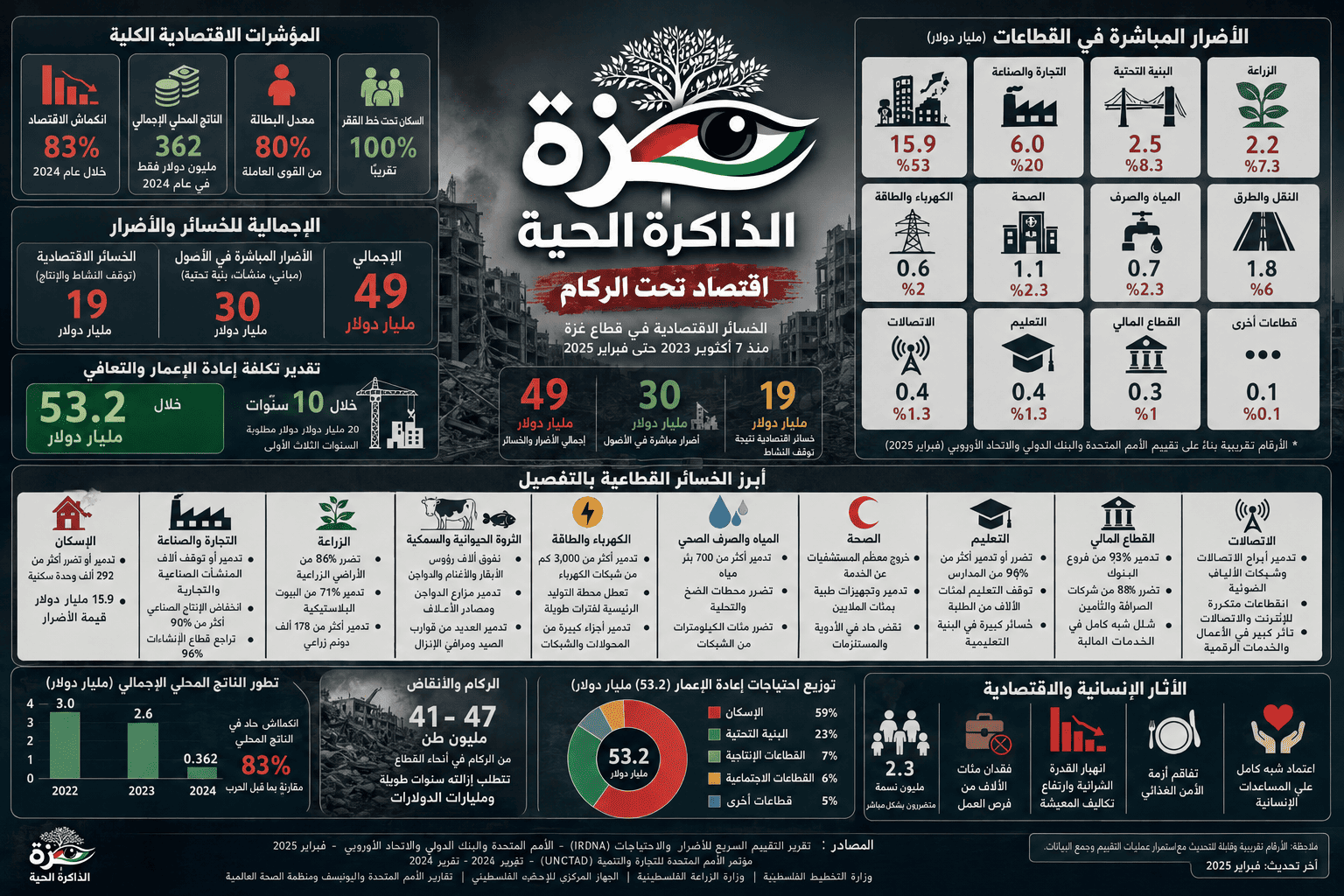
From a Blockaded Economy to an Economy Under the Rubble: The Economic Losses in the Gaza Strip Since October 7, 2023
Gaza Al-Thakira Al-Hayya (The Living Memory) – June 9, 2026 – When the war on the Gaza Strip broke out on October 7, 2023, the destruction was not confined to residential buildings or civilian facilities; rather, it extended to obliterate the entire economic infrastructure. Within a few months, the Strip’s economy suffered an unprecedented blow, prompting international institutions to describe what transpired as one of the largest economic collapses the world has witnessed in a geographically limited area during modern history. Gaza, which spans an area of approximately 365 square kilometers and is home to more than 2.3 million people, was already suffering from the effects of a continuous blockade imposed since 2007, an unemployment rate exceeding 45% prior to the war, and a fragile economy heavily reliant on humanitarian aid. With the outbreak of the war, most economic, productive, and service sectors collapsed, and the infrastructure sustained widespread destruction. According to a joint assessment issued by the United Nations, the World Bank, and the European Union in February 2025, the value of direct damages reached approximately $30 billion, while economic losses resulting from the cessation of productive and service activities amounted to around $19 billion, bringing the total damages and losses to nearly $49 billion during the first year of the war alone. Chapter I: An Economy Stripped of Its Vital Capacity Prior to the war, the annual Gross Domestic Product (GDP) of the Gaza Strip stood at approximately $3 billion, despite the blockade and restrictions imposed on movement and trade. However, during 2024, the Gazan economy recorded the largest collapse in its modern history. Data from the United Nations Conference on Trade and Development (UNCTAD) indicates that Gaza's economy contracted by 83% during 2024, while the GDP plummeted to a mere $362 million. This collapse signifies that most economic activities ceased or vanished, leaving thousands of establishments unable to operate or produce. Furthermore, unemployment surged to nearly 80% of the workforce, rendering the majority of the Strip's population dependent on humanitarian and food assistance. United Nations estimates indicate that the war erased nearly seven decades of human and economic development progress in Gaza. Chapter II: Housing and Real Estate... The Destruction of Accumulated Wealth The housing sector stands as the single most affected sector by the war. Real estate in Gaza was not merely shelter; it represented a repository of wealth and the life savings of Palestinian families who invested long years into building their homes, apartments, and properties. According to the World Bank assessment: The value of damages in the housing sector reached approximately $15.9 billion. The residential sector accounted for 53% of the total recorded damages. More than 292,000 housing units were damaged or destroyed. Entire neighborhoods were damaged in Gaza City, Jabalia, Beit Hanoun, Beit Lahia, Khan Younis, and Rafah. UN estimates indicate that more than 70% of the buildings in the Strip sustained varying degrees of destruction or damage. These losses did not only trigger a housing crisis but also led to the collapse of a massive portion of the real estate and construction market, resulting in the loss of tens of thousands of jobs tied to this sector. Chapter III: Trade and Industry... Halting the Engines of Production Before the war, thousands of industrial and commercial establishments formed the backbone of the Gazan economy. Gaza encompassed: Food processing factories. Garment and textile factories. Furniture factories. Plastic industries. Metal industries. Small handicraft workshops. However, the war resulted in: The destruction or closure of thousands of establishments. The destruction of warehouses containing goods and raw materials. A near-total cessation of industrial production. According to international institutional estimates: Industrial production dropped by more than 90%. Construction sector activity plummeted by 96%. The trade and industry sector accounted for roughly 20% of total direct damages. Consequently, this led to the loss of tens of thousands of job opportunities and the collapse of local productive capacity. Chapter IV: Agriculture... The Loss of Land and Food Sources Prior to the war, the agricultural sector constituted a fundamental pillar of the local economy. It contributed nearly 10% to the GDP and provided direct and indirect income for hundreds of thousands of citizens. However, satellite imagery and UN reports revealed a staggering scale of destruction. By 2025: Approximately 86% of agricultural lands were damaged. Only 1.5% of agricultural land remained safely usable. 71% of greenhouses were damaged. More than 80% of agricultural wells were damaged. Estimates from the Palestinian Ministry of Agriculture indicate: The destruction of over 178,000 agricultural dunams. The destruction of nearly 1,000 agricultural wells. The destruction of hundreds of cattle, sheep, and poultry farms. As a result, thousands of farmers lost their sole source of income. Chapter V: Livestock and Fisheries The livestock sector suffered severe losses due to the destruction of farms and the perishing of animals from bombardment and feed shortages. The losses encompass: Thousands of head of cattle. Tens of thousands of sheep and goats. Millions of poultry. Egg and milk production farms. Meanwhile, the marine fishing sector dealt a heavy blow: The destruction of a large number of fishing boats. Damage to ports and fishermen’s harbors. The complete idleness of thousands of fishermen. This sector had previously provided direct and indirect income to approximately 100,000 people prior to the war. Chapter VI: Electricity and Energy Electricity represents the lifeblood of a modern economy, yet this sector suffered comprehensive devastation. Official Palestinian estimates point to: The destruction of thousands of meters of electrical grids. The destruction or damage of major transformers. The prolonged disruption of the sole power plant. Additionally, over 3,000 kilometers of electrical networks were destroyed. This catastrophic failure led to: The idling of factories. The disruption of hospitals. A decline in agricultural production. The collapse of water and telecommunication services. Chapter VII: Water and Sanitation Even before the war, Gaza suffered from a chronic water crisis. However, the war exacerbated the situation to an unprecedented degree. Estimates indicate: The destruction of more than 700 water wells. Damage to pumping stations. The destruction of vast sections of water networks. Damage to desalination plants. Furthermore, hundreds of kilometers of sewage networks were damaged, leading to a severe decline in water supplies and escalating environmental and health hazards. Chapter VIII: The Healthcare Sector The health sector constituted one of the most heavily targeted sectors during the war. According to United Nations estimates: The majority of hospitals sustained severe damage. A large number of hospitals were knocked entirely or partially out of service. Dozens of health centers and clinics were damaged. The sector also lost: Advanced medical equipment. Laboratories. Ambulances. Pharmaceutical warehouses. Total losses are estimated in the hundreds of millions of dollars. Chapter IX: Education... The Loss of Human Capital Prior to the war, Gaza possessed: Hundreds of public and private schools. Universities, colleges, and institutes. However, the war resulted in: The destruction or damage of the vast majority of educational institutions. The suspension of education for extended periods. Stripping hundreds of thousands of students of their right to education. UN estimates indicate that more than 90% of educational buildings sustained destruction or damage. The loss here is not confined to physical structures; it encompasses the loss of entire academic years and long-term consequences for human capital. Chapter X: Roads and Transportation The road network suffered catastrophic damage. Losses include: The destruction of hundreds of kilometers of roads. The destruction of bridges and internal crossings. Damage to transport networks and logistics services. This extensive damage severely hindered the movement of goods, commodities, relief aid, and rescue operations. Chapter XI: Telecommunications and Information Technology Before the war, the telecommunications sector was one of the few sectors exhibiting relative growth. However, the war led to: The destruction of telecom towers. The obliteration of fiber-optic networks. Recurrent blackouts of internet and phone services. Software development companies and digital service providers, which previously provided employment opportunities for the youth, were also severely impacted. Chapter XII: Banking and Financial Services The Palestinian financial system in Gaza sustained unprecedented losses. According to World Bank estimates: Approximately 93% of bank branches were destroyed. 88% of exchange companies were damaged. 88% of insurance companies were damaged. Only a very limited number of Automated Teller Machines (ATMs) remained operational. This led to: Extreme difficulty in accessing funds. The paralysis of commercial transactions. A sharp contraction in banking activity. Chapter XIII: The Labor Market The number of employed individuals in Gaza before the war was close to 500,000 workers, both directly and indirectly. However, the war caused: The loss of hundreds of thousands of jobs. The collapse of entire sectors of employment. A surge in unemployment to roughly 80%. Consequently, the vast majority of families lost their primary sources of income. Chapter XIV: Municipalities and Public Services Municipalities suffered extensive losses that included: Heavy machinery and equipment. Administrative buildings. Road networks. Sanitation and waste management services. This severely crippled the capacity of local government units to deliver essential public services. Chapter XV: Rubble... The Other Face of Losses One of the most telling images reflecting the magnitude of the catastrophe is the mountains of rubble strewn across various parts of the Strip. United Nations estimates point to the existence of between 41 and 47 million tons of debris. This rubble represents: Destroyed homes. Demolished factories. Schools and hospitals. Entire flattened infrastructure networks. The mere removal of this rubble will require years of labor and billions of dollars. Chapter XVI: The Cost of Reconstruction According to the joint assessment of the United Nations, the World Bank, and the European Union: $53.2 billion is required for reconstruction and recovery needs spanning a ten-year period. $20 billion is urgently required within the first three years. Housing and infrastructure comprise the lion's share of this cost. As destruction persisted through 2025 and into 2026, international estimates suggest that the reconstruction bill will climb to significantly higher levels. How Gaza's Economy Was Erased Gaza has not witnessed an economic loss of this magnitude since the beginning of the occupation in 1967. In less than two years, the housing, agriculture, manufacturing, trade, services, and infrastructure sectors collapsed entirely; GDP contracted by 83%, unemployment soared to unprecedented levels, and vast expanses of cities and refugee camps were reduced to ruins. Numbers alone do not capture the true scale of the catastrophe. Behind every destroyed home is a family that lost its life savings; behind every halted factory are workers who lost their livelihoods; and behind every ruined school or university is an entire generation whose educational opportunities have been disrupted. The economic losses in Gaza are not merely figures in billions of dollars; they tell the story of an entire society whose economic and social foundations have been decimated, in one of the greatest economic and humanitarian disasters of the twenty-first century..